'Their Failure': Fazlur Rehman Slams Pakistan Military For Rising Terrorism, Rejects KP Emergency
Pakistan’s decision to impose emergency rule and Governor’s Rule in Khyber Pakhtunkhwa (KP) has triggered a sharp confrontation with Jamiat Ulema-e-Islam-Fazl (JUI-F) chief Maulana Fazlur Rehman, who has challenged the g
Oleh Manoj Gupta··45K dibaca
'Their Failure': Fazlur Rehman Slams Pakistan Military For Rising Terrorism, Rejects KP Emergency
Pakistan’s decision to impose emergency rule and Governor’s Rule in Khyber Pakhtunkhwa (KP) has triggered a sharp confrontation with Jamiat Ulema-e-Islam-Fazl (JUI-F) chief Maulana Fazlur Rehman, who has challenged the government’s justification for the move and questioned the military establishment’s record in tackling terrorism.
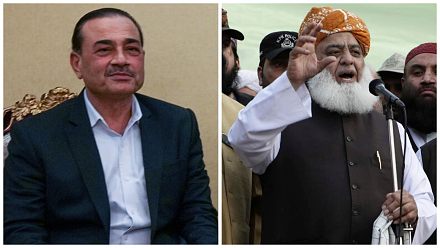
In a scathing attack on Pakistan’s civil-military establishment, Rehman accused successive military leaderships of failing to contain militancy despite years of counterterrorism operations. He also alleged that Prime Minister Shehbaz Sharif’s government had gone back on its commitments during negotiations aimed at resolving the political standoff with the Pakistan Tehreek-e-Insaf (PTI).
Fazlur Rehman Blames Military Leadership For Rising Terrorism
The JUI-F chief argued that repeated military operations, stretching from former military ruler General Pervez Musharraf’s tenure to the present, had failed to deliver lasting security.
Referring to the deterioration in law and order over the years, he said the worsening situation reflected a failure of the strategies adopted by those responsible for combating terrorism.
“If the situation has worsened from Musharraf’s time until today, it is their failure – a failure of their strategy,” Rehman said.
He questioned the outcome of military operations conducted over more than a decade, asking what had been achieved through the counterterrorism campaigns under way since 2010.
‘What About Balochistan?’ Rehman Questions Selective Emergency
Rehman questioned why the federal government had singled out KP for emergency measures when neighbouring Balochistan was also facing serious security challenges.
He suggested that the distinction between the two provinces was political rather than purely security-related, alleging that Balochistan’s provincial administration was more willing to follow the federal government’s directions.
“The only difference is that the Balochistan government agrees with whatever the federal government says,” he said.
He further questioned whether the intervention in KP was genuinely based on the provincial government’s performance, arguing that the same standards should be applied elsewhere.
Pak Government Broke Commitments During PTI Talks, Alleges Rehman
The JUI-F chief also accused Prime Minister Shehbaz Sharif’s government of abandoning commitments made during negotiations to resolve the confrontation with the PTI over its long march towards Islamabad.
Recounting the developments preceding the emergency declaration, Rehman said he had arrived in Islamabad on October 7, when PTI leaders approached him to discuss the political situation.
After hearing their account, he concluded that the government had left little room for meaningful negotiations.
Rehman said the PTI was proceeding with its long march in stages across KP but had agreed to postpone its advance towards Islamabad following his intervention.
He subsequently received an invitation to meet Prime Minister Shehbaz Sharif. Although he had not met the prime minister for several months, he said his colleagues advised him to accept the invitation in the country’s interest.
During their meeting, Sharif insisted that the PTI’s long march should first be called off. The PTI, meanwhile, was demanding a meeting with its jailed founder Imran Khan and his subsequent transfer to a hospital.
Rehman said he informed the prime minister that he needed to consult the PTI leadership before any agreement could be reached, particularly because KP Chief Minister Sohail Afridi was leading the march.
He subsequently contacted Afridi and other PTI leaders to explore a possible settlement.
From Negotiations To Emergency: Rehman Details Government’s Reversal
Rehman said Afridi had indicated that the PTI was prepared to call off its long march if the government accepted its demands.
According to Rehman, Sharif subsequently informed him that the issues would be placed before the federal cabinet.
However, he alleged that the government proceeded towards imposing emergency measures rather than allowing the proposed dialogue to move forward.
Rehman said Dar contacted him from the cabinet meeting to communicate the government’s decision, citing terrorism as the reason for the intervention.
The JUI-F chief questioned why he had been encouraged to mediate between the government and the opposition if the federal cabinet intended to proceed independently with the emergency declaration.
He accused the government of retreating from an agreed course of action despite progress towards resolving the confrontation.
“Why did the government back out despite accepting the demands? Why did it break its commitment?” he asked.
JUI-F Vows Legal, Parliamentary And Public Resistance
Rejecting the imposition of emergency rule and Governor’s Rule, Rehman announced that his party would challenge the federal government’s decision through constitutional, parliamentary and public platforms.
He said the JUI-F would approach the courts, raise the matter in parliament and mobilise public opposition to the measures.
The JUI-F chief maintained that his party stood by Pakistan’s Constitution and would continue its struggle to restore the rights of the people of KP.
He described the federal government’s intervention as an attack on democratic rights and accused those responsible of undermining democracy while claiming to act in its defence.