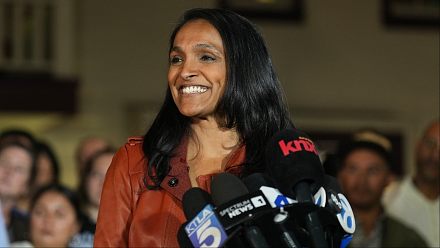
Nithya Raman Becomes LA Mayor: Here's How US City Chiefs Differ From Indian Mayors
Shashi Tharoor’s reaction to Nithya Raman’s historic victory in the Los Angeles mayoral election has brought the spotlight on the difference between urban governance in India and the United States – the powers enjoyed by
Oleh Vani Mehrotra··27K dibaca
Nithya Raman Becomes LA Mayor: Here's How US City Chiefs Differ From Indian Mayors
Shashi Tharoor’s reaction to Nithya Raman’s historic victory in the Los Angeles mayoral election has brought the spotlight on the difference between urban governance in India and the United States – the powers enjoyed by mayors.
Raman, who was born in Kerala, has defeated incumbent Karen Bass to become the first South Asian mayor of Los Angeles, marking another milestone for Indian-origin politicians in the US. Her victory also means that two of America’s largest cities, Los Angeles and New York, will be led by politicians of Indian origin, with Zohran Mamdani serving as New York City mayor.
Congratulating Raman, Congress MP Shashi Tharoor took the opportunity to draw a comparison between municipal leadership in the US and India.
In a post on X, he described Raman as a daughter of Thiruvananthapuram and said he was confident she and Mamdani would do a better job than their counterparts in India.
Tharoor argued that Indian mayors are constrained by a British-era administrative system that disperses authority and budgets, leaving them without sufficient powers to govern cities effectively.
His remarks raise an important question: Why do mayors in several American cities exercise considerably greater executive authority, while their counterparts in India often have limited control over municipal administration and finances?
HOW ARE MAYORS IN THE US DIFFERENT FROM THOSE IN INDIA?
The fundamental difference lies in how executive authority is distributed between elected political representatives and appointed administrators.
In several major American cities, including Los Angeles and New York, the mayor functions as the chief executive of the city government. The office carries substantial administrative and budgetary responsibilities, allowing the mayor to exercise direct influence over municipal departments, public services and policy implementation.
The mayor is also directly elected by city residents, giving the office a citywide electoral mandate.
According to NITI Aayog’s Urban Reform Agenda report, strong mayoral systems share three important features – executive authority concentrated in an elected leader, control over key urban functions, and fiscal or administrative autonomy for long-term planning.
The report identifies New York and Los Angeles among American cities with strong mayoral systems, where mayors exercise significant administrative and budgetary control.
This gives mayors considerable responsibility for the functioning of their cities, from public services and infrastructure to housing and urban development.
Their performance can also become a central issue in subsequent elections.
WHY DO INDIAN MAYORS HAVE LIMITED POWERS?
The situation is considerably different in India, where the mayor’s position and authority are determined largely by the municipal legislation of individual states.
The 74th Constitutional Amendment Act, 1992, gave constitutional recognition to urban local bodies and sought to strengthen democratic decentralisation. However, Article 243W leaves it to state legislatures to specify the powers, responsibilities and functions that municipalities will exercise.
Consequently, India does not have a uniform system of mayoral governance. The method of electing mayors, their tenure and their executive authority vary across states and cities.
In many municipal corporations, the mayor is the elected political head and presides over corporation meetings, while the municipal commissioner, an appointed bureaucrat, exercises substantial executive authority.
The commissioner generally oversees day-to-day administration, municipal employees, financial management and the implementation of projects. The extent of the mayor’s influence over these functions depends on the applicable state municipal law.
NITI Aayog has highlighted this institutional imbalance, observing that mayors in several Indian cities lack adequate administrative and financial control over urban local bodies.
It has also pointed to overlapping responsibilities between elected representatives and appointed administrators, which can weaken accountability.
The report notes that mayoral tenures vary significantly, ranging from one year in Bengaluru and Chandigarh to five years in Bhopal, with Mumbai having a 2.5-year tenure.
IS THE MAYOR JUST A CEREMONIAL HEAD IN EVERY INDIAN CITY?
Not entirely. There are important differences within India itself.
For instance, Kolkata follows a Mayor-in-Council system, under which executive responsibilities are shared through an elected political structure rather than being concentrated entirely in the municipal commissioner.
Kerala also offers a useful contrast. A 2020 national consultation on urban governance by Praja Foundation identified mayors in Kerala as among the most empowered in the country, with administrative responsibilities and greater influence over municipal functioning.
In Mumbai, however, the Brihanmumbai Municipal Corporation Act, 1888, vests executive power in the municipal commissioner, while the mayor primarily presides over corporation meetings.
The nature of the office depends on the city’s governing legislation and the distribution of authority within its municipal administration.
WHAT MAKES THE AMERICAN MODEL DIFFERENT?
The difference is not simply about whether a mayor is elected directly. It is also about whether the elected leader has the authority and resources to implement the promises made during an election campaign.
In Los Angeles, Raman will inherit the responsibilities of leading the city’s executive administration. Her campaign focused on affordable housing, homelessness, public transport, neighbourhood infrastructure and public safety.
Similarly, New York Mayor Zohran Mamdani heads a city government with extensive executive responsibilities and a substantial municipal budget.
In India, however, a mayor may promise better roads, sanitation, water supply and urban infrastructure but may not exercise direct administrative control over the officials and departments responsible for delivering these services.
The division of responsibilities between municipal commissioners, state governments, development authorities and other agencies can further complicate decision-making.
This fragmentation can also make it difficult for residents to hold one elected city leader accountable for the overall performance of urban governance.
WHAT HAS NITI AAYOG RECOMMENDED?
NITI Aayog’s Urban Reform Agenda has called for strengthening the office of the mayor by making the mayor the head of the city government with clearly defined executive powers.
It has recommended that state governments amend their municipal laws to establish an unambiguous division of responsibilities between mayors, municipal commissioners, standing committees and elected councillors.
The report has also advocated directly elected mayors with fixed five-year tenures, arguing that stronger political and executive leadership can improve accountability and long-term urban planning.