Israel Elections: Will Record Turnout Help Netanyahu As He Claims Election Is Being ‘Stolen’?
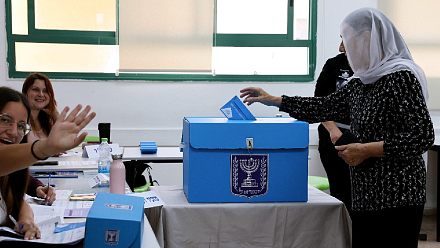
Israel on Tuesday recorded its highest voter turnout at 2 pm since 1973, with 44.9% of eligible voters casting their ballots by that time, according to the Central Elections Committee.
Oleh Shankhyaneel Sarkar··45K dibaca
Israel Elections: Will Record Turnout Help Netanyahu As He Claims Election Is Being ‘Stolen’?
Israel on Tuesday recorded its highest voter turnout at 2 pm since 1973, with 44.9% of eligible voters casting their ballots by that time, according to the Central Elections Committee.
The surge in participation has put the spotlight on Prime Minister Benjamin Netanyahu’s prospects, with the premier warning supporters that staying away from polling stations could hand power to his opponents.
“If we do not go out to vote now, we will find ourselves with a government of the Arab parties,” Netanyahu warned in a message urging Israelis to vote for Likud. “Every vote counts!”
The turnout had already reached 31.5% by noon, with more than 2.3 million Israelis voting by that point. That was the highest participation recorded at noon since 1973, according to the committee, and was up from 28.4% at the same time during the 2022 election, The Times of Israel reported.
Netanyahu Warns Of Arab Voter Mobilisation
Netanyahu Tuesday midday made Arab voter participation a central part of his election-day appeal, warning that right-wing supporters risk losing power if they do not turn out in comparable numbers.
In a post on X, the prime minister claimed that buses were taking voters to polling stations and that long queues had been reported in Arab localities, while right-wing strongholds were yet to show similar mobilisation. He urged Likud supporters to leave their homes and vote, warning that an opposition victory could result in a government backed by Arab parties.
US Ambassador to Israel Mike Huckabee also weighed in on the election, writing on X: “All voting is in person, ID required. No mail-in or absentee ballots. Arabs vote same as Israelis.” Huckabee described the election as a contentious process in a democratic country, while noting that Arab citizens vote under the same rules as other Israeli citizens.
In 2015, he urged supporters to vote after claiming Arab citizens were heading to polling stations in large numbers.
His latest appeal again places Arab participation at the centre of the political contest, even as the overall turnout figures offer no breakdown of which communities are driving the increase.
The allegations of election interference have added to the tension. Netanyahu claimed earlier on Tuesday that police had caught three senior United Arab List officials with envelopes of cash in the south. The party confirmed that three activists had been detained in the Negev but denied they held senior positions and called the arrests groundless.
What Are Israeli Right-Wing Leaders Saying About Turnout?
Netanyahu is not alone in warning his supporters about the consequences of high participation among Arab and left-wing voters.
Finance Minister Bezalel Smotrich, leader of the Religious Zionism party, argued that the early turnout figures reflected unusually high voting rates in Arab communities and left-wing strongholds. He urged right-wing voters to abandon smaller parties that risk falling below the electoral threshold, warning them against wasting their votes.
However, The Times of Israel noted that the nationwide turnout figures did not establish which communities were responsible for the increase. Smotrich’s claim was therefore not demonstrated by the aggregate numbers released by election officials.
The electoral arithmetic explains the concern. Under Israel’s proportional representation system, parties must secure at least 3.25% of the national vote to win seats in the Knesset. A party that falls short receives no seats, while the distribution of votes among smaller parties can alter the balance between the competing blocs.
Higher participation among Arab voters could strengthen Arab-led parties and potentially help the anti-Netanyahu camp.
But the overall turnout figure alone cannot establish whether that is happening, and the eventual impact will depend on the distribution of votes across all parties.
Arab Voters Turn Out Amid Anger Over Crime And Housing
Reports from Arab communities suggest that at least some voters are responding to local grievances as well as the national contest over Netanyahu’s future.
In Rahat, a Bedouin town in southern Israel, voters told The Times of Israel that National Security Minister Itamar Ben Gvir had galvanised the community to turn out in unusually large numbers. They cited increased housing demolitions under the current government, what they saw as inadequate action against gun violence in Arab communities, and the cancellation of funding and agreements associated with the previous government.
“They refer to a massive uptick in housing demolitions under the current government, to a lack of effort to deal with gun violence in the Arab sector and to cancellations of funds and agreements made during the government of Naftali Bennett and Yair Lapid, which for the first time included an Arab party, Ra’am, under Mansour Abbas,” the ToI reported.
It said roughly half the town had already voted by the time it was published, contrasting with previous elections when polling-station activity picked up later in the day. Women were also reportedly turning out in unprecedented numbers.
“There is no significance” to being the biggest party among the opposition contenders, Bennett said. “On the contrary, vote for the party you believe in, the party that will bring about the great change.”
He added that his party had been “succeeding in bringing tens of thousands of Israelis over to the Zionist, service-oriented bloc”.
Election-Day Incidents Add To Political Tensions
The vote has also been accompanied by allegations of irregularities at polling stations and reports of confrontations involving political figures.
The Democrats party said a man carrying a knife approached its leader, Yair Golan, during a voter-mobilisation tour in Tel Aviv. According to the party, Golan’s security guards blocked the man as he approached in a threatening manner, and a large knife fell from inside his clothing. The guards subdued him before police detained him.
“Incitement and violence will not deter us,” Golan said in response. He blamed what he described as Netanyahu’s “poisoned machine” and his alleged “Qatari agents” for incitement against him, and urged Israelis to vote.
Golan’s threat level had previously been raised to four out of six. Israel’s Shin Bet security service assumed responsibility for his security detail on Monday after a prolonged legal battle, Haaretz reported.
Several parties have also complained about alleged problems with ballot slips and the conduct of polling-station officials. The Yashar party said its ballot slips had been removed, damaged or marked in ways that could lead to votes being disqualified. A civilian election watchdog reported complaints from 115 polling stations about attempts to document voters in violation of Central Elections Committee regulations.
However, the Central Elections Committee said there was no evidence of systematic ballot tampering and that individual complaints were being addressed, The Times of Israel reported.