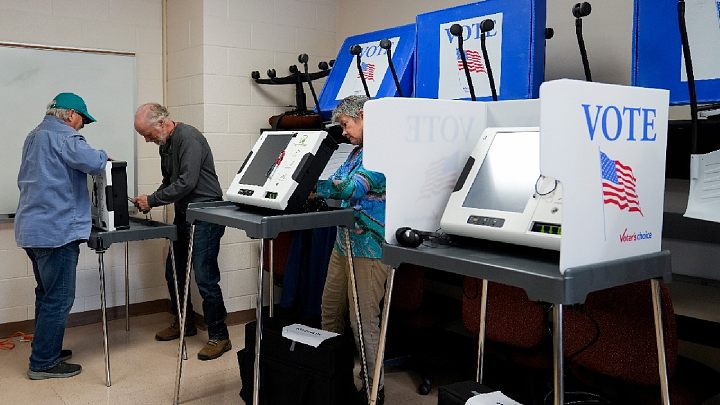
'Don't Let Them Rig This': Touchscreen Errors Fuel Vote-Rigging Fears Ahead Of US Midterms
Stella Parton, sister of late country music icon Dolly Parton, took to Facebook on Wednesday to recount how she had to go back three times to correct her selections on a touchscreen voting machine at her polling place ne
Oleh Shankhyaneel Sarkar··67K dibaca
'Don't Let Them Rig This': Touchscreen Errors Fuel Vote-Rigging Fears Ahead Of US Midterms
Stella Parton, sister of late country music icon Dolly Parton, took to Facebook on Wednesday to recount how she had to go back three times to correct her selections on a touchscreen voting machine at her polling place near Nashville, Tennessee, saying it repeatedly defaulted to Republican Senator Marsha Blackburn.
“Do it anyway. Don’t let them rig this election,” Parton wrote, urging voters not to let the experience deter them from casting their ballots.
Her account is among a wave of social media posts from voters reporting difficulties with touchscreen ballot-marking devices as early voting gets underway ahead of the November 3 US midterm elections. While some have interpreted the incidents as evidence of deliberate attempts to manipulate votes in favour of Republicans, election officials say the problems are generally linked to user error or screen calibration, and have reported no evidence of widespread vote-switching.
The reports have emerged in several states, including Kansas, Ohio, South Carolina, Tennessee and Texas, drawing renewed attention to the reliability of voting equipment and the spread of election-related misinformation.
What Should Voters Do If A Touchscreen Machine Records The Wrong Choice?
Election officials and voting machine manufacturer Election Systems & Software (ES&S) have urged voters experiencing difficulties to seek assistance from poll workers rather than assume that their votes have been changed deliberately.
Voters should review their selections carefully before submitting their ballots. If a touchscreen does not register the intended choice, they can try selecting the candidate again or ask a poll worker for help.
If a paper ballot has already been printed and does not reflect the voter’s intended selections, the voter should alert a poll worker rather than cast it. Officials can then follow the jurisdiction’s procedure for replacing the ballot.
The guidance is particularly relevant to ballot-marking devices, which allow voters to make selections on a touchscreen before printing a paper record. That record can be reviewed by the voter and is typically used in the subsequent vote-counting process.
Voters Report Problems In Tennessee And Texas
The touchscreen complaints have gathered tens of thousands of likes, shares and views on social media in recent days, with reports emerging from several high-population areas.
In Tennessee’s Williamson and Davidson counties, which include Franklin and Nashville respectively, voters have described difficulties with touchscreen machines.
Parton’s account drew particular attention because she said she had to correct her selections repeatedly after the machine kept defaulting to Blackburn, a Republican senator. Her post urged voters to persevere despite the problems, but also warned that the election could be rigged.
Chad Gray, election administrator in Williamson County, said officials had found no discrepancies in the voting equipment. He added that if problems or questions arose, representatives from both parties would examine the devices to ensure they were functioning properly.
Tennessee Elections Coordinator Mark Goins told local broadcaster WSMV that the reported problems were “not a vote-flipping situation”.
“It’s more like an unintended touch that they may not even realize,” Goins said.
A separate Facebook video showed a user describing how his mother-in-law encountered difficulties while attempting to vote for Democratic candidates in Kendall County, Texas. According to his account, the machine repeatedly selected Republicans. He said she eventually managed to vote as intended, while acknowledging that the problem could have been user error. He nevertheless concluded that people were “jacking with our elections”.
Staci Decker, elections administrator in Kendall County, attributed such incidents to voters touching the wrong part of the on-screen selection box or pressing the screen too hard, which can cause calibration problems. She said her policy was to have staff recalibrate the screens every few days.
“This is part of an attempt at every election (especially the bigger ones) to scare voters away,” Decker said in an email. “Every single piece of equipment used in our election is tested before it can be used in an election.”
Election Officials Say Complaints Are Not Unusual
Reports of touchscreen difficulties are not new, and election officials say such complaints commonly emerge during high-turnout elections.
In South Carolina, an X user said a machine had made it difficult to select Democratic Senate nominee Annie Andrews. However, state election officials had not observed an unusual increase in reports of voters struggling to make their selections, said Sydni Bain, a spokesperson for the state’s election commission.
“We commonly receive some of these reports during elections, particularly statewide elections with high turnout,” Bain said. “We encourage all voters to be careful in making their selections and to review their ballot before it is cast.”
In Bexar County, Texas, an X user reported having to tap the screen forcefully to get a machine to register a choice for Democrat James Talarico instead of Republican Ken Paxton in the Senate contest.
County officials said they could not confirm any equipment problems.
“This could possibly be user error,” said John Moreno, the county’s assistant public information officer. “If a voter has concerns about their ballot, they should bring it to the attention of the on-site judge.”
Kristin Miles, president of the Texas Association of County Election Officials and election administrator in Bastrop County, said claims of votes being switched by machines surface during election cycles.
“Nearly every case comes back to the screen calibration on older touchscreen machines, not a change to anyone’s vote,” she said.
Officials also emphasised that voting machines are tested before elections and that most jurisdictions conduct post-election audits involving manual counts of samples of paper ballots.
How Touchscreen Ballot-Marking Devices Work
Voters across the United States cast ballots in different ways. Some fill out paper ballots by hand, while others use ballot-marking devices that print a paper record of their selections.
Many of the recent social media reports have involved ExpressVote ballot-marking devices manufactured by Election Systems & Software, a Nebraska-based company. These machines allow voters to select candidates on a touchscreen and then print a paper record, which voters can review before it is used in vote tabulation.
Katina Granger, ES&S’s senior manager of public relations, said the company works closely with election officials and provides technical support when needed. She said the company had not been made aware of any widespread voting-machine issue during the current election cycle.
Granger advised voters encountering difficulties to ask poll workers for assistance. If a printed ballot does not reflect their intended selections, they should notify a poll worker rather than cast it, allowing election officials to follow the prescribed process for replacing it.
Why Touchscreen Complaints Can Fuel Election-Rigging Claims
The latest reports have emerged against a backdrop of declining trust in election results among many Democrats. An AP-NORC poll found that many Democrats had lost confidence in election outcomes over the preceding four years, with many expressing concern about the president interfering with the vote.
The spread of touchscreen complaints on social media has added to those anxieties, with some users interpreting individual accounts as evidence of a coordinated effort to favour Republicans. But a report of a machine registering an unintended selection does not, by itself, establish that votes have been deliberately altered.
David Becker, executive director of the Center for Election Innovation and Research, said most claims of vote-flipping could be explained by human error. He also warned that people seeking to spread disinformation could use genuine voter concerns to undermine confidence in elections.
“Almost all of the claims of vote flipping are understandable human error,” Becker said. “Is there one of us who hasn’t had a butt dial or mistyped something on our phones? It is not nefarious.”
The US election system is decentralised, with thousands of election jurisdictions operating under rules set by state and, in some cases, local governments. Procedures and equipment can therefore differ across the country.