No Surgery, 3-Day Hospital Stay, ₹1.70 Lakh Bill: Delhi Man Questions ‘Unnecessary’ Charges As Internet Calls It ‘Broad Daylight Robbery’
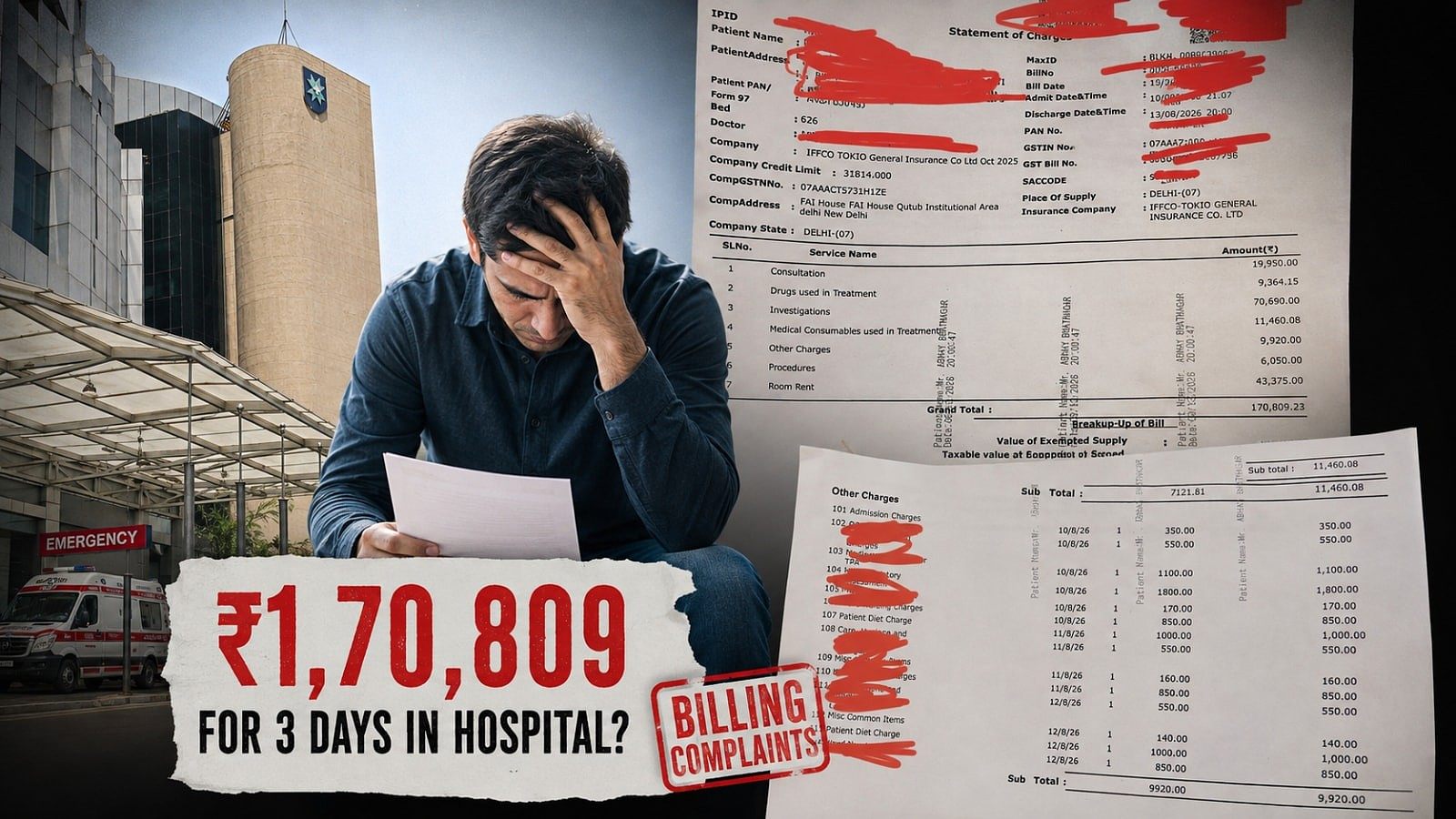
A Delhi man’s detailed post alleging questionable billing practices at BLK-Max Hospital in Karol Bagh has gone viral on X, after he claimed his brother’s three-day hospital stay resulted in a ₹1,70,809 bill.
Oleh Buzz Staff··42K dibaca
No Surgery, 3-Day Hospital Stay, ₹1.70 Lakh Bill: Delhi Man Questions ‘Unnecessary’ Charges As Internet Calls It ‘Broad Daylight Robbery’
A Delhi man’s detailed post alleging questionable billing practices at BLK-Max Hospital in Karol Bagh has gone viral on X, after he claimed his brother’s three-day hospital stay resulted in a ₹1,70,809 bill.
X user Abhishek Bhatnagar said his brother was admitted on August 11, 2026, and discharged on August 13, 2026. According to him, the treatment mainly involved medication and investigations, with no surgery being performed.
After going through the bill following the discharge, Bhatnagar said he found several charges that he believed needed clarification. He also claimed that IFFCO-Tokio declined reimbursement for some of the disputed amounts.
“This is my story of how @BLK_Hospital, Karol Bagh cheated us through what I believe are serious billing malpractices,” Bhatnagar wrote, adding that his brother was admitted for “just 3 days” and that the final gross bill came to ₹1,70,809.
Explaining why he decided to examine the bill closely, he said families often focus entirely on treatment when a loved one is hospitalised. “After discharge, when I went through every line of this bill, several charges simply did not make sense,” he wrote.
One of the charges he questioned was ₹3,150 in RMO fees, calculated at ₹1,050 per day for three days. Bhatnagar said the bill did not identify the RMO, provide a separate progress note or explain what additional service the fee covered. He also said the insurer refused reimbursement.
“₹3,150 RMO Fees — but which doctor?” he asked, seeking details of who the RMO was, when the patient was examined and where the relevant notes were. He also questioned why the amount was charged separately when the single-room rent itself was ₹13,770 plus GST per day.
Bhatnagar also flagged a ₹1,100 charge listed as “Medical Evaluation for TPA”. He claimed that he and his brother had filled out the insurance and TPA forms and submitted the required health declarations. According to him, they were not aware of any separate medical evaluation.
“This one surprised me even more,” he wrote, asking, “Where is the evaluation report?” He argued that a charge described in medical terms should be supported by documentary evidence.
Another disputed item was a ₹794 sanitiser bottle. Bhatnagar alleged that the bottle was already opened and being used in the room, while its MRP was around ₹250.
“We found ourselves billed ₹794 for a sanitizer bottle that was already opened/used in the room,” he wrote, questioning why an already-opened bottle was billed at more than three times its MRP.
Diet-related charges also drew his attention. According to Bhatnagar, the bill included ₹700 for a dietician, ₹1,000 per day for patient diet for two days and other food-related charges, taking the total diet-related billing to around ₹5,370.
He claimed that the family had not been informed about a separate dietician fee and that no special diet or major dietary restriction had been prescribed. His brother was also allowed to have home-cooked food from the first day, he said.
“Diet charges were another shock,” Bhatnagar wrote, before questioning: “Then what exactly are all these additional diet charges for?”
The diagnostic charges were another major point of contention. Bhatnagar said the bill included ₹31,600 for an MRI Brain and ₹1,250 for an X-ray. While the family received written reports, he alleged that they were unable to obtain the actual scan images or digital copies.
“We received written reports. But when we asked for the actual MRI/X-ray images, the hospital staff refused to provide the films,” he claimed. He questioned why accessing diagnostic images should be difficult after a patient has paid ₹31,600 for an MRI.
Bhatnagar also alleged that his brother was repeatedly asked to undergo Holter monitoring despite having no known heart condition. He said the family asked to see the doctor’s written order but was not shown one, prompting them to decline the test.
“We asked for the doctor’s written order. We were not shown one. So we declined,” he wrote, adding, “If a test is medically necessary, why is showing the doctor’s order such a problem?”
The post also raised questions over ward nursing charges. Bhatnagar said ₹850 per day was charged separately for nursing, amounting to ₹2,550 over three days, on top of the ₹13,770-per-day single-room rent. He said the insurance company also declined this amount.
“I want BLK-Max to explain whether routine ward nursing is separately chargeable under its tariff and under its cashless agreement with IFFCO-Tokio,” he wrote.
Similarly, he questioned a ₹550-per-day charge listed under “Care, Hygiene & Infection Control”, which came to ₹1,650 for three days. Bhatnagar argued that if the amount covered cleaning, sanitisation, disinfectants or housekeeping, the hospital should provide a clear breakup and explain why it was separate from the room tariff.
“What exactly are we paying ₹13,770/day room rent for if basic room hygiene, cleaning and infection-control practices are being billed separately?” he asked.
Summing up his concerns, Bhatnagar pointed to the number of separate charges appearing around a single hospital room, including room rent, ward nursing, RMO fees, care and hygiene, medical consumables, dietician charges, patient diet, admission charges, consultant visits and TPA evaluation.
“Every line may have a billing code. But a billing code alone doesn’t prove that every charge is fair, non-overlapping or separately recoverable from the patient,” he wrote.
He added that the issue was about more than his individual bill. “When someone in your family is hospitalised, you are thinking about their health not auditing 100 billing codes,” Bhatnagar said, arguing that families can find themselves dealing with both hospitals and insurers over charges that were not properly explained.
He subsequently asked BLK-Max to provide RMO names and visit records, supporting documentation for the ₹1,100 TPA evaluation fee, an explanation for the sanitiser charge, a complete diet-charge breakup, MRI and X-ray digital scans, doctors’ orders for disputed investigations, clarification on ward nursing and hygiene charges, and details of what is included in the single-room rent.
“If every charge is genuine, producing the supporting records should be easy,” he wrote.
Bhatnagar said he decided to share the experience because he believed many families may simply pay hospital bills without questioning every individual charge.
“For me, this experience exposed what appears to be a deeply questionable and consumer-unfriendly billing system at a major private hospital,” he wrote, adding, “Patients deserve treatment without having to become forensic auditors after discharge.”
Internet Reacts
The post subsequently gained traction on X, with several users sharing strong reactions to the allegations.
“This has been a regular story of most of private hospitals, specially after so much of foreign fundings in Indian health care. Thanks to our govt which failed measurably to provide standard heath care. Also, thanks to our reservation system,” said one user.
“This is too much. It’s well known fact that healthcare is nothing but a profession and all they want is to make money from the tragedy of people…. But this is broad daylight robbery,” said another.
This is my story of how @BLK_Hospital, Karol Bagh cheated us through what I believe are serious billing malpractices.
My brother was admitted for just 3 days.
No surgery. Mainly medication + investigations.
Final gross bill: ₹1,70,809.
Admission date to Discharge: 11th… pic.twitter.com/JMjvMdESHl
— Abhishek Bhatnagar (@abhishek) August 14, 2026
“Bro please sue these f*ckers on consumer court. This is absurd!” said a third.
“BLK toh pakka chor hai….you should seek every clarification and drag them to the courts of law, they will not understand in simple straight words,” said a fourth.
“This is unfair looting from patients.. This need to be escalated by higher authorities,” said another.