Trump Was Told Nvidia Chief Jensen Huang Was Target Of A Chinese Spy Plot, But Did Nothing: Report
US intelligence agencies last year had concluded that a senior executive at a Singapore-based data centre company was working as a Chinese intelligence asset and funneling information to Beijing, including through her re
लेखक Shankhyaneel Sarkar··74K पढ़े गए
Trump Was Told Nvidia Chief Jensen Huang Was Target Of A Chinese Spy Plot, But Did Nothing: Report
US intelligence agencies last year had concluded that a senior executive at a Singapore-based data centre company was working as a Chinese intelligence asset and funneling information to Beijing, including through her relationship with Nvidia CEO Jensen Huang, but President Donald Trump chose not to act after being briefed on the findings roughly a year ago, The New York Times reported on Thursday.
According to the report, Alice Huang, also known as Huang Le, a Chinese citizen and senior executive at Megaspeed, was under scrutiny over the company’s suspected role in helping Chinese firms access advanced artificial intelligence chips manufactured by Nvidia. US intelligence agencies subsequently concluded that she was collecting information for Beijing, raising concerns in Washington about her access to Huang, one of the most influential figures in the global AI industry.
The discovery set off alarm bells at the White House, the NYT reported, given Nvidia’s central role in the US effort to maintain its lead over China in artificial intelligence. Intelligence findings raised questions about whether Alice Huang could have obtained information about Nvidia or gained insights into Trump’s thinking on chip exports to China.
However, Trump did not act on the information when he was briefed last year, according to people familiar with the surveillance who spoke to the newspaper on condition of anonymity because the findings involved classified intelligence.
The report said Trump was wary of disrupting Nvidia’s chip sales, which have helped drive economic growth and the stock market, or further complicating Washington’s trade relationship with Beijing.
Nvidia CEO’s relationship with executive under scrutiny
The New York Times reported that US intelligence agencies had been conducting electronic surveillance of Alice Huang. Communications involving an American citizen were identified during the monitoring, and a process known as unmasking subsequently identified that individual as Jensen Huang.
It remains unclear when Jensen Huang and Alice Huang first met or what information, if any, she passed on to Chinese authorities. US officials initially did not believe the Nvidia chief knew that she was allegedly gathering intelligence for Beijing, although some senior officials in the Trump administration have since questioned whether he could have remained unaware of her suspected role, the report said.
Jensen Huang has not received a defensive briefing which is a warning sometimes given to Americans who may be targets of foreign intelligence services, according to people familiar with the surveillance cited by the newspaper. The monitoring of Alice Huang is continuing, while companies affiliated with her have continued purchasing Nvidia chips this year.
Nvidia rejected suggestions that its business relationship with Megaspeed gave the company access to sensitive information.
“Jensen’s interactions with Ms. Huang are not unusual or unexpected,” Nvidia spokesman John Rizzo told the New York Times, adding that meetings with customers were part of the CEO’s job and that Huang spoke with thousands of customer executives every year.
Rizzo also said customers such as Megaspeed received ordinary business information, “not sensitive Nvidia trade secrets”, and no information relevant to national security. Nvidia maintained that it had investigated and debunked earlier claims that Megaspeed was smuggling chips into China.
The White House, the CIA and the National Security Agency declined to comment, according to the report.
Megaspeed’s chip purchases raise questions
US authorities have been investigating Megaspeed since late 2024, when a Commerce Department official visited a data centre in Malaysia and found Nvidia equipment still packed in boxes, suggesting it was being shipped in or out rather than installed at the site, the NYT reported.
Megaspeed operates as an intermediary, purchasing Nvidia-powered computing equipment and renting computing capacity to Chinese companies, including Alibaba. US investigators suspect that some chips acquired through the network may also have been diverted illegally into China.
Trade records obtained from ImportGenius, a trade data platform, showed that a Malaysian sister company of Megaspeed purchased at least $4.8 billion worth of advanced AI equipment containing Nvidia chips and technology between June 2024 and February 2026, according to the newspaper.
The purchases were unusually large for a small and relatively obscure company. Megaspeed and its affiliates continued buying Nvidia products this year, often through intermediaries, the report said.
The US has restricted exports of its most advanced Nvidia chips to China since 2022. However, companies in Southeast Asia have been able to establish data centres that purchase computing equipment and rent processing capacity to Chinese firms. The Biden administration tightened rules governing this practice, but Trump subsequently rolled back those restrictions. His administration is now weighing whether to tighten them again, according to the NYT.
Megaspeed’s current leadership said it was taking the allegations seriously. In a statement to the newspaper, the company said outside counsel had been retained to conduct an internal investigation and that it had notified the US government of its willingness to cooperate.
China’s embassy in Washington rejected the allegations. Asked about the US intelligence assessment concerning Alice Huang, embassy spokesman Liu Chang described the accusations as a campaign of “groundless smears and slanders” against China.
Trump’s ties with Nvidia chief complicate chip policy
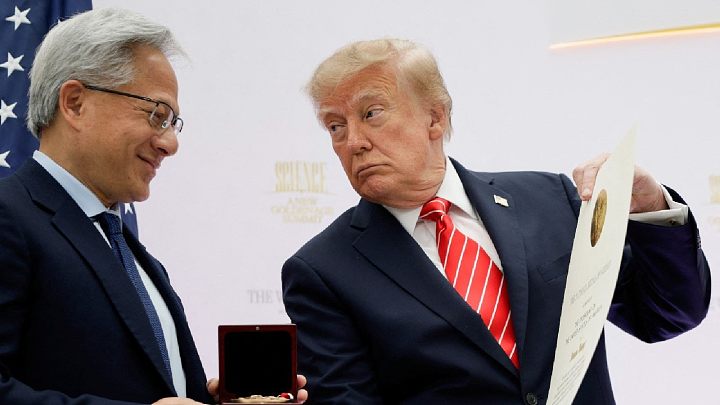
The report also highlighted Jensen Huang’s growing access to Trump as the administration weighed restrictions on Nvidia’s sales to China.
Huang had lobbied the administration to ease export restrictions and allow Nvidia to continue doing business with Chinese customers. He also negotiated an arrangement under which the US government would receive a 25 per cent share of revenue from certain Nvidia chips approved for sale to China, the New York Times reported.
Current and former US officials told the newspaper that the close relationship between Trump and Huang had impeded efforts to tighten restrictions on Nvidia’s overseas sales. Some proposed sanctions and investigations involving China or Nvidia had stalled within the Commerce Department, the officials said.
Huang, who previously kept a low profile in Washington, visited Trump’s Mar-a-Lago residence with his wife as the administration considered restrictions on Nvidia chips. Nvidia later donated at least $20 million to Trump’s ballroom fund, according to a person familiar with the matter cited by the newspaper.
The report did not establish that Jensen Huang knowingly assisted Chinese intelligence or that Alice Huang had obtained sensitive information from him. It also left unanswered what information she allegedly passed to Beijing, how valuable it was to Chinese authorities and why Trump chose not to act on the intelligence findings.