The Story Behind Punya Maati: Why Is Soil From Sex Workers’ Doorsteps Used For Idols?
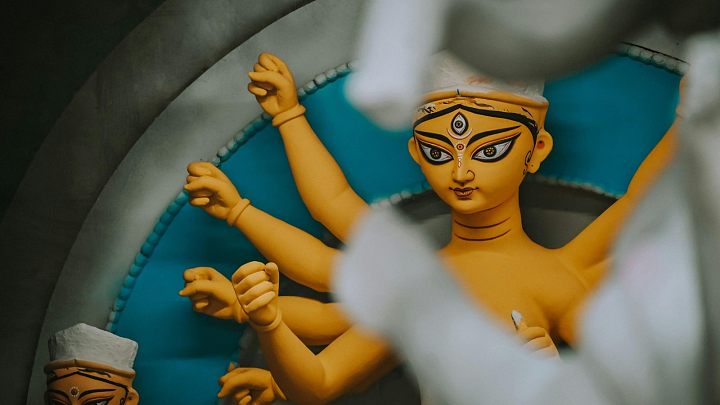
Every year, as the festive season approaches, the narrow lanes of Kumartuli, Kolkata’s famous potters’ quarter, come alive with the sound of artisans shaping clay into the familiar forms of Goddess Durga and her children
लेखक Lifestyle Desk··16K पढ़े गए
The Story Behind Punya Maati: Why Is Soil From Sex Workers’ Doorsteps Used For Idols?
Every year, as the festive season approaches, the narrow lanes of Kumartuli, Kolkata’s famous potters’ quarter, come alive with the sound of artisans shaping clay into the familiar forms of Goddess Durga and her children. Bamboo frames are covered with straw, layers of clay are carefully applied, and the idols slowly begin to take shape.
But there is a lesser-known tradition associated with the making of these idols that has intrigued devotees for generations. Along with the clay used to sculpt the goddess, some traditional Durga idols incorporate a handful of soil collected from the doorstep of a sex worker’s home. Known as Punya Maati, or sacred soil, this unusual ritual carries layers of religious belief, social symbolism and historical debate.
The practice is particularly associated with Bengal, where artisans in Kumartuli have traditionally sourced soil from neighbourhoods such as Sonagachi, one of Kolkata’s best-known red-light districts. Yet, the meaning behind this ritual goes beyond the soil itself. It raises a question that remains relevant today: what does it mean to worship a goddess who represents feminine power while a section of women continues to face social exclusion?
What Is Punya Maati And Why Is It Considered Sacred?
In Bengali, punya refers to virtue or spiritual merit, while maati means soil. The term is used for the soil traditionally collected from the threshold of a sex worker’s home and incorporated into the clay mixture used to make Durga idols.
One widely circulated belief offers a striking explanation for why this particular soil is considered sacred. According to this interpretation, men who visit a sex worker leave their virtue or purity at her doorstep. The soil outside the home is therefore believed to accumulate this virtue, making it punya or holy.
The belief is paradoxical. Women whose work has historically attracted social condemnation become, through this ritual, the source of an ingredient considered spiritually significant in the creation of a goddess.
However, this is a traditional explanation rather than an established historical account of how the custom began. The origins of Punya Maati remain debated, and different religious interpretations have developed around the practice over time.
The Connection Between Durga Puja And Social Inclusion
Another interpretation centres on the idea that the divine cannot be separated from the people society chooses to marginalise.
Goddess Durga is worshipped as a manifestation of Shakti, or feminine power. She represents strength, protection and the triumph of good over evil. The inclusion of soil from a sex worker’s doorstep has therefore been interpreted as a reminder that the sacred must extend beyond the boundaries of social respectability.
The custom has also been linked to the worship of different forms of feminine energy and to traditions that recognise women across social categories. These explanations, however, should not be treated as a single, universally accepted account of the ritual’s origins.
At its most inclusive, the symbolism of Punya Maati suggests that no community should be considered beyond the reach of the divine.
Is There A Mythological Story Behind The Tradition?
Several legends are associated with the use of this soil, although their details vary across accounts.
One popular explanation connects the practice to the legend of Lord Ram and the autumnal worship of Goddess Durga, commonly known as Akal Bodhan. According to this account, Ram sought the goddess’s blessings before his battle with Ravana, and soil associated with a sex worker named Ambalika was used in the making of the idol.
Other interpretations connect the tradition to stories involving celestial women, including Menaka, and to the worship of feminine forms associated with Shakti.
These stories are often cited to explain the ritual’s spiritual significance. However, the precise historical origin of the custom is difficult to establish, and claims that it is explicitly prescribed in ancient Hindu scriptures should be approached with care unless supported by a specific textual reference.
What remains clear is that the ritual has become part of the cultural memory surrounding Durga Puja in Bengal, passed down through generations of artisans and families who preserve older forms of worship.
From Sonagachi To Kumartuli: A Tradition That Asks Difficult Questions
The story of Punya Maati is also inseparable from the women whose homes and neighbourhoods have been associated with the ritual.
For much of the year, sex workers have faced stigma and exclusion from spaces that other members of society take for granted. Yet, during the preparations for Durga Puja, their neighbourhoods have traditionally been approached for soil believed to carry spiritual significance.
The contrast is difficult to ignore. A ritual can recognise a community symbolically without necessarily changing the social conditions that keep its members marginalised.
That tension is what makes Punya Maati more than an unusual detail in the making of a Durga idol. It invites devotees to reflect on the difference between honouring someone through a ritual and respecting their dignity in everyday life.
As artisans continue to shape the goddess from clay, the tradition leaves behind a question that extends beyond Durga Puja: if the divine feminine is believed to exist in every woman, should social acceptance and respect not extend to every woman, too?