Shilpa Shetty's Ball Workout Looks Simple, But Can You Ace This Fitness Challenge?
A workout does not always have to involve heavy weights, complicated equipment or high-intensity circuits. Sometimes, a simple ball can make an exercise surprisingly challenging. Shilpa Shetty recently demonstrated just
लेखक Swati Chaturvedi··21K पढ़े गए
Shilpa Shetty's Ball Workout Looks Simple, But Can You Ace This Fitness Challenge?
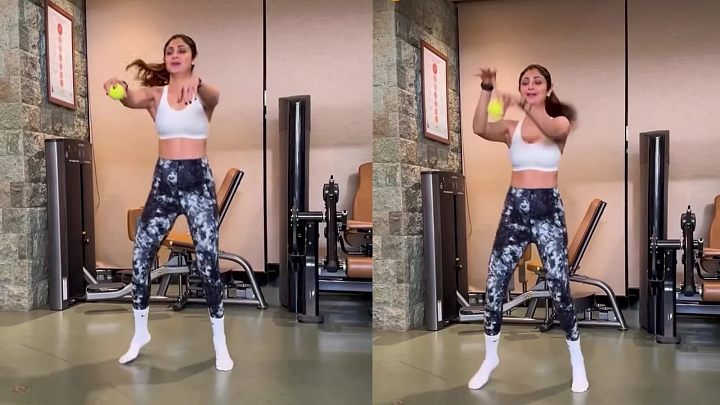
A workout does not always have to involve heavy weights, complicated equipment or high-intensity circuits. Sometimes, a simple ball can make an exercise surprisingly challenging. Shilpa Shetty recently demonstrated just that, sharing a ball-based workout on Instagram and inviting her followers to try it for themselves.
In the video shared on October 26, the actor is seen wearing a white sports bra, blue leggings and white socks as she takes on the exercise. Accompanying the post, she wrote, “A simple ball, a not-so-simple challenge. Think you can ace it?”
The appeal of the exercise lies in its simplicity. Ball-based activities can require participants to track movement, coordinate their hands and respond at the right moment. Depending on the variation, they can also introduce balance and body-control challenges, making them a useful addition to a varied fitness routine.
View this post on Instagram
A post shared by Shilpa Shetty Kundra (@theshilpashetty)
What makes ball exercises challenging?
Unlike repetitive movements where the sequence is predictable, catching or controlling a moving ball requires continuous visual attention and timely physical responses. The difficulty can increase when the exercise involves both hands, alternating movements or balancing at the same time.
Here are some of the skills these exercises can help practise.
1. Hand-eye coordination
Catching a ball requires the eyes to track its movement while the hands respond at the right moment. Repeated practice can help develop coordination between visual information and physical action.
2. Focus and attention
A ball-based drill requires you to pay attention to the movement rather than perform a sequence automatically. Tracking the ball and anticipating where it will move can make the exercise mentally engaging as well as physical.
3. Balance and body awareness
Some ball exercises can be performed while standing on one leg or shifting weight between the feet. These variations add a balance component, challenging the body to maintain stability while the hands perform a separate task.
4. Motor control and timing
Releasing, tracking and catching a ball requires controlled movement and accurate timing. Practising such activities can help refine the coordination needed to carry out these specific tasks.
5. A more engaging workout routine
One advantage of ball exercises is their versatility. They can be adapted for beginners and more experienced exercisers, and their playful nature can provide a change from conventional workout routines.
Can ball exercises improve brain health?
Coordination exercises involve both physical movement and attention, which is why they are sometimes described as brain-body workouts. Activities that require a person to observe, make decisions and coordinate movement can engage several cognitive and motor processes at once.
However, it is important to distinguish between engaging the brain during an exercise and proving that the exercise improves memory, prevents cognitive decline or eliminates brain fog. The benefits depend on the activity, the individual and the evidence available. A ball drill should not be treated as a guaranteed way to improve cognitive performance.
For general health, coordination exercises are best viewed as one part of a broader fitness routine that includes aerobic activity, strength training, mobility work and adequate recovery.
How beginners can try ball exercises safely
If you want to experiment with a similar workout, start with a simple version rather than attempting the most challenging variation immediately.
Begin with one ball: Practise gentle tosses and catches while standing with both feet firmly on the ground.
Focus on control: Start slowly and aim for consistent catches instead of speed.
Progress gradually: Once the basic movement feels comfortable, try alternating hands or adding a simple movement.
Introduce balance carefully: Single-leg variations are more demanding. Use a stable support nearby and avoid them if you feel unsteady.
Choose a clear space: Make sure the floor is non-slip and there are no objects around that could cause you to trip.
If you have an injury, persistent balance difficulties or a medical condition that affects movement, seek appropriate professional guidance before attempting more demanding variations.
Shilpa Shetty’s reminder to keep fitness interesting
Shilpa Shetty frequently shares glimpses of her fitness routine, from yoga and strength work to exercises that challenge balance and coordination. Her latest ball-workout post offers a reminder that movement can be varied and engaging without requiring an elaborate setup.
The takeaway is not that one exercise can transform physical or cognitive health overnight. Rather, simple coordination drills can add variety to a well-rounded fitness routine and sometimes, a little challenge is enough to make a workout more interesting.