Pirelli Calendar 2027: India Takes Centre Stage, Framed By Two Very Different Eyes
For the first time in the history of The Cal, Pirelli has handed its most storied project to two photographers working in tandem rather than one voice working alone. The 2027 Pirelli Calendar turns its lens on India—a co
लेखक Mallika Bhagat··7K पढ़े गए
Pirelli Calendar 2027: India Takes Centre Stage, Framed By Two Very Different Eyes
For the first time in the history of The Cal, Pirelli has handed its most storied project to two photographers working in tandem rather than one voice working alone. The 2027 Pirelli Calendar turns its lens on India—a country, as they put it, “known for its beauty, diversity and complexity”—and splits the telling between Norwegian photographer Sølve Sundsbø and Indian master Raghu Rai. It’s a deliberate choice: one outsider’s gaze, one insider’s, set in dialogue rather than competition.
The project carries an added weight this year. Following Raghu Rai’s passing, his daughter Avani Rai—an acclaimed photographer in her own right—stepped in to carry her father’s vision through to completion, turning what was already a cross-cultural conversation into something more personal.
Two Photographers, Two Indias
Sundsbø, known internationally for his sharp, highly stylised aesthetic, brings an outsider’s reverence to the project. “When we started talking about it, it was quite clear that I couldn’t do this project on my own. I had no right to do it on my own,” he says of the decision to co-helm the calendar. Working alongside a name he considers foundational to the medium only sharpened that sense of responsibility: “And when they said Mr Raghu Rai would be part of it, it was like, for me, he is like a photography god.” His focus stayed narrow and human—portraiture. “I’m concentrating on portraits of people from this country,” he explains, “and then I’m leaving Avani the harder job of trying to capture more of its soul.”
The 2027 Pirelli Calendar turns its lens on India—a country, as they put it, “known for its beauty, diversity and complexity”—and splits the telling between Norwegian photographer Sølve Sundsbø and Indian master Raghu Rai.
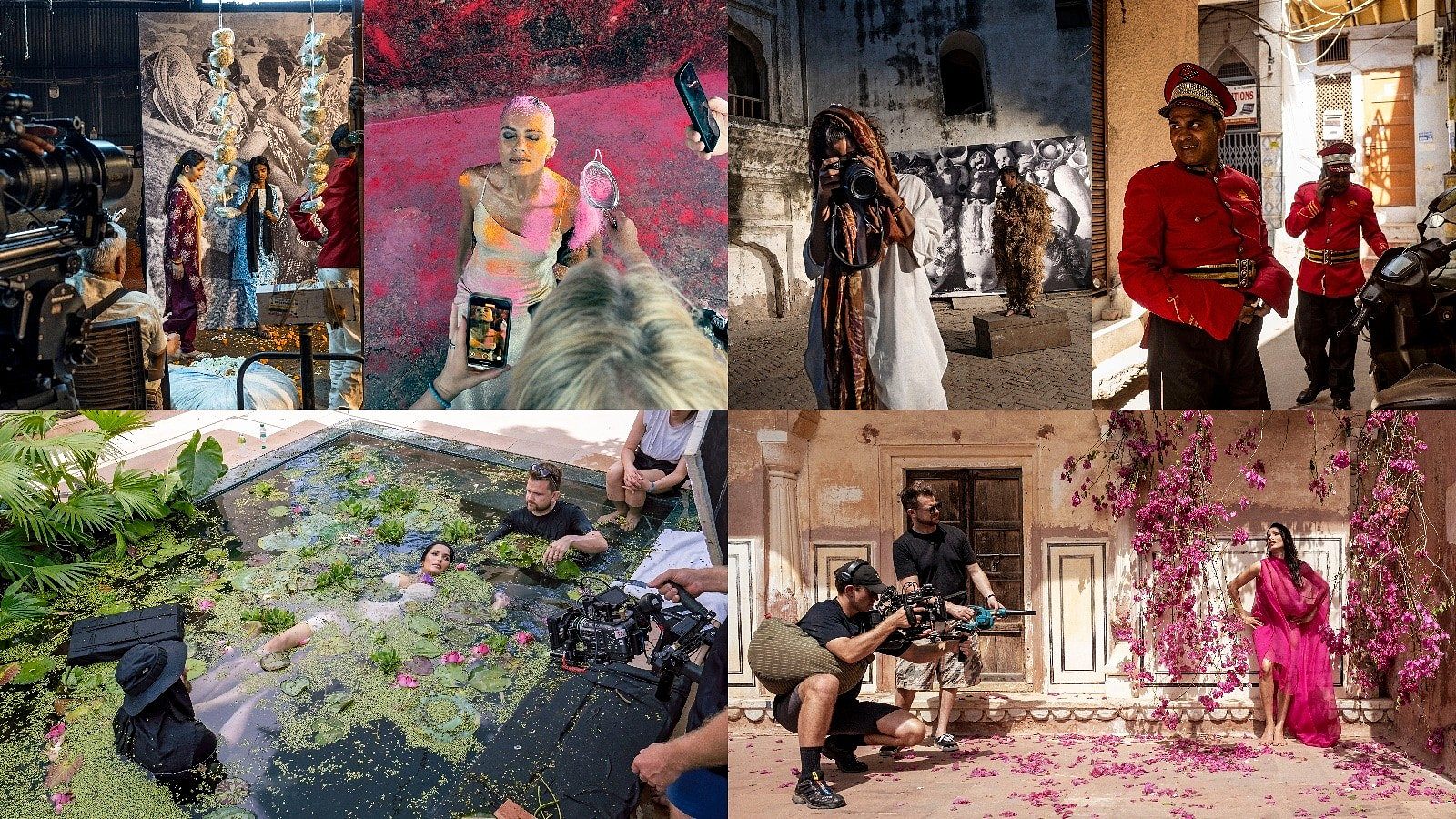
That “harder job” is exactly where Avani Rai’s half of the project lives. Continuing a concept her father originally imagined as a studio production built around his own unpublished archive, she chose instead to take it outdoors, back to the streets that shaped Raghu Rai’s life’s work. “Originally, when my father was putting it together, the idea was to have his older, unpublished works as the backdrop and frame, and it was supposed to be in a studio,” she says. “But when I decided to take the project forward, I felt that he belonged to the streets. So, I took the same idea he was putting together into the streets, to the people he photographed throughout his life. And I stand behind him: I frame him, I frame his work and I frame the reality that exists 30, 40 or 50 years later.”
Where It Was Shot
Sundsbø photographed across Rajasthan, between Jaipur’s Jaigarh Fort and Ajabgarh. Avani Rai, by contrast, worked the streets of Old Delhi, deliberately retracing locations her father had photographed across his own long career, folding decades of continuity into a single frame.
Who’s In Front Of The Camera
Sundsbø’s cast leans toward recognisable names: actresses Aditi Rao Hydari and Avantika Vandanapu, actress-producer Freida Pinto, musician-composer Anoushka Shankar, poet and performer Rupi Kaur, models Lakshmi Menon and Bhavitha Mandava, and author-producer-television host-culinary entrepreneur Padma Lakshmi, with photographer Avani Rai herself also appearing in front of his lens. Avani Rai’s own cast tells a different story altogether: more than 200 people, spanning everyday citizens, dancers, street artists, artisans, musicians and performers, alongside her mother, Gurmeet Rai.
In Their Own Words
For Avani Rai, the project is inseparable from grief and inheritance. “My father is in my viewfinder, looking at the world with me. Everything else goes still, and all that breathes is the world inside that frame, and him beside me. He never tells me what photograph to take. He tells me to wait. Wait for everything to come alive. And beside me, he sits,” she says. On what she hopes the images capture, she adds: “You cannot show India. You can only show its essence – what it feels like to stand inside it. And to chase that essence with my father beside me is something I will carry for the rest of my life.” She points, too, to something distinctly Indian in how time behaves: “In India, the past and the present don’t just coexist. They live in multiple universes, all at once.” Her intention with the street-level approach was continuity itself: “I decided to take this project onto the streets, amongst people he has spent his life photographing and where he belongs. When people look at these images, I want them to experience this continuity.”
For Avani Rai, the project is inseparable from grief and inheritance.
Sundsbø, meanwhile, was candid about the risk of an outsider’s take on a country this vast. “Someone at Pirelli asked me, ‘If you close your eyes and think of India, what do you see?’ The risk, of course, is falling into clichés. But clichés exist for a reason: they preserve something timeless.” That question shaped his visual choices directly: “To me, it was obvious that the images had to embrace colour and a certain visual richness. India’s history is so rich that it is impossible to capture it in a single narrative. That’s why the sets are filled with colour, flowers, intense light, and deep contrasts.”