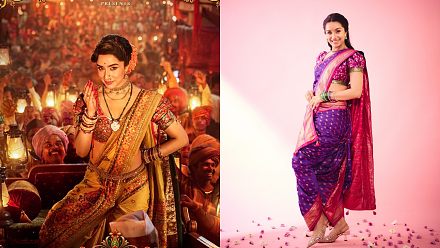
Nine Yards Of Marathi Pride: Shraddha Kapoor’s 'Eetha Celebrates' The Legacy Of The Nauvari Saree
“Nauvari kehte hain isse… kya nauvari… yeh sirf kapda nahi, abhimaan hain… jisse pehenne mile woh bhagyavaan hain… Are Marathi saaz ka samaan hain yeh aur Marathi maaz ki pehchaan hain.”
लेखक Labani Mahanandy··7K पढ़े गए
Nine Yards Of Marathi Pride: Shraddha Kapoor’s 'Eetha Celebrates' The Legacy Of The Nauvari Saree
“Nauvari kehte hain isse… kya nauvari… yeh sirf kapda nahi, abhimaan hain… jisse pehenne mile woh bhagyavaan hain… Are Marathi saaz ka samaan hain yeh aur Marathi maaz ki pehchaan hain.”
When Shraddha Kapoor, as Vithabai Bhau Mang Narayangaonkar in Eetha, delivers this dialogue in the film’s trailer, it is difficult not to feel a shiver run down your spine. There is conviction in every word, a certain theatrical flourish in the delivery, and a sentiment that needs no translation. The nauvari is not just nine yards of fabric. It is pride draped in silk and cotton, a marker of identity, and a garment with a history far too rich to be reduced to a passing fashion trend. Shraddha’s dialogue is a reminder that some clothes do considerably more than dress the body. They carry the weight of a culture.
And the nauvari has never been particularly short of an audience. In October 1996, Sonali Bendre welcomed Michael Jackson to Mumbai in a traditional Maharashtrian nine-yard saree, offering the King of Pop a distinctly local greeting. Years later, Deepika Padukone and Priyanka Chopra brought the drape to the grand cinematic canvas in Bajirao Mastani, while Vidya Balan channelled its performance-ready spirit in the Lavani number Jau De from Ferrari Ki Sawaari.
Now, Eetha brings it back into focus through the story of Vithabai, an artiste whose life and stagecraft were deeply intertwined with Maharashtra’s folk performance traditions. But before the nauvari became a favourite of film costume departments and celebrity wardrobes, it had already spent centuries earning its place in the cultural imagination.
(Image: Instagram/@shraddhakapoor)
Nine Yards, Centuries Of Heritage
The name is almost disarmingly literal. Nau means nine and vari refers to yards, describing the generous length of fabric that distinguishes this traditional Maharashtrian drape. Also known as the lugade or kashta saree, the nauvari departs from the conventional six-yard silhouette through its distinctive dhoti-style construction. The fabric is drawn between the legs and tucked at the back, creating a trouser-like finish, before being wrapped around the waist and arranged over the shoulder. The result is a drape that marries the grace of a saree with a freedom of movement rarely associated with traditional formal dressing.
Its history is closely associated with Maharashtra’s social and cultural evolution, particularly the Maratha period. The practical construction is often linked to women who worked in the fields, rode horses and, according to popular historical accounts, participated in military life. The drape allowed for greater mobility while retaining the conventions of traditional attire. Its precise origins are difficult to assign to a single historical moment, but its design offers an insight into the lives of the women who wore it. Here was a garment that understood the demands of everyday life: it had to accommodate movement, labour and activity, not merely occasion and ornament.
(Image: Instagram/@shraddhakapoor)
Over time, the nauvari grew beyond its functional purpose to become an enduring expression of Maharashtrian identity. Its draping traditions evolved across communities and regions, giving rise to distinctive variations. The Brahmani style, for instance, is recognised for its particular arrangement, while other regional interpretations reflect local customs and preferences. Fabric and occasion further shape its character. Cotton versions have long been part of everyday wardrobes, while silk, rich borders and elaborate finishes lend the saree a more ceremonial gravitas. There is no singular way to wear the nauvari, and therein lies part of its enduring appeal: its heritage is as varied as the women who have kept it alive.
The Grammar Of The Drape
The nauvari’s appeal lies in its construction as much as its visual impact. Its defining feature is the kashta, the fabric drawn between the legs and tucked at the back to create a dhoti-like silhouette. The remaining length is arranged around the waist, with the pallu brought over the shoulder. Traditionally, the drape can be worn without a petticoat, although contemporary interpretations often adapt the technique to suit modern preferences. It is a silhouette with structure, fluidity and a certain architectural elegance.
The styling is equally distinctive. A traditional Maharashtrian nath, green glass bangles, a crescent-shaped bindi, gold jewellery and a bun adorned with jasmine bring the ensemble into its familiar visual vocabulary. The border and pallu offer room for ornamentation, but the drape itself remains the defining feature. It can be understated in cotton or resplendent in silk; either way, it carries a presence that does not depend on excessive embellishment. The nauvari does not need to compete for attention. It commands it.
(Image: Instagram/@shraddhakapoor)
Its relationship with Lavani makes this particularly evident. In the hands of a skilled performer, the saree becomes an extension of the choreography. The pleats flare with a turn, the pallu follows the rhythm of the movement, and the dhoti-style construction allows the dancer to execute intricate footwork with ease.
Where The Nauvari Meets The Tamasha Stage
This brings us to Tamasha, Maharashtra’s traditional folk theatre form, where music, dance, satire, humour and storytelling come together in a distinctly theatrical idiom. Lavani is among its most recognisable performance traditions, known for its rhythmic footwork, expressive gestures and powerful musical accompaniment. The nauvari has long been central to its visual identity, lending performers both the freedom to move and the dramatic silhouette that has become synonymous with the form.
Vithabai Narayangaonkar belonged to this world. Celebrated as Tamasha Samradni, or Empress of Tamasha, she rose to prominence through a performance tradition in which the costume was inseparable from the craft. The nauvari was not a styling reference borrowed for the stage; it was part of the visual language through which performers inhabited their art. Its movement, its colours and the way it framed the dancer all contributed to the spectacle. In portraying Vithabai, Shraddha Kapoor is stepping into a legacy where the garment carries meaning well beyond its aesthetic appeal.
(Image: Instagram/@shraddhakapoor)
Perhaps that is what makes the Eetha dialogue resonate. The nauvari has appeared in celebrity photographs, period dramas and choreographed set pieces, but its significance cannot be measured by its screen time. Sonali Bendre’s unexpected meeting of Maharashtrian tradition and global pop culture, the cinematic grandeur of Pinga and the renewed attention brought by Shraddha’s portrayal are all chapters in its public life. Its deeper story, however, belongs to generations of women who have worn it as everyday attire, ceremonial dress and performance costume.
Fashion has an enduring appetite for rediscovery, and heritage silhouettes are often brought back into the conversation with the promise of a revival. The nauvari hardly needs one. Its history has never been confined to a museum or a costume department; it continues to live in the wardrobes, rituals and performances of Maharashtra. It is one of the ways that pride is worn