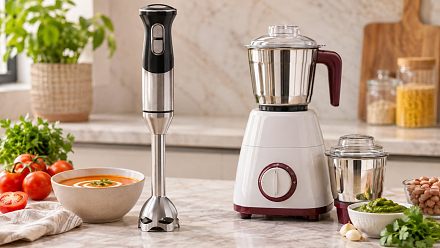
Need A Kitchen Helper Under ₹1,500? Here's When To Pick A Hand Blender Over A Mixer Grinder
If your kitchen shopping list includes a small appliance that can make everyday cooking easier, you might find yourself choosing between a hand blender and a mixer grinder. Both promise to save time, both come in compact
लेखक Consumer Trends Desk··21K पढ़े गए
Need A Kitchen Helper Under ₹1,500? Here's When To Pick A Hand Blender Over A Mixer Grinder
If your kitchen shopping list includes a small appliance that can make everyday cooking easier, you might find yourself choosing between a hand blender and a mixer grinder. Both promise to save time, both come in compact designs and both can handle certain blending tasks. But they are designed for rather different jobs.
A hand blender is particularly useful when you want to purée tomato soup directly in a saucepan, blend dal, whip up lassi or make a quick smoothie. A mixer grinder, on the other hand, is better suited to grinding dry spices, making chutneys, preparing pastes and handling ingredients that need more intensive grinding.
The confusion usually starts when you look at budget models. At under Rs 1,500, there are several options on Amazon India, but the features can vary considerably. Some hand blenders are basic single-shaft appliances, while others offer detachable attachments. Mixer grinders in this bracket tend to be entry-level models with fewer jars and more modest motor capacities.
So, which one deserves space on your kitchen counter? Here’s what you should consider before buying.
1. What do you cook more often?
Start with your everyday cooking habits rather than the appliance specifications.
If you regularly make soups, smoothies, milkshakes, lassi, mayonnaise or purées, a hand blender can be extremely convenient. You can immerse its blending shaft directly into a container, blend the ingredients and clean the detachable portion afterwards.
It is particularly useful when preparing tomato soup, blending cooked vegetables or making a smooth dal without transferring hot food into a mixer jar.
A mixer grinder makes more sense if your cooking involves grinding spices, making ginger-garlic paste, preparing coconut chutney or grinding soaked ingredients. It offers a more enclosed jar-based system that is better suited to these tasks.
If you make Indian food regularly and need just one appliance for grinding and chutneys, a mixer grinder is generally the more versatile purchase.
2. Hand blender: Look at the shaft and blade design
A hand blender’s most important component is its blending shaft. This is the part that goes into your pot, glass or mixing bowl.
A stainless-steel shaft is a useful feature, particularly if you plan to blend warm soups or cooked vegetables. It is generally more durable and easier to clean than a basic plastic blending attachment.
Also check the blade design and splash guard. A well-designed guard helps reduce splattering while blending liquids. This matters when working with thinner preparations such as lassi, soups and smoothies.
Some models also include whisking attachments, choppers or additional jars. These can make the appliance more versatile, but check whether they are actually included in the box rather than simply mentioned in a generic product description.
For a basic hand blender, a 200W to 300W motor can be sufficient for light household blending. It is not intended to replace a high-powered mixer grinder or process hard ingredients continuously.
3. Mixer grinder: Don’t overlook the jars
With a mixer grinder, the jars matter almost as much as the motor.
A small jar is useful for grinding spices and preparing chutneys, while a larger jar is better for blending liquids and making pastes. If the appliance comes with only one jar, check its capacity and the manufacturer’s recommended uses.
Look for stainless-steel blades, a secure lid and a sturdy jar-locking mechanism. The base should also have non-slip feet to prevent excessive movement during operation.
At this price point, you may have to compromise on the number of jars or overall capacity. That is not necessarily a problem if you mostly cook in small quantities.
However, don’t expect an inexpensive 300W personal blender to perform like a conventional 750W mixer grinder. They are designed for different levels of workload.
4. Motor power: More watts aren’t the whole story
It is tempting to choose an appliance simply because its product listing advertises a higher wattage. But the motor’s design, blade construction and intended workload matter too.
For a hand blender, 200W to 300W is a reasonable range for everyday light blending. You can use it for soups, lassi, smoothies and soft cooked ingredients.
For a mixer grinder, 500W is a more practical starting point if you intend to grind spices, prepare chutneys and make pastes regularly. Lower-powered compact models can work for lighter tasks, but they may struggle with tougher ingredients or larger quantities.
Also check the recommended operating time. These appliances are not designed to run continuously for long periods. Give the motor breaks between batches and avoid overloading the jars.
5. Cleaning and storage can make a difference
A hand blender is usually easier to store because it takes up less counter space. If it has a detachable shaft, cleaning is relatively straightforward. Just remember that the motor housing should never be immersed in water.
Mixer grinders require more storage space because of their jars, lids and accessories. The jars also need to be cleaned thoroughly, particularly around the blade assembly and rubber gaskets.
If you have a small kitchen, a compact hand blender may be the more convenient appliance to keep within reach.
6. What can you realistically expect under Rs 1,500?
This is where expectations become important.
Under Rs 1,500, you can find basic hand blenders from brands such as Orpat, Maharaja Whiteline and Cello. You can also find entry-level mixer grinders from brands such as Lifelong and Pigeon, although the availability and configurations vary.
At this price, prioritise the appliance’s core function rather than paying extra for accessories you may never use.
If you already own a mixer grinder, a hand blender can be a useful secondary appliance for soups, smoothies and purées. But if you are buying your first kitchen appliance, a mixer grinder will generally cover more Indian cooking requirements.
Hand blender or mixer grinder: Which one should you choose?
Here’s a quick way to decide:
Choose a hand blender if you regularly make soups, smoothies, lassi, purées and milkshakes.
Choose a mixer grinder if you need to grind spices, make chutneys, prepare masalas and blend thicker pastes.
Choose a hand blender with a whisk attachment if you also make whipped cream, light batters or dressings.
Choose a mixer grinder with multiple jars if you want one appliance to handle several everyday cooking tasks.
The bottom line? Don’t buy a hand blender expecting it to grind masalas, and don’t buy a mixer grinder just because you want to purée a bowl of soup. Both have their place in a kitchen, but they solve different problems.
Hand blenders
1. Maharaja Whiteline 175 W Turquoise Blue & White Hand Blender
A simple option for everyday blending jobs such as lassi, milkshakes and soft ingredients. A sensible pick if you want a basic appliance without paying for extra attachments.
An entry-level hand blender for soups, smoothies and purées. Worth considering if you want a straightforward stick blender for occasional kitchen use.
3. Cello 300 W White Hand Blender
A higher-wattage option for routine blending, including smoothies, soups and liquid preparations. Check the exact shaft material and included attachments on the listing.
Mixer grinders
4. Lifelong llmg93 500 Watt 2 Jars Mixer Grinder
A compact mixer grinder for everyday grinding and blending requirements. The two-jar configuration makes it a more versatile choice than a single-purpose portable blender.
5. Pigeon Pure 300W Personal Blender
A compact personal blender with a multi-use jar and sipper. Better suited to smoothies, shakes and smaller blending jobs than heavy-duty masala grinding.