Milind Soman Did Two Ironmans In Six Days And Says The Real Challenge Was What Happened Between Them
At 60, Milind Soman appears to have found a rather unusual way of answering a question most athletes would prefer not to test quite so dramatically: how quickly can your body recover from an Ironman?
लेखक Swati Chaturvedi··22K पढ़े गए
Milind Soman Did Two Ironmans In Six Days And Says The Real Challenge Was What Happened Between Them
At 60, Milind Soman appears to have found a rather unusual way of answering a question most athletes would prefer not to test quite so dramatically: how quickly can your body recover from an Ironman?
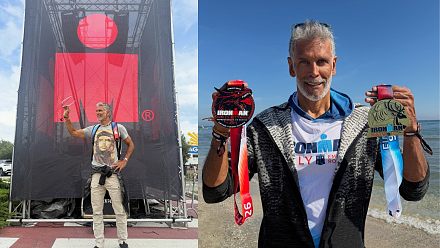
Just six days after completing the notoriously demanding Ironman Wales on September 13, the actor, model and endurance athlete lined up for another full-distance Ironman, this time in Italy on September 19. And he finished that one too.
Soman’s latest feat involved another 3.8-kilometre swim, 180-kilometre bike ride and 42.2-kilometre marathon, the three disciplines that make up a full Ironman.
But his own explanation for doing two such extreme races almost back-to-back is more interesting than the distances themselves.
“This one was to learn new lessons on recovery,” Soman wrote in an Instagram post, explaining that understanding the time required to recover from a particular physical stress is an important part of understanding individual fitness.
In other words, Italy wasn’t simply another medal. It was an experiment.
Six Days. Two Ironmans. One Very Different Question.
The first race had barely left his legs when Soman was preparing for the second. Ironman Wales, held on September 13, is known for its demanding terrain and was described by Soman as one of the hardest Ironman experiences he has undertaken. Six days later, he was back on the start line in Italy.
The scale becomes easier to appreciate when the two races are placed side by side.
September 13 — Ironman Wales
3.8 km swim + 180 km bike + 42.2 km run
September 19 — Ironman Italy
3.8 km swim + 180 km bike + 42.2 km run
That’s 7.6 kilometres of swimming, 360 kilometres of cycling and 84.4 kilometres of running across six days, before even accounting for the recovery, travel and preparation between the two events.
For most people, even contemplating that volume would be extraordinary. For Soman, the interesting question was what his body could learn from it.
Why Recovery Became The Real Fitness Test
Soman’s post offered an unusually nuanced definition of fitness. According to him, fitness isn’t only about how much you can do. It is also about how quickly you can recover sufficiently to do it again with the same level of comfort.
That is an important distinction. Performance is easy to quantify. You can record your running pace, cycling distance or swimming time. Recovery is less visible. It happens in the hours and days after the workout, when the body has to replenish energy stores, repair muscle tissue and restore itself after physical stress.
Soman deliberately chose to test that less glamorous side of endurance.
Rather than asking, Can I complete an Ironman? he had already answered that.
The question now was: What happens when I ask my body to do it again almost immediately?
Italy Was Another Full Ironman, Not A Shortcut
Ironman Italy Emilia-Romagna takes place in and around Cervia, on Italy’s Adriatic coast. The official course consists of a 3.8 km sea swim, a 180 km bike course through the Romagna countryside and a 42.2 km run, making it a full-distance Ironman rather than a shorter variation.
The bike course is largely flat but includes the climb towards Bertinoro, while the run takes athletes through the historic surroundings of Cervia.
So there was no clever substitution involved. Soman wasn’t swapping one endurance discipline for another or entering a reduced-distance event. He simply did another Ironman. Six days later.
View this post on Instagram
A post shared by Milind Usha Soman (@milindrunning)
And Then There Was Rice And Rajma
Among the images Soman shared after the race was something considerably more ordinary than an Ironman finish line: a plate of rice and rajma.
After thousands of metres in the water, hundreds of kilometres on a bike and a full marathon, the humble Indian meal made for a wonderfully grounded postscript.
It also fits neatly into the larger story of endurance: the extraordinary performance eventually comes back to very ordinary things, food, rest, sleep and giving the body what it needs to rebuild. The dramatic part is the race.
The quieter part is what happens afterwards.
At 60, Soman Is Still Curious About Fitness
Soman has spent decades making endurance a central part of his public identity. In 2015, at 50, he completed the Ironman in Zurich in 15 hours and 19 minutes, completing the 3.8-km swim, 180-km cycle and marathon within the event’s 16-hour limit.
A decade later, his approach seems less about proving that he can keep up with his younger self and more about understanding what his body is capable of now.
That distinction matters. At 60, doing something difficult is impressive. But deliberately using an extreme physical challenge to understand how his body responds to stress and recovery is a different kind of fitness philosophy.
It is less about chasing a number and more about curiosity.
Fitness Isn’t Always About Doing More
There is a temptation, particularly in the world of celebrity fitness, to treat more as automatically better: more kilometres, heavier weights, longer workouts, fewer rest days.
Soman’s latest challenge suggests a more complicated picture. His experiment was not simply about adding volume. It was about observing what happens when an enormous amount of volume is compressed into a very short period.
And that makes recovery part of the performance itself. An athlete who can finish an Ironman is demonstrating endurance.
An athlete who can recover sufficiently to tackle another one six days later is testing an entirely different physiological equation.
That doesn’t mean back-to-back Ironmans should become anyone’s fitness goal. Soman has spent years training for endurance events, and his experiment is highly individual. What is possible for an experienced endurance athlete cannot simply be translated into a prescription for the average person.
But that is precisely what makes his observation worth paying attention to.
The Finish Line Wasn’t The Point This Time
There is a familiar image associated with an Ironman: the finish-line photograph, the medal, the exhausted smile and the triumphant declaration that the impossible has been done.
Soman certainly had that moment. But his Italy race appears to have been motivated by something less immediately visible. He wanted to understand recovery.
How much stress can the body absorb? How long does it need before it can perform again? What changes when age, training history, nutrition, sleep and accumulated experience become part of the equation?
Those questions don’t have a finish line. And perhaps that’s the most interesting thing about Soman’s latest Ironman. At 60, he isn’t just trying to go farther. He’s trying to understand what happens next.