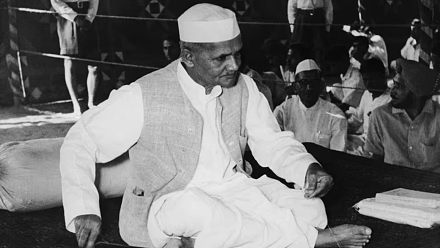
Lal Bahadur Shastri Jayanti 2026: Life, Legacy And The Story Behind ‘Jai Jawan, Jai Kisan’
Lal Bahadur Shastri Jayanti 2026: October 2 marks the birth anniversary of former Prime Minister Lal Bahadur Shastri, one of the most prominent leaders of post-Independence India. Born on October 2, 1904, in Mughalsarai,
लेखक Nibandh Vinod··21K पढ़े गए
Lal Bahadur Shastri Jayanti 2026: Life, Legacy And The Story Behind ‘Jai Jawan, Jai Kisan’
Lal Bahadur Shastri Jayanti 2026: October 2 marks the birth anniversary of former Prime Minister Lal Bahadur Shastri, one of the most prominent leaders of post-Independence India. Born on October 2, 1904, in Mughalsarai, Uttar Pradesh, Shastri went on to become Prime Minister at a crucial period in the country’s history. This year, marks the 122nd birth anniversary of the former PM.
Known for his simplicity, humility and association with the freedom movement, Shastri served as Prime Minister from June 9, 1964, to January 11, 1966. His tenure included the 1965 India-Pakistan war and a period of food shortages and economic challenges.
His birth anniversary is observed alongside Gandhi Jayanti on October 2. Shastri’s famous call of “Jai Jawan, Jai Kisan” remains closely associated with his leadership and his emphasis on the contribution of India’s soldiers and farmers.
Who Was Lal Bahadur Shastri?
Lal Bahadur Shastri grew up in modest circumstances. His father, a school teacher, died when Shastri was about a year and a half old, after which his mother raised him and his siblings with limited means.
As a young student, Shastri became influenced by the Indian freedom movement. At the age of 16, he responded to Mahatma Gandhi’s call to join the Non-Cooperation Movement and gave up his studies.
He later studied at Kashi Vidya Peeth in Varanasi, where he received the title “Shastri”, meaning a scholar. The title eventually became part of the name by which he was widely known.
Lal Bahadur Shastri’s Role in India’s Freedom Movement
Shastri actively participated in the freedom struggle and was imprisoned several times by the British.
According to the Prime Minister’s official biography, he spent a total of about seven years in British jails during the freedom movement. His involvement in the struggle helped shape his political career after Independence.
After Independence, Shastri took up responsibilities in Uttar Pradesh before moving to national politics. He held several important portfolios in the Union Cabinet, including Railways, Transport and Communications, Commerce and Industry, and Home Affairs.
Why Did Lal Bahadur Shastri Resign as Railway Minister?
One of the episodes frequently cited in accounts of Shastri’s political career is his resignation as Railway Minister following a major railway accident.
Shastri accepted moral responsibility and resigned from the Cabinet. The official Prime Minister’s biography records that Jawaharlal Nehru accepted his resignation and praised the gesture as an example of constitutional propriety, while stating that Shastri was not personally responsible for the accident.
The episode subsequently became associated with Shastri’s public image of personal accountability and simplicity.
Lal Bahadur Shastri as Prime Minister
Shastri became Prime Minister on June 9, 1964, following Jawaharlal Nehru’s death.
There is a small historical distinction worth noting: Shastri is often referred to in popular accounts as India’s second Prime Minister. The Prime Minister’s Museum & Library, however, lists Gulzarilal Nanda as the second Prime Minister because he served as acting Prime Minister twice, while Shastri is listed as the third Prime Minister. Shastri was therefore India’s second full-time Prime Minister.
His tenure lasted from June 9, 1964, to January 11, 1966. Despite being relatively short, it included several defining moments for the country.
What Is the Story Behind ‘Jai Jawan Jai Kisan’?
The phrase “Jai Jawan, Jai Kisan” is among the most enduring slogans associated with Lal Bahadur Shastri.
The slogan highlighted the importance of two groups that Shastri regarded as vital to India’s strength and survival: the country’s soldiers and its farmers.
It gained prominence during a period when India faced both security challenges and food shortages. The slogan therefore came to represent the importance of national defence as well as agricultural production.
The Prime Minister’s Museum & Library describes Shastri as the leader who coined the popular slogan and notes his role in promoting the White and Green Revolutions.
Lal Bahadur Shastri and the 1965 India-Pakistan War
One of the most significant events of Shastri’s tenure was the 1965 India-Pakistan war.
Shastri led India during the conflict, which became a defining episode of his time as Prime Minister. The Prime Minister’s Museum & Library records that he led the country during the 1965 war and links his leadership with the slogan “Jai Jawan, Jai Kisan”.
The war ended with the Tashkent Declaration, signed by Indian Prime Minister Lal Bahadur Shastri and Pakistani President Ayub Khan in January 1966.
What Was the Tashkent Declaration?
The Tashkent Declaration was signed on January 10, 1966, in Tashkent, then part of the Soviet Union.
The agreement followed the 1965 India-Pakistan conflict and provided a framework for the two countries to withdraw forces and work towards restoring peaceful relations.
Shastri died in Tashkent on January 11, 1966, just hours after the declaration was signed. He was 61.
Lal Bahadur Shastri’s Legacy
Shastri’s political legacy is closely associated with simplicity, personal integrity, public service and his leadership during a difficult period for India.
His relatively short tenure as Prime Minister included a war, food shortages and efforts to strengthen agricultural production.
His famous slogan, “Jai Jawan, Jai Kisan”, continues to be invoked in discussions about India’s armed forces and agricultural community. A 2025 government statement marking his birth anniversary described the slogan as a lasting symbol of India’s regard for soldiers and farmers.
Lal Bahadur Shastri Jayanti: Significance
Lal Bahadur Shastri Jayanti is an occasion to remember the former Prime Minister’s contribution to India’s freedom struggle and his role in the country’s early post-Independence years.
The day also brings attention to Shastri’s emphasis on the contribution of farmers and soldiers. His “Jai Jawan, Jai Kisan” message continues to be one of the most recognisable phrases associated with his political legacy.
For India, October 2 therefore carries a dual historical significance: it marks the birth anniversaries of Mahatma Gandhi and Lal Bahadur Shastri, two leaders associated with different but important chapters of the country’s modern history.