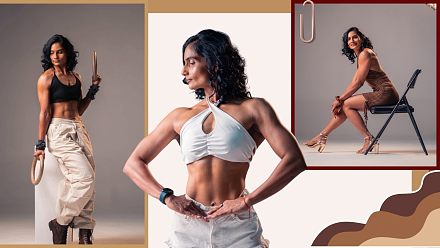
From Picking Up Her First Weight At 33 To Representing India Internationally, A Look At Vijeta Doneria's Remarkable Journey
There is a particular kind of ambition we learn to abandon as we grow older. Not because the desire disappears, but because we begin to negotiate with it. We tell ourselves there will be time later, that the moment has p
लेखक Labani Mahanandy··13K पढ़े गए
From Picking Up Her First Weight At 33 To Representing India Internationally, A Look At Vijeta Doneria's Remarkable Journey
There is a particular kind of ambition we learn to abandon as we grow older. Not because the desire disappears, but because we begin to negotiate with it. We tell ourselves there will be time later, that the moment has passed, that certain things belong to a younger, fitter, more prepared version of ourselves. Eventually, the reasons not to begin start sounding remarkably like common sense.
Vijeta could have listened to them. At 33, with no athletic background and little affinity for running, she began lifting weights. There was no competitive ambition driving her, no carefully mapped route to an international podium. She wanted to feel healthier, stronger and more at ease in her own skin. What she found instead was a capacity for reinvention she hadn’t known to look for.
Years later, in Singapore, she stood on an international stage representing India and won a silver medal at the Junior Masters Women’s Sports.
Her entry into fitness was unremarkable by design. She hadn’t grown up playing sport, and strength training and calisthenics had never figured into her plans. But consistency has a way of introducing us to versions of ourselves we haven’t yet imagined.
“I never stepped into fitness with dreams of becoming a competitive athlete. My intention was straightforward: I just wanted to feel healthier, stronger, and better in my own skin. I had never been sporty growing up; I genuinely disliked running, and strength training or calisthenics weren’t even on my radar,” she said.
Then came the small, cumulative revelations: a lift that felt lighter, a movement that began to make sense, a physical challenge that no longer seemed quite so far beyond reach. Each offered evidence that her perceived limits were not necessarily her actual ones.
“One small victory led to the next my lifts went up, movements started feeling natural, and I realized how severely I had underestimated myself,” Vijeta recalled.
It is tempting to read a journey like Vijeta’s backwards, beginning with the medal and tracing a neat line to the first workout. But transformation rarely announces itself so clearly while it is happening. At the beginning, there was only the decision to return to the gym. The ambition arrived later, shaped by everything she discovered along the way.
A Different Measure Of The Self
Long before fitness became a competitive pursuit, Vijeta had been negotiating with another set of expectations, those surrounding appearance. For years, she relied on fairness creams and camera filters, believing that attractiveness and, by extension, a sense of worth, required her to conform to a prescribed aesthetic.
Training gradually unsettled that equation. The mirror, once a place of scrutiny, began to lose its authority.
“Today, I no longer judge my body solely by how it looks in a mirror; I celebrate what it can execute. This body can deadlift heavy weight, run long distances, perform a muscle-up, step onto an international stage, and represent India. Shifting my focus from external aesthetics to functional capability transformed my life far more than any physical change ever could. I stopped trying to alter how I looked and started pursuing what I could become,” she shared.
The transformation was not simply physical; it changed the questions she asked of herself.
The Discipline Of Becoming
By the time Singapore came into view, the curiosity that had first drawn Vijeta to weights had evolved into the demands of competitive sport. The final eight to ten weeks of preparation required a different degree of precision. Training, nutrition, posing and recovery had to work in concert, with the goal of preserving muscle and strength.
“Building a physique is science, but presenting it under stage lights is an art form,” she said.
Yet the work that tested her most was not necessarily the work visible in the gym. During the lead-up to the competition, Vijeta was navigating a difficult personal phase. Compartmentalising that distress while maintaining the demands of preparation.
“The hardest part was managing behind the scenes while still delivering 100 percent in prep. In the lead-up to the show, I was navigating a personal phase. There were days when compartmentalising personal distress from athletic duty was exhausting, but it taught me a permanent truth about resilience: you do not need all your life’s pieces sorted before you keep moving forward. Sometimes, you just have to focus on the next rep, get through the day in front of you, and trust that you can weather the storm. And I did,” she said.
For Vijeta, preparation became an education in self-awareness.
“The real magic is the profound internal transformation that gets you there. When you push your body to peak conditioning, it initiates a deep conversation with your mind. You experience days of pure boundless energy and days that invite you to slow down and listen closely to your body’s signals navigating shifting hormones, recovery, and focus,” she explained.
That attentiveness extended beyond competition preparation. Some of the milestones she now works towards, long-distance running, heavy compound lifts and complex calisthenics movements such as muscle-ups, once seemed entirely outside her capabilities.
“The greatest lesson those skills gave me is that adaptation cannot be rushed. Often, you train for weeks or months feeling like nothing is shifting, until one random session your nervous system clicks, and you execute the move cleanly. It taught me deep respect for the process. If you feed your body the right training stimulus, give it time, and honor recovery, it will adapt. Patience is non-negotiable,” she said.
The Myth Of Being Too Late
Age has a way of acquiring the authority of a deadline. By 30, we are expected to be settled; by 40, to know our limitations. For women in particular, physical ambition can come with an unspoken set of permissions and prohibitions, what is considered appropriate to attempt, and when.
Vijeta’s message is clear: “Start anyway. We drown ourselves in arbitrary societal deadlines that by 30 we must be settled, by 40 we shouldn’t attempt new physical feats, or that by mid-life we must have everything figured out. Reality doesn’t care about these timelines.”
Her advice is less about chasing an extraordinary outcome than about refusing to let an imagined timeline make the decision for you.
“You don’t need the entire roadmap laid out to take the first stride. Begin with whatever resources, strength, and time you have right now,” she added.
The Woman Who Started At 33
Asked what she would tell the woman who first walked into the gym, Vijeta returns to the uncertainty that preceded everything that followed.
“I would look her in the eye and say: ‘You have no idea what you are capable of. Stop worrying about whether you belong, and just keep showing up,’” she said.
“Most importantly, I would remind her that one day she will step onto a world stage holding the tricolor flag high, backed by a silent army of well-wishers and prayers,” she went on to add.
At 33, she began without knowing what she might become. Perhaps that was precisely what made becoming possible.