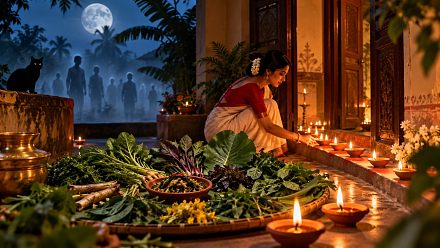
Forget Halloween! Bengal Has Its Own Night Of Ghosts, 14 Lamps And Mysterious Food Rituals
Forget pumpkin-carving parties, spooky costumes and trick-or-treating. And if Halloween has ever left you feeling like you missed out on all the spooky hocus-pocus, Bengal has a rather intriguing alternative. Meet Bhoot
लेखक Lifestyle Desk··17K पढ़े गए
Forget Halloween! Bengal Has Its Own Night Of Ghosts, 14 Lamps And Mysterious Food Rituals
Forget pumpkin-carving parties, spooky costumes and trick-or-treating. And if Halloween has ever left you feeling like you missed out on all the spooky hocus-pocus, Bengal has a rather intriguing alternative. Meet Bhoot Chaturdashi, a night when the boundary between the living and the dead is believed to grow a little thinner.
Observed on the fourteenth day of Krishna Paksha, the waning phase of the lunar fortnight, in the Bengali month of Kartik, just before Kali Puja, this occasion comes with its own share of ghostly folklore, ancestral spirits and mysterious food rituals. And no, the ghosts aren’t here for candy.
According to Bengali folklore, the spirits of fourteen generations of ancestors return to visit their old homes on this night. Families light fourteen earthen lamps to guide them through the darkness, prepare a rather unusual medley of fourteen leafy greens and make sure no corner of the house is left entirely in the shadows.
What Is Bhoot Chaturdashi? Meet Bengal’s Night Of The Spirits
The name itself sets the mood. Bhoot means ghost or spirit, while Chaturdashi refers to the fourteenth lunar day. Observed on the eve of Kali Puja, Bhoot Chaturdashi is steeped in the belief that the spirits of fourteen generations of ancestors, known collectively as Choddo Purush, return to the earthly world for a visit.
Think of it as an annual homecoming, except the guests are ancestors you may never have met. The tradition is rooted in the idea of remembering those who came before us, keeping their presence alive through rituals passed down generations. Some local beliefs also associate the night with wandering spirits and malevolent forces, making the lamps an important part of protecting the household.
There are other interpretations, too. In certain traditions, Goddess Kali, in her fierce form as Chamunda, is believed to protect devotees from evil spirits.
Choddo Prodip: Why Bengalis Light 14 Lamps On This Night
As dusk settles, Bengali homes prepare for Choddo Prodip, the lighting of fourteen earthen lamps. Traditionally, these small oil lamps are placed around the house, particularly near entrances, windows, staircases and darker corners.
The most familiar belief is that each lamp represents one of the fourteen generations of ancestors. Their gentle glow is meant to guide the departed souls back to their family homes, ensuring they do not lose their way in the darkness. The lamps are also believed to keep unwelcome spirits at bay.
Choddo Shaak: The Mysterious Bengali Ritual Of Eating 14 Greens
Here is where Bhoot Chaturdashi gets particularly interesting for food lovers. Alongside the lamps, Bengali households traditionally prepare Choddo Shaak, a medley of fourteen varieties of leafy greens eaten on this day.
This is no ordinary plate of saag. The traditional ingredients include a mix of seasonal and wild greens, with names such as ol, keu, beto, kalkasunda, neem, shorshe, shalincha, jayanti, gulancha, palta, ghentu, hinche, shushni and sheluka. The exact combination can vary across regions and families, and sourcing all fourteen varieties can be quite the seasonal treasure hunt.
The greens are washed, chopped and cooked together, often lightly stir-fried or prepared as a mixed shaak bhaja. The result is a distinctly earthy, slightly bitter preparation that is as much about tradition as it is about taste. Some families also preserve the water used to wash the greens and sprinkle it around the house, connecting the food ritual with the belief that returning ancestors should be welcomed and nourished.
The practice is often associated with protection from evil spirits and illness.
Why The Number 14 Matters: The Connection With Choddo Purush
The number fourteen appears everywhere on Bhoot Chaturdashi, and it is no coincidence. The fourteen lamps and fourteen greens are traditionally linked to Choddo Purush, or fourteen generations of ancestors. The number gives the evening its defining symbolism: remembering one’s lineage while protecting the home from whatever might be lurking outside it.
The custom also reflects a distinctly Bengali relationship with ancestry and memory.
From Folklore To The Kali Puja Night: What Happens Next?
Bhoot Chaturdashi sets the atmosphere for Kali Puja, one of Bengal’s most significant religious celebrations. The following night, devotees worship Goddess Kali, the fierce embodiment of Shakti, associated with the destruction of evil and the triumph of divine power.
Bhoot Chaturdashi may invite comparisons with Halloween, but it has a character entirely its own. There are no elaborate costume parties or buckets of candy. Instead, there are fourteen lamps glowing in the corners of a home, fourteen greens simmering in the kitchen and stories of ancestors returning for one night.
It is a festival where the supernatural meets the everyday, where a plate of leafy greens carries generations of tradition and a row of tiny flames becomes an act of remembrance. Bengal, it seems, has found a rather distinctive way to keep its ancestors close and its ghosts guessing.