Finding 'hidden sperm': New technique offers hope to men previously told they were infertile
A new AI-powered technology is locating sperm cells in men who were told they had none – and giving couples who have been trying for years another chance at having children.
लेखक Krupa Padhy··5K पढ़े गए
Finding 'hidden sperm': New technique offers hope to men previously told they were infertile
A new AI-powered technology is locating sperm cells in men who were told they had none – and giving couples who have been trying for years another chance at having children.
It was early November 2025 when Penelope received a call whilst driving home from work in New Jersey in the US. It was her doctor, phoning with news she had been longing for. After an agonising two and a half years of trying, Penelope was finally pregnant.
After many tests, Penelope and her husband Samuel had learned that he had Klinefelter syndrome, a genetic condition that affects males who are born with an extra X chromosome, often not diagnosed until adulthood. Most people with Klinefelter syndrome produce little or no sperm in their ejaculate, a condition known as azoospermia. About 10% of infertile men experience azoospermia.
Bursting with joy and disbelief, Penelope waited until Samuel (both their names have been changed to protect their identity for privacy reasons) returned home that evening to share the news.
"His face was just a wave of emotion," she says. "He cried… just to finally get to that point, because it took so much effort, time and research. And the fact that we only had one embryo, and it worked, we were just over the Moon."
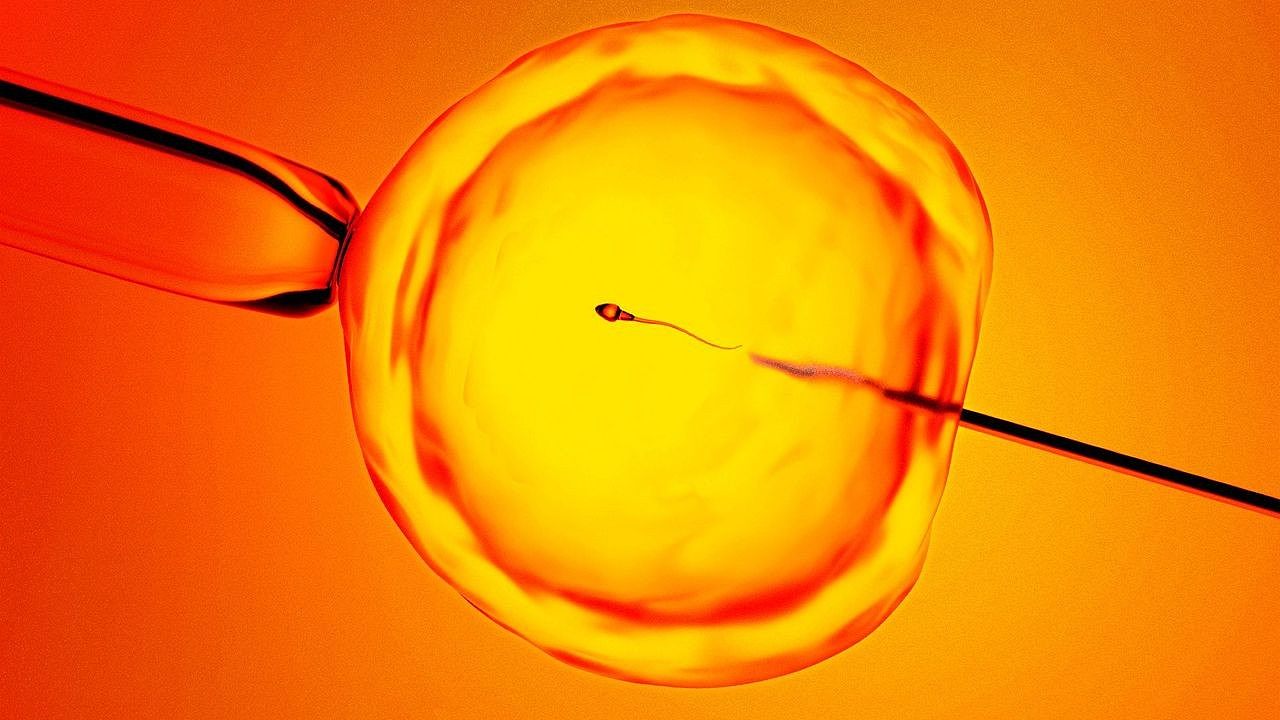
Their pregnancy was only made possible thanks to a new technique, known as the Star (Sperm Track and Recovery) system, developed by Columbia University to trace sperm in men with azoospermia. The system uses artificial intelligence to help identify and locate the few "hidden" sperm that men with this condition can have.
"I was scared. I thought that I wasn't going to be able to have my own kid, which is a really big part of my life," says Samuel, who was told he had a 20% chance of having a biological child. "And that was a big slap in the face."
Infertility affects millions of people worldwide, with around one in every six people of reproductive age experiencing problems with getting pregnant at least once in their lifetime. Male infertility is a contributing factor in up to 50% of cases and 1% of all men are azoospermic.
This means potentially millions of men worldwide have sperm counts so low that their individual spermatozoa are so hard to find that they are considered to be azoospermic. But the power of AI to find these hidden sperm could offer hope to those hoping to become parents.
At the end of last year, after five years in development, the first baby to be born using the Star system allowed a couple who had battled with infertility for almost two decades to finally have a child. It's a moment Zev Williams, director of Columbia University Fertility Center, and his team remember well.
"Everyone was just jumping up and down with joy," he says. "There are so few things where the reward for all the effort that was put into it is something as wonderful and special as this. Now there's a baby girl and hopefully, God willing, many, many more."
Since the arrival of the first Star baby, the technology has been used regularly at the fertility centre, with the waiting list of people hoping to conceive growing to hundreds from all around the world. Based on the latest 175 patients to have used the technology, Williams says they are finding sperm in just under 30% of cases. These are individuals who had otherwise been told that they had no chance of having a baby using their own sperm.
In further tests, Star was able to find 40 times more sperm than a manual search by a trained human technician, according to Williams.
Usually a semen sample has tens of millions of sperm per millilitre. A tiny droplet from a sample is examined under a microscope so sperm count can be estimated, while also looking for whether the sperm are moving and healthy. But in azoospermic samples, only a single sperm might be present in the entire sample – although in some cases there are none. Sifting through the sample, one tiny drop at a time, is impractical.
Modern telescopes produce an overwhelming amount of data of the night's sky that is impossibly time consuming for human astronomers to analyse for objects that haven't been seen before. But using machine learning algorithms can do this work in minutes.
"The picture of the sky was very reminiscent of what we're looking for, and what we see in men who are told they have no sperm," says Williams. He began to ponder whether it would be possible to apply such technologies to identify and isolate sperm in the same way.
He and his team were already using a high-powered imaging technology that could be used to scan the sample. The challenge was to analyse hundreds of images per second in real time to detect and extract any sperm that can be found.
Williams and his colleagues use microfluid chips – glass or polymer etched with a series of channels as thin as a human hair. The sperm sample then flows through and can be scanned by the imager.
A machine learning algorithm detects any sperm cells in the images in real-time so they can be isolated as gently as possible, ensuring they are not destroyed.
"As the sample is flowing through, we're imaging it at 300 images per second," says Williams. "Most of what we're seeing is just debris and fragments. It's not like it's an empty liquid. And you're trying to find that really rare sperm in a sea of all this other debris and cell fragments."
Williams says that the Star method has achieved a sensitivity rating of 100%, meaning it has the ability to find a single sperm in a sample if there is one present.
"It's just finding something where we couldn't see it before," he says.
Once identified, a robotic system then extracts the sperm cell or cells within milliseconds of their discovery. "The robotics on the microfluid chip sorts out that tiny little part of the fluid that has the sperm in it," says Williams. "You end up with a tube filled with the seminal fluid, but without any sperm in it, and a tiny droplet that has the sperm in it."
In Samuel's case, there was an added challenge and a first for the Star system – with Klinefelter, there's no sperm in the ejaculate, so to find sperm, urologists need to go in the testicle. Samuel underwent hormone therapy for nine months in preparation for a successful testicular extraction surgery at another fertility centre.
The sample was then sent to William's team at Columbia for investigation.
"The tissue from the surgery was transported to our andrology laboratory which then processed it to be able to run through the Star system," says Eric Forman, medical and laboratory director at Columbia University Fertility Center, who supervised the procedure.
At the same time, Penelope was having her egg retrieval procedure. A fresh sperm sample is usually provided on the same day, because it offers the best chance of fertilisation. They were running against time.
Star was able to isolate eight sperm in Samuel's sample, which were in turn injected into Penelope's eggs. One turned into a full blastocyst, a more developed stage of an embryo.
Their baby, likely to be the first boy born as a result of Star, is due at the end of July. It's a point they were never sure they'd reach.
"It's starting to feel really real now, especially because I'm feeling movement. We had our anatomy scan and everything is just looking so great," says Penelope.
In ovarian stimulation, for example – an essential process in IVF which helps the ovaries produce multiple eggs – machine learning is allowing for a more personalised dosage of the hormone gonadotropin to be calculated. Meanwhile, deep learning tools are assisting with more accurate and viable gamete and embryo selection.
But to assess long-term outcomes, experts agree that more large-scale clinical trials are needed, as well as clarity around how to handle sensitive medical data, confidentiality and disputes around accountability and ownership.
There are also concerns about the overpromise of a happy ending that can come with AI innovations.
"Couples who have long fertility journeys can become desperate to conceive and are vulnerable to being sold expensive treatments of unproven value," says Siobhan Quenby, professor of obstetrics at The University of Warwick in the UK.
"It is very exciting that advanced, imagining, engineering and AI have been combined to develop a new solution for severe male factor subfertility," she adds. "One successful pregnancy is an important start. However, further research on more patients is needed before the value of this new treatment can be fully assessed."
More like this:
For Samuel, however, the prospect that this AI-powered technique could help him and his wife grow their family again in the future is tantalising.
"Of course, now we're being greedy and we want another kid hopefully in the future, but this is something we're going to have to go through again because we don't have anything in reserve besides eggs," he says. But they also now have hope, he says, where there previously was none.
* This article was updated on 1 May 2026 as it incorrectly stated that Eric Forman worked at Cornell Medical Center This was corrected to Columbia University Fertility Centre.
--
For timely, trusted tech news from global correspondents to your inbox, sign up to the Tech Decoded newsletter, while The Essential List delivers a handpicked selection of features and insights twice a week.
For more science, technology, environment and health stories from the BBC, follow us on Facebook and Instagram.