Diwali Means More Than Lord Ram’s Return Home: The Different Legends Behind India’s Festival Of Lights
When you think of Diwali, the first significance that may come to mind is Lord Ram’s return to Ayodhya after 14 years of vanvaas. As the story goes, the people of Ayodhya lit earthen lamps to welcome Ram and Sita home, t
लेखक Lifestyle Desk··11K पढ़े गए
Diwali Means More Than Lord Ram’s Return Home: The Different Legends Behind India’s Festival Of Lights
When you think of Diwali, the first significance that may come to mind is Lord Ram’s return to Ayodhya after 14 years of vanvaas. As the story goes, the people of Ayodhya lit earthen lamps to welcome Ram and Sita home, turning light into a lasting symbol of the festival.
But the story did not remain confined to one telling. The Ramayana, originally written in Sanskrit, travelled across languages, regions and generations, with different retellings keeping its central story alive. Even Mughal emperor Akbar had the epic translated into Persian, while paintings from the period depicted the lamps that were said to have guided Rama and Sita home.
Across India the same moonless night in Kartik carries different memories, different deities and different histories, yet the underlying movement remains constant — a deliberate turning toward light.
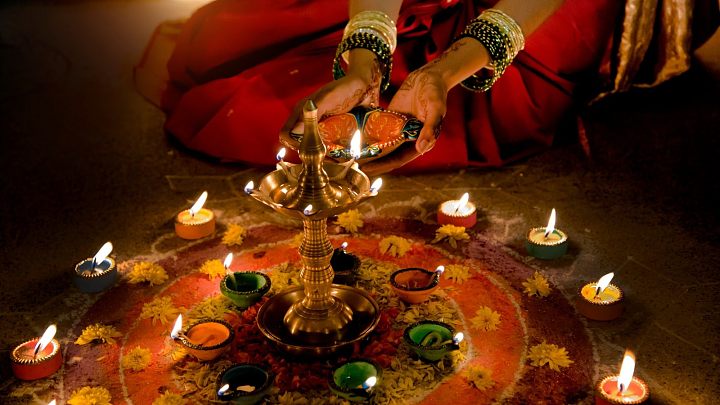
Before glitter and colourful powders took over, rangoli was often made with rice flour.
The Story Of Lord Ram’s Return
One of the most widely known Diwali traditions comes from the Ramayana. The festival is associated with Lord Rama returning to Ayodhya after 14 years of exile, following the defeat of Ravana and the rescue of Sita. According to tradition, people lit earthen lamps to welcome the returning royal family, giving Diwali its enduring association with light overcoming darkness.
The Ramayana itself travelled across languages and cultures, being translated, retold and performed in different parts of India and beyond. Over centuries, these versions have given the festival a rich cultural vocabulary that extends well beyond a single narrative.
Worshipping Goddess Lakshmi And Lord Ganesha For Prosperity
In many parts of North India, Diwali is closely associated with Lakshmi Puja. According to Hindu tradition, Goddess Lakshmi emerged during the Samudra Manthan, or churning of the cosmic ocean, and her appearance is linked to the Kartik Amavasya.
Lord Ganesha is worshipped alongside Lakshmi, with devotees seeking prosperity as well as wisdom and auspicious beginnings. For many households, the evening therefore centres on prayers, diyas and the hope of a prosperous year ahead.
The Mahabharata Connection
Another tradition connects the festival with the Pandavas. After years of hardship and exile, the five brothers are believed to have returned to their kingdom on the night of Kartik Amavasya, with lamps lit to welcome them.
Diwali also carries the broader teachings of the Mahabharata, particularly the emphasis on dharma, righteousness and making ethical choices even when circumstances are difficult.
Diwali In Jainism
For Jains, Diwali marks a profoundly spiritual event: the nirvana of Lord Mahavira, the 24th Tirthankara. Jain tradition refers to the festival as Dipalika or Dipalikaya, associated with the light of spiritual liberation.
Devotees observe prayers, fasting and recitations, particularly around Mahavira’s final teachings. The day after Diwali also marks the beginning of the Jain New Year, adding another layer of renewal to the festival.
Bandi Chhorh Diwas And The Sikh Tradition
Sikhs remember the same date as Bandi Chhor Divas, the Day of Liberation. Guru Hargobind Sahib secured the release of 52 fellow prisoners by fashioning a cloak with 52 tassels so each man could hold on and walk free. The lamps that greeted their return to Amritsar still burn as a reminder that freedom, once claimed, is shared.
According to Sikh tradition, the Guru refused to leave unless the other prisoners were freed as well. His release and the liberation of the others came to symbolise freedom, compassion and standing up for others.
Kali Puja In Bengal
In Bengal the new-moon night belongs to Kali. The practice of Dipannita Kali Puja grew from a 16th-century vision and spread widely in the 19th century under the influence of Sri Ramakrishna. While the rest of the country lights lamps for prosperity or homecoming, Bengali households honour the fierce form of the goddess who destroys ignorance and ego in the deepest dark.
The tradition grew significantly in Bengal over the centuries and became one of the community’s major annual religious celebrations. Devotees gather at night to offer prayers to Kali, whose fierce form is associated with the destruction of evil and ignorance.
So, is Diwali one festival or many? In India, it can be both. The stories differ, the rituals change and the deities may not be the same. Yet the symbolism of moving from darkness towards light continues to connect these traditions, giving Diwali a meaning that is as diverse as the country celebrating it.
Disclaimer: The stories and traditions featured in this article are drawn from popular beliefs, religious texts and folklore. They are presented for informational purposes and with respect for the diverse beliefs and sentiments of different communities.