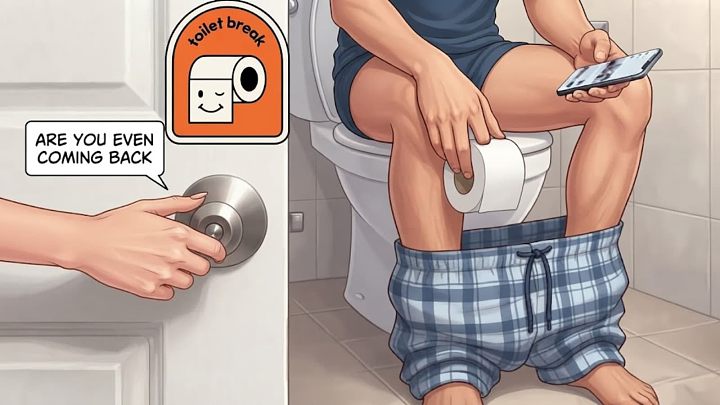
Could Men Be ‘Weaponising Pooping’ To Dodge Responsibilities?
There are few things in a relationship more frustrating than feeling like you are doing the work of two people while your partner somehow keeps finding pockets of uninterrupted time for themselves.
लेखक Tanya Dutt··23K पढ़े गए
Could Men Be ‘Weaponising Pooping’ To Dodge Responsibilities?
There are few things in a relationship more frustrating than feeling like you are doing the work of two people while your partner somehow keeps finding pockets of uninterrupted time for themselves.
It could be the five minutes you get to eat breakfast only after everyone else is sorted, the shower that is constantly interrupted, or the mysterious hour that disappears behind a bathroom door just when dinner needs making or the children need attention.
A friend was recently venting about exactly this. Her husband had come home late from work and, understandably, wanted some time to himself. He went into the bathroom to freshen up. Nothing unusual about that. Except he stayed there for nearly an hour and a half.
When he finally came out, the first thing he asked was, “What’s for dinner?”. In those 90 minutes, she had cooked, cleaned up and dealt with the rest of the evening. He had managed to switch off completely, while she remained on duty.
She initially let it go. He had been late back from work, after all. Then the next morning, something similar happened.
Before leaving for work, he handed her his clothes to iron and announced that he was going to the bathroom to freshen up. While she was getting herself and the house ready for the day, he disappeared behind that same closed door.
That is when a seemingly harmless bathroom break starts looking a little different. Is someone simply taking their time, or has the bathroom quietly become the one place where household responsibilities can be put on pause?
Divorce expert and author Olivia Howell recently put a name to this exact habit, “weaponized pooping.” In a Substack essay published on 18 September (that quickly spread across the internet), Howell argued that some men are using the bathroom as a strategic escape hatch from family responsibilities.
The logic is simple and almost brilliant. You can interrupt someone watching TV, scrolling on the couch, or working out in the garage. But the moment someone says “I need to use the bathroom,” most people freeze. No one wants to knock and demand proof. The closed door becomes sacred territory.
What Does ‘Weaponised Pooping’ Mean?
This is where the conversation needs some nuance. Sometimes a person genuinely needs more time in the bathroom. Digestive problems, constipation or simply wanting a few quiet minutes after a long day are not automatically signs of avoidance. One report discussing the trend also noted that bowel habits can vary and that prolonged toilet time should not automatically be treated as evidence of a relationship problem.
The bigger issue is what happens around the bathroom break. Say one partner is putting the child to bed, loading the dishwasher and packing lunch for the next morning while the other suddenly says, I need to go.
Now imagine that happens every evening. The problem is not really the toilet. It is the unequal distribution of time, responsibility and availability.
Is the Bathroom Becoming a Relationship Escape Hatch?
That is what makes this trend strangely relatable. In many homes, especially where one person is already carrying the mental load, uninterrupted time is a luxury. You may finally sit down for ten minutes and someone needs something. You may start cooking and remember the grocery order. You may be halfway through a shower and hear, where is my shirt?
So when one partner can simply close a door and become unavailable without anyone questioning it, resentment can build.
Howell has described the bathroom as a particularly useful escape because challenging someone who says they need to use the toilet can feel unreasonable. Online reactions to her argument have been divided, with some people seeing the behaviour as avoidance and others arguing that everyone deserves a little uninterrupted alone time.
What used to be a five-minute biological necessity can stretch into twenty, thirty, even forty-five minutes of Reddit, YouTube, sports scores, or random videos about pressure-washing driveways. Meanwhile the partner outside has fed the kids, wiped the counters, and started the next load of laundry.
One mother on Reddit described her husband on paternity leave with newborn twins. Every time it was his turn for a diaper change or bottle, he suddenly needed the bathroom, always with his phone. Another woman said she eventually divorced her partner partly because the long bathroom sessions with the phone became a pattern she could no longer ignore.
Online reactions have been predictably split. Some men pushed back hard, arguing that a few minutes of peace is not a crime and that women are over-policing basic bodily functions. Others, including many women, recognised the pattern immediately and shared their own stories of waiting outside closed doors while the mental load of the house continued to pile up on their shoulders.
There’s even a health angle. A recent study found that people who regularly use their phones on the toilet have a significantly higher risk of hemorrhoids, largely because they sit far longer than necessary. Gastroenterologists now advise leaving the phone outside when nature calls.
So where does that leave couples? The bathroom should remain a private space. No one should feel monitored or timed. At the same time, relationships work better when both people notice the invisible labour happening outside that door. If one partner is consistently using “I need to go” as a reliable exit from shared duties, it’s worth a calm conversation rather than silent resentment.
Next time someone in your house disappears with their phone and reappears asking what’s for dinner, you might smile and remember Howell’s phrase. Sometimes a long bathroom break is just a long bathroom break. Sometimes it’s something else entirely. The difference usually shows up in the pattern and in who is still standing in the kitchen when the door finally opens.