Are We Slowly Forgetting India’s Traditional Wedding Songs?
Rows of yellow and orange marigold flowers adorn an intimate haldi ceremony. Giggles and laughter fill the air. A blushing bride is surrounded by her loved ones, each competing with the other to apply a little haldi on h
लेखक Priyanka Das··15K पढ़े गए
Are We Slowly Forgetting India’s Traditional Wedding Songs?
Rows of yellow and orange marigold flowers adorn an intimate haldi ceremony. Giggles and laughter fill the air. A blushing bride is surrounded by her loved ones, each competing with the other to apply a little haldi on her. In the background, a DJ plays a string of Bollywood haldi specials – Sasural Genda Phool, Navrai Majhi, Gal Mitthi Mitthi, and the likes.
Sitting at a distance is the bride’s grandmother, beaming with happiness as her favourite grandchild prepares to step into a new phase of life. Her mind drifts to another day, just a few decades ago. The memories evoke a similar warmth, but something is amiss.
She remembers a huddle of women crooning delightfully witty lyrics to the beats of a dholki, stealing naughty glances at one another as they sing. The 80-year-old chuckles at the memory, then grows pensive. Will she be among the last generation to witness the tradition of singing wedding geet?
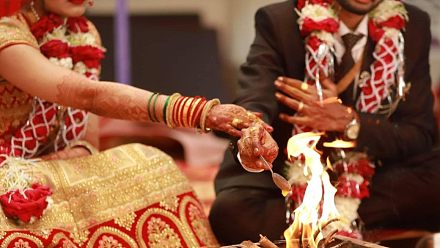
There was a time when an Indian wedding did not simply have music; it had a musical vocabulary of its own. While some songs blessed the couple, others teased the groom’s family. Some mourned the bride’s departure, while others gave women a rare opportunity to joke about marriage, in-laws, sexuality and social expectations. In most communities, these songs survived without written scores. They travelled from grandmother to granddaughter, mother to daughter, and neighbour to neighbour. What happens when the people who remember them become the last generation to pass them on?
Photo: Screengrab of the song, Sasural Genda Phool from Delhi-6
Indian wedding songs have never been mere background music. They are woven into the rituals themselves. They are playful, teasing, irreverent and, at times, deliberately provocative.
Main Toh Karoongi Apni Hi Manmani
Saas Kahegi Paas Toh Aao, Aake Mere Pair Dabaa
Main Kahoongi Chal Budhiya
Main Toh Nahi Teri Naukrani
Main Toh Karoongi Apni Hi Manmaani
(I’ll do what I feel like, Mother in-law will ask me to press her legs, I’ll tell her to go away, I am not your servant, I’ll do what I feel like)
This is a popular wedding song associated with the Mirasins of Awadh, a community traditionally involved in singing at weddings, births and other life-cycle rituals. Once an integral part of weddings in northern India, the tradition of Mirasin singing is now at risk of disappearing.
Gari geet, popular in Bihar and eastern Uttar Pradesh, are traditionally sung by women from the bride’s family while welcoming the groom’s side. A perfect way to break the ice, the songs use humour, satire and, at times, offensive language to comment on men, marriage and social norms.
In Rajasthan too, music is deeply woven into the wedding calendar. Banna banni geet are traditionally sung during different wedding rituals. The lyrics, as you may have guessed by now, playfully tease the bride and groom, describe their attire, express the bride’s longing for her groom, or offer advice and blessings for their new life together.
Moving eastwards, Bengali weddings are known for high-octave ululation and the blowing of conch shells. But the community also has a rich repertoire of folk songs known as biyer gaan, traditionally sung during various pre-wedding and wedding rituals. The songs express hopes, emotions and frustrations, and can even address issues such as dowry and social discrimination through humour.
Photo: Sumita Roy Dutta/Wikimedia Commons
Biya naam are an indispensable part of traditional Assamese weddings. Blending mythological narratives with human emotions, these songs evoke the bittersweet experience of a bride leaving her parental home, while also making room for playful exchanges between the bride’s and groom’s families.
Further north in Kashmir, wanvun (which means chorus) is traditionally sung by women at different stages of a wedding. Performed to a steady rhythm, these songs use alliteration, metaphors, and similes to tell stories through the lyrics.
In Uttarakhand, mangal geet draw inspiration from the divine marriage of Lord Shiva and Parvati. Sung by women from both the bride’s and groom’s families, these songs form an important part of wedding celebrations.
In Kerala, the Knanaya Christian community has a tradition of kalyanappattukal, or folk weddings songs that recount the community’s history, migration and biblical heritage.
Punjabi wedding songs, meanwhile, evoke nostalgia and invite playful banter. Suhaag songs are often melancholic and emotional, sung by women on the bride’s side as they reflect on her childhood and impending departure from her parental home. Ghorhian, on the other hand, are upbeat folk songs associated with the groom’s side, often sung as he prepares to mount his mare before heading to the wedding venue.
To put it succinctly, every corner of India has its own expansive repertoire of wedding songs, traditionally passed down by women from one generation to the next. It would not be an exaggeration to say that these songs have provided one of the few socially accepted spaces in which women could mock the groom, complain about their in-laws, or joke about marriage.
So, why are the songs disappearing?
Traditional wedding singing has increasingly been replaced by DJs and choreographed Bollywood-style performances across the country.
Photo: Instagram/@neelam.od
The extended networks of grandmothers, aunts and neighbours that once kept these traditions alive have gradually shrunk. Many songs survived because women sat together for hours while preparing food, grinding grain or applying mehndi. These gatherings were not merely social occasions; they were spaces where songs were learnt, remembered and passed on.
UNESCO has also highlighted how urbanisation, migration and mechanisation can disrupt the everyday contexts in which women’s oral traditions were once transmitted. As lifestyles change and families become more dispersed, opportunities to learn these songs from older generations are becoming fewer.
The disappearance of India’s wedding songs will not happen dramatically. There may be no final performance, no last dholak beat, no announcement that a centuries-old tradition has ended.
It may happen quietly.
An elderly woman will remember a song her mother taught her. She will sing it once at a family wedding. Her daughter will record it on her phone. Her granddaughter will save the video. And then the wedding will move on — to the DJ, the choreography and the familiar Bollywood cacophony.
But for generations, these songs did more than fill the silence between rituals. They carried memories of homes, daughters, mothers, marriages and departures. They allowed women to bless, tease, complain, mourn and laugh, often in words that belonged only to them.
Perhaps saving India’s wedding songs does not mean bringing the past back. It simply means making sure that when the last woman who remembers a song begins to sing, somebody is still listening.