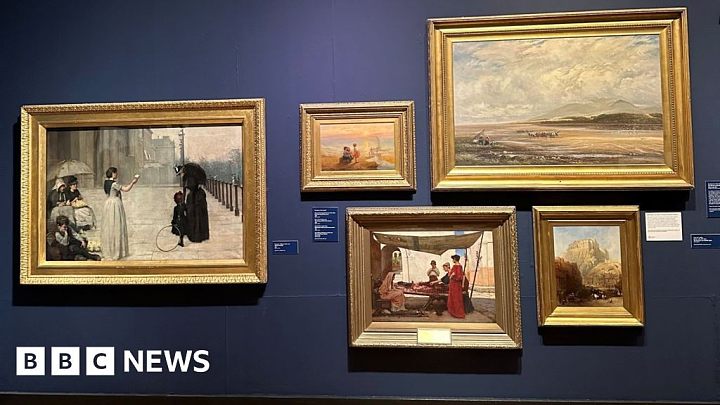
Why is so little council-owned art out on display?
The majority of artworks owned by North East councils are not being displayed, with some authorities in the region exhibiting less than 10% of their collections, figures have revealed.
Ni Pamela Bilalova··44K nabasa
Why is so little council-owned art out on display?
The majority of artworks owned by North East councils are not being displayed, with some authorities in the region exhibiting less than 10% of their collections, figures have revealed.
According to data obtained by the BBC through a freedom of information request, only 3% of the art owned by Newcastle City Council is currently on display, with South Tyneside and Redcar and Cleveland showing 8% each.
In Sunderland 11% is displayed and Durham is showing 12% of its collection. About 15% is on show in Stockton. North Tyneside and Gateshead are the only local authorities to show nearly half of their collections, at 45% and 47% respectively.
Why is so much art kept in storage?
Experts say the figures are far from unusual, with factors including available space and conservation requirements playing a part in how much can be shown.
Don O'Meara, president of the Society of Antiquaries of Newcastle upon Tyne, said some of the materials might be too delicate to display.
"I think the image that pops into people's minds is the scene at the end of Raiders of the Lost Ark where you have this vast store and you've got the man pushing the boxed up item to disappear into this vast archive, but actually a lot of these items would be quite small," he said.
Curator Niall Hodson said it would be "physically impossible" to exhibit everything at once, with most museums and galleries, including in Sunderland, having a "large number" of artworks on paper or textiles.
They would "gradually fade" if they were exposed to light full time, he said, adding: "You need to have objects like that rotated carefully on display for maybe a few months every few years.
"Otherwise they they won't exist in 10, 20 or 50 years time."
The former Sunderland Lib Dem councillor added: "The job will always be one of making sure it's rotated and seen by appointment, not one of getting it all out on display at once."
North East Museums Newcastle, which manages museums and galleries in the city on behalf of the council, said displays were changed regularly and the permanent collection was rotated.
Artworks in storage were also used for educational and research purposes and many could be viewed online, they added.
O'Meara said rotating the items was not as straightforward as it might look.
Insurance, fire risk, light levels, floor vibrations, security and the mobility of objects all had to be considered, he said.
"It would be fantastic if work could be rotated and seen as widely as possible, but I would really emphasise that simply moving an object does come with a cost," he said.
Hodson said at present Sunderland did not have capacity to show more artworks until extra museum and gallery space was created.
"Having 11% of the collection on display is probably higher than most public galleries manage," he said, adding: "Usually, it's in single figures.
"It's a good number for Sunderland and actually for any council to have that sort of percentage of artwork on display."
Sunderland's cabinet member for culture, tourism and heritage Ciera Hudspith said the current redevelopment of the city's Museum and Winter Gardens was also a chance to increase access to collections and "involve more people in interpreting Sunderland's heritage".
New galleries will be created as part of the refurbishment, which Hudspith said would allow more of the city's collections to be shown.
"Like many museums and galleries, only a proportion of our collections can ever be displayed at any one time due to the space available, conservation requirements and the need to ensure exhibits are presented in the best possible way," she said.
Hodson said public art collections were "more accessible than people think" and many artworks could be seen online or by appointment.
"That's actually probably how most things that people really want to see will get seen," he said.
O'Meara said it would be "great" to get more art out in the community and look at ways it could be displayed "not always in a gallery", for example digitally or through converting empty shops into temporary exhibition spots.
"Access isn't just about being on permanent public display," he said, adding he would urge people to join societies and attend archive open events to "see what's on in their local museum and just appreciate it is for everybody.