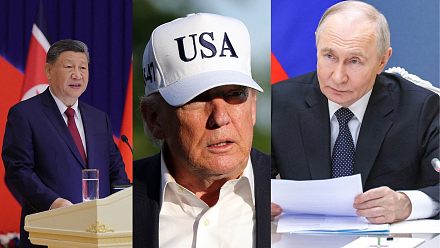
Trump, Xi And Putin To Hold First-Ever Trilateral Summit Next Week: Why The Meeting Matters And What To Expect
US President Donald Trump, Chinese President Xi Jinping and Russian President Vladimir Putin are set to hold an unprecedented three-way meeting on the sidelines of next week’s Asia-Pacific Economic Cooperation (APEC) sum
Ni Shuddhanta Patra··72K nabasa
Trump, Xi And Putin To Hold First-Ever Trilateral Summit Next Week: Why The Meeting Matters And What To Expect
US President Donald Trump, Chinese President Xi Jinping and Russian President Vladimir Putin are set to hold an unprecedented three-way meeting on the sidelines of next week’s Asia-Pacific Economic Cooperation (APEC) summit in Shenzhen, China. The talks, scheduled for Thursday, will bring together the leaders of the world’s three biggest nuclear powers at a time of tensions over the Iran war, the Russia-Ukraine conflict and global trade.
The White House confirmed the plans for the trilateral summit on Friday. While the meeting is being seen as a significant diplomatic moment, geopolitical experts have cautioned against expecting major breakthroughs, saying it could carry more symbolic importance than deliver concrete outcomes.
Trump has said the meeting will provide an opportunity to discuss the US war with Iran and his proposal for a three-way agreement on nuclear weapons stockpiles. However, a senior US official, as quoted by Associated Press, said Trump would discuss Iran with Xi and Putin but avoid raising Ukraine.
Nuclear Disarmament On The Agenda
One of the key issues expected to come up is nuclear disarmament. The last nuclear arms agreement between Washington and Moscow, known as New START, expired in February, ending restrictions on the two countries’ nuclear arsenals for the first time in more than half a century.
Trump had rejected Russia’s proposal to extend the agreement by another year, instead calling for a “new, improved and modernised” arrangement that would also include China.
The US official said the meeting would mark the “beginning of hopefully a conversation” on nuclear disarmament, adding that no agreement was expected to be announced.
However, China has shown little interest in joining such an arrangement. According to Pentagon estimates, Beijing has more than 600 nuclear warheads, compared with over 5,000 each in the US and Russia. The difference in the size of the arsenals remains a major obstacle to bringing China into a nuclear arms agreement.
Why The Summit Matters To China And Russia
The three-way meeting comes at a complicated time for relations between the countries. Trump has sought to strengthen ties with Xi following a truce in their trade dispute last year, despite differences over the Iran war and other issues.
He has also attempted to build a relationship with Putin, even as Russia continues its nearly five-year-old war in Ukraine and deepens its military, intelligence and diplomatic partnership with Iran.
For Xi, hosting the meeting could offer an opportunity to showcase China’s growing international influence. For Putin, it provides a chance to project Russia as a global power on an equal footing with Washington and Beijing.
Edgard Kagan, a former US ambassador to Malaysia who is now with the Center for Strategic and International Studies, said Putin wanted to signal his willingness to discuss major decisions with Trump and Xi, including those concerning Ukraine. Such an approach, he said, was unlikely to please Kyiv and European countries.
Ukraine And Trade Could Cast A Shadow
Ukrainian President Volodymyr Zelenskyy has expressed concern that the three leaders could discuss a possible settlement of the Ukraine war without Kyiv’s participation.
The meeting could also overshadow the APEC summit, which will bring together 21 economies in Shenzhen. The event is an opportunity for China to showcase the city, which has developed from a small fishing village into a major technology and economic centre.
Hoo Tiang Boon, a professor of Chinese foreign policy at Nanyang Technological University, as quoted by AP, said the trilateral meeting could undermine China’s efforts to present itself as a supporter of free trade and multilateralism.
The three leaders have met separately several times. Xi and Putin have met more than 40 times since 2013, while Trump and Putin have met seven times. Trump and Xi have held face-to-face talks on eight occasions, including Xi’s September state visit to Washington.
China is Russia’s largest trading partner and has increased its purchases of Russian energy resources since Moscow launched its war against Ukraine in 2022. It has also become a key supplier of technology components to Russian industries, despite Western demands to stop such supplies. Beijing has maintained that it is neutral in the conflict, while Moscow has repeatedly supported China’s position on Taiwan.
The proposed summit has drawn comparisons with the 1945 Yalta Conference, where the US, Britain and the Soviet Union discussed post-war arrangements. However, Kremlin spokesperson Dmitry Peskov rejected the comparison, saying any agreements reached in Shenzhen could not be imposed on other countries.
“It’s clear that a meeting between the leaders of countries such as Russia, China and the United States is extremely significant,” Peskov said, adding that a global order should be based on mutual benefit and mutual respect.