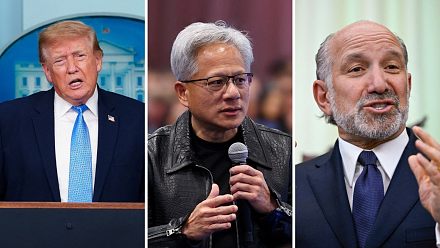
Trump Approved Crackdown On Nvidia Chip Diversions To China 3 Times. Who's The Roadblock? Howard Lutnick
United States President Donald Trump has reportedly given the go-ahead on three separate occasions this year to crack down on companies suspected of diverting advanced Nvidia artificial intelligence (AI) chips to China.
Ni Prisha Vibhavari··36K nabasa
Trump Approved Crackdown On Nvidia Chip Diversions To China 3 Times. Who's The Roadblock? Howard Lutnick
United States President Donald Trump has reportedly given the go-ahead on three separate occasions this year to crack down on companies suspected of diverting advanced Nvidia artificial intelligence (AI) chips to China.
However, the proposed action has repeatedly run into resistance from Commerce Secretary Howard Lutnick, according to an Axios report.
The latest approval came last Thursday, November 5, when Trump authorised measures against suspected chip diversion after consulting billionaire entrepreneur Elon Musk.
But despite the President’s clearance, the restrictions have yet to be implemented, with Lutnick reportedly continuing to delay the process.
The standoff has exposed differences within the Trump administration over how aggressively Washington should restrict China’s access to advanced American semiconductor technology.
Lutnick oversees the Commerce Department, which is responsible for implementing export controls.
Also Read: Jensen Huang’s Exit Looms As Nvidia Board Weighs Ouster Over Affair, China Spy Row: Report
The Axios report, based on interviews with six senior sources familiar with the discussions, also places the dispute against the backdrop of the growing controversy surrounding Nvidia CEO Jensen Huang and his reported relationship with Alice Huang, a Singapore-based executive suspected by US intelligence of having links to Chinese intelligence.
Confrontation Inside White House?
The latest confrontation reportedly unfolded during a meeting in the White House Situation Room on November 5.
Those present included Treasury Secretary Scott Bessent, Defence Secretary Pete Hegseth, US Trade Representative Jamieson Greer, National Security Adviser and Secretary of State Marco Rubio, and Lutnick.
During the discussion, Bessent questioned why the Commerce Department had not acted on proposals to tighten restrictions on companies suspected of routing Nvidia chips to China, particularly Singapore-based Megaspeed, which has emerged at the centre of the controversy.
According to sources cited by Axios, the other officials supported Bessent’s position. Lutnick appeared to accept the argument but indicated that he would need presidential clearance, saying, “I need to check with the president.”
His response reportedly frustrated officials who believed that the Commerce Department had already been instructed to move ahead with the restrictions on previous occasions.
One administration official described Lutnick’s conduct by saying, “He’s stalling it out,” alleging that the Commerce secretary had privately approached Trump earlier to persuade him to reconsider the proposed export restrictions.
Another official described the issue as “an ongoing concern with Howard and this issue”, Axios reported.
When Lutnick again suggested consulting Trump, one participant challenged him, saying: “Great. Why don’t we do it today?”
Trump Consults Musk, Says ‘Let’s Get It Done’
The officials subsequently moved to the Oval Office at around 5 pm to seek a final decision from Trump.
The President reportedly called Musk, his technology adviser, during the discussion. Musk backed the position advanced by Rubio, Bessent, Greer and Hegseth in favour of imposing restrictions on suspected chip diversion.
Lutnick, however, warned that such a move “will start a trade war with China.”
The other officials countered his argument, maintaining that Beijing was already taking steps against American interests.
“Everyone argued back that China is already doing to us what Lutnick warned would happen,” one source told Axios.
Trump ultimately backed the proposed action, declaring, “Let’s get it done.”
However, the disagreement reportedly continued even after the meeting. Once officials had left the Oval Office, Lutnick suggested that he would prepare a set of options for the President to consider.
“I’ll develop some options and come back,” he said.
The response drew an immediate pushback from other officials, who believed the decision had already been taken.
Also Read: Another Affair Allegation Rocks Nvidia CEO Jensen Huang, This Time With Company VP
“Everyone was like: ‘No, no, the decision’s been made. Go fucking execute,’” one source said, adding, “Well, it still hasn’t happened.”
Trump’s Three Approvals, Commerce Department’s Resistance
The latest episode was reportedly not the first time Trump had authorised action against companies suspected of diverting Nvidia chips to China.
According to Axios, the President had approved similar measures in May, August and again on November 5.
However, Lutnick and Commerce Undersecretary Jeffrey Kessler allegedly resisted efforts by Bessent and other administration officials to put the restrictions into effect.
The concerns had gained urgency in May, when a classified intelligence assessment concerning Jensen Huang’s relationship with Alice Huang was circulated among senior US officials, including Trump.
Alice Huang, who is not related to the Nvidia CEO, was identified by US intelligence as a suspected Chinese intelligence asset. She is associated with Megaspeed, a Singapore-based data centre company that has come under scrutiny over suspected diversion of American AI chips to Chinese entities.
Following the circulation of the intelligence assessment, Bessent, Director of National Intelligence Jay Clayton, Hegseth and other White House officials reportedly pressed Lutnick and Kessler to take action.
One source described their response, saying, “and they were refusing.”
The Commerce Department’s handling of the matter has also drawn scrutiny because it is the agency responsible for enforcing US technology export restrictions.
Why Is The Nvidia Chip Row Important?
The dispute comes against the backdrop of the Trump administration’s decision last year to ease restrictions on Nvidia’s H200 AI chips for the Chinese market.
The H200 processors are older than Nvidia’s latest offerings but remain powerful AI computing chips. The administration agreed to permit their sale to China in exchange for a 25% tariff.
Nvidia has strongly pushed for access to the Chinese market, with CEO Jensen Huang arguing that allowing American companies to sell less advanced chips could help preserve US technological influence.
His argument has been that restricting supplies entirely could encourage China to accelerate the development of domestic alternatives, whereas continued access to American technology could keep Chinese companies dependent on US suppliers.
However, the suspected diversion of advanced Nvidia processors to China has raised concerns about whether existing export controls are sufficient to prevent sensitive American technology from reaching Chinese entities.
The controversy has intensified following revelations about Huang’s relationship with Alice Huang and the intelligence concerns surrounding Megaspeed.