Namaste, Kerkar’s Bhairavi To Taj Mahal, Traffic: What India Told Aliens Through NASA's Voyager Golden Record
Voyager 1, NASA’s celebrated deep-space probe, has reached one light-day from Earth — a historic milestone that no other human-made object has achieved.
Ni Manjiri Joshi··88K nabasa
Namaste, Kerkar’s Bhairavi To Taj Mahal, Traffic: What India Told Aliens Through NASA's Voyager Golden Record
Voyager 1, NASA’s celebrated deep-space probe, has reached one light-day from Earth — a historic milestone that no other human-made object has achieved.
Do you know that India had sent greetings in 10 Indian languages alongside a classical vocal performance aboard NASA’s Voyager Golden Record in 1977? As Voyager 1 reaches one light-day from Earth, these cultural recordings continue traveling deeper into interstellar space as a permanent time capsule of humanity.
VOYAGER 1
Since it lifted off in September 1977, Voyager 1 has racked up an impressive list of achievements. The probe and its twin spacecraft, Voyager 2, which launched a month later, were originally built to last just five years and explore Jupiter and Saturn. Both have extended their missions nearly 10 times longer than expected.
One light-day is the distance at which a radio signal, moving at the speed of light, takes 24 hours to reach the spacecraft. That’s equivalent to roughly 16 billion miles (26 billion kilometers), making Voyager 1 the farthest human-made object — a title it has held since 1998, when it surpassed another NASA probe called Pioneer 10.
“It’s never happened before, and it may never happen again — it’s that kind of extraordinary,” said Kareem Badaruddin, Voyager mission manager at NASA’s Jet Propulsion Laboratory in Pasadena, California.
“That they are still operating in a scientifically useful way after 49 years is a testament to the dedication and talent of those who designed and built them and those that continue to operate them,” said William Kurth, a research scientist at the University of Iowa who started working on Voyager as a graduate student in 1974. He now leads the Voyager Plasma Wave Science investigation.
The Voyager probes are currently studying interstellar space, having left the heliosphere — a vast protective bubble generated by the sun’s magnetic field — in 2012 and 2018, respectively.
NASA’s Voyager 1 has reached one light-day from Earth (Image: NASA)
WHAT IS VOYAGER GOLDEN RECORD?
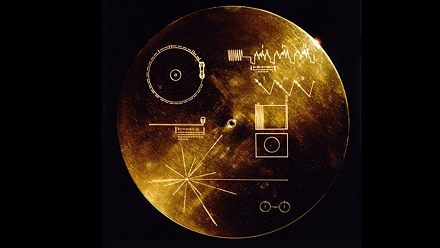
The Voyager Golden Record is a 12-inch gold-plated copper phonograph disc launched aboard NASA’s Voyager 1 and Voyager 2 spacecraft in 1977. Designed by a committee led by astronomer Carl Sagan, it acts as an interstellar time capsule built to survive over a billion years and introduce human civilization to any extraterrestrial life that might find it.
The disc is made of copper plated with nickel and gold to prevent corrosion in deep space. It is housed inside a protective aluminum jacket along with a cartridge and needle for playback.
The aluminum cover is etched with symbolic diagrams showing how to play the audio at 16⅔ revolutions per minute and how to decode its analog signals into pictures. It uses the fundamental transition rate of a hydrogen atom as a universal clock.
A pulsar map on the cover pinpoints our Sun’s exact location in the Milky Way. An ultra-pure sample of uranium-238 electroplated onto the cover allows finders to calculate when the probe launched based on radioactive decay.
The disc holds 115 analog-encoded images, 90 minutes of diverse global music, natural Earth sounds (such as thunder, whales, and human heartbeats), and spoken greetings in 55 languages.
The @NASAVoyager golden record contains sounds and greetings from humanity. Listen to them here: https://t.co/TuNrYHroaK #Voyager40 https://t.co/63GspvJPZx
— NASA (@NASA) September 6, 2017
SPOKEN GREETINGS IN 10 INDIAN LANGUAGES
Astronomer Carl Sagan and Linda Salzman Sagan assembled greetings in 55 languages for the twin Voyager probes. Varanasi-born physicist Dr. Bishun Khare coordinated the recordings for the Indian subcontinent at Cornell University. Most Indian messages open with the traditional salutation “Namaste”. The Golden Record features spoken greetings across 10 Indian languages, including Hindi, Telugu, Bengali, Gujarati, Kannada, Marathi, Odia, Punjabi, Rajasthani, and Urdu, alongside messages in Nepali and Sinhalese.
In addition to the well-known sounds on my Golden Record, images like these were included as a beacon of humanity to those I might encounter on my journey.
I carry this message into the cosmos thanks to astronomy pioneers like Dr. Frank Drake (1930-2022). https://t.co/zeHwD8k5AC
— ARCHIVED – NASA Voyager (@NASAVoyager) September 3, 2022
INDIA’S MUSICAL CONTRIBUTION
The lone Indian selection among the 27 global musical tracks is “Jaat Kahan Ho,” a Hindustani classical piece in Raga Bhairavi. It features renowned Jaipur-Atrauli gharana vocalist Surshri Kesarbai Kerkar, chosen based on ethnomusicologist Robert E. Brown’s recommendation.
THE INDIAN PHOTOGRAPHS ON THE DISC
The Taj Mahal: Included as a masterpiece of human architecture, the NASA Golden Record image archive features the Taj Mahal specifically because Emperor Shah Jahan built it out of love for his wife Mumtaz Mahal rather than as a religious or military monument.
Rush Hour Traffic in India: Another photograph captures bustling rush-hour street traffic in India, chosen alongside scenes from Pakistan, Oxford, and Boston to show how humans gather, commute, and live in dense urban environments.