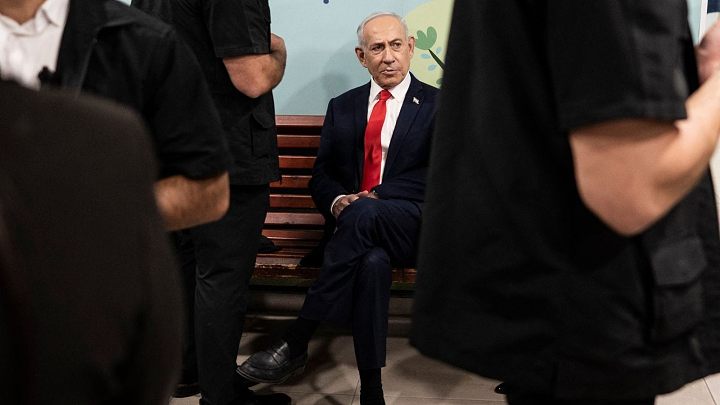
Is Netanyahu's Election Setback A Political Lifeline? Why A Hung Parliament May Work In His Favour
Benjamin Netanyahu may have failed to secure a parliamentary majority, but that does not mean he is on his way out. As Israel faces another round of coalition uncertainty, the veteran leader has two things working in his
Ni Apoorva Misra··21K nabasa
Is Netanyahu's Election Setback A Political Lifeline? Why A Hung Parliament May Work In His Favour
Benjamin Netanyahu may have failed to secure a parliamentary majority, but that does not mean he is on his way out. As Israel faces another round of coalition uncertainty, the veteran leader has two things working in his favour—he remains caretaker prime minister, and his rivals face a difficult task of uniting behind an alternative.
Israel’s latest election has delivered an outcome that is both a setback for Prime Minister Netanyahu and an opportunity for political survival. His Likud-led bloc is ahead of the opposition in the preliminary count, but it has fallen short of the majority needed to form a government on its own.
With neither side able to command a clear majority, Israel is staring at potentially weeks of coalition negotiations. Yet, for Netanyahu, the absence of a decisive verdict could buy time, keep him in office and give him another opportunity to negotiate his way back to a governing majority.
ALSO READ | ‘Govt Backed By Arab Parties Out Of Question’: Netanyahu Claims Right-Wing Bloc Has Decisive Majority
Here is why a hung parliament may not be the end of the road for Israel’s longest-serving prime minister.
1. Netanyahu Stays On As Caretaker Prime Minister
The immediate advantage for Netanyahu is that he does not have to vacate the prime minister’s office simply because his bloc has failed to win a majority.
Under Israel’s parliamentary system, the outgoing government continues to function as a caretaker administration until a new government is sworn in. That means Netanyahu remains prime minister while political parties negotiate the formation of the next coalition.
Preliminary results reported by the BBC showed Netanyahu’s Likud and its far-right and ultra-Orthodox allies heading towards 53 seats in the 120-member Knesset, against 48 for the opposition bloc led by former military chief Gadi Eisenkot. Arab-led parties were projected to win 19 seats, potentially giving them considerable leverage in the government-formation process.
The magic number in the Knesset is 61. Without that majority, Netanyahu cannot rely on his existing bloc alone to secure a government.
But the caretaker arrangement means the election has not immediately transferred power to his opponents. Netanyahu can remain at the helm while President Isaac Herzog consults political parties and determines who is best placed to form the next government.
ALSO READ | Jerusalem Jigsaw: Beyond Netanyahu Vs Eisenkot, Why Winning Israel’s Election May Still Not Be Enough To Form Govt
There are limits to what a caretaker government should do, and its ability to push through major policies can be constrained by political and legal considerations. Nevertheless, remaining in office gives Netanyahu continuity and time while his opponents attempt to build an alternative.
2. The Opposition Has A Numbers Problem Of Its Own
Netanyahu’s failure to secure a majority does not automatically mean the opposition can form a government.
Israel’s electoral system is based on proportional representation, which means voters elect parties to the Knesset rather than directly choosing the prime minister. The leader who ultimately governs must assemble a coalition capable of commanding parliamentary support.
This is where the opposition faces its own challenge.
The preliminary figures put Eisenkot’s main opposition bloc at 48 seats. The Arab-led parties, projected to win 19 seats collectively, could theoretically provide the additional support needed to challenge Netanyahu’s bloc. However, cooperation with these parties remains politically contentious, with most Jewish parties ruling out working with them.
That creates a difficult choice for Netanyahu’s opponents. They can attempt to build a broader coalition that relies on Arab-party support, but doing so could alienate potential partners on the right. Alternatively, they can seek a unity arrangement involving parties that disagree sharply on policy, security and the future direction of the country.
Netanyahu, meanwhile, can explore negotiations with smaller parties and potential defectors from the opposition. A unity government involving rival political figures is another possibility, although no such arrangement can be assumed until negotiations produce a concrete agreement.
In other words, the opposition may have enough seats on paper to challenge Netanyahu, but translating those numbers into a functioning government is a separate battle.
3. Netanyahu Has Come Back From Political Defeat Before
Netanyahu’s political history offers another reason not to write him off.
In 2021, after more than a decade in power, he lost the premiership when a coalition led by Naftali Bennett and Yair Lapid managed to bring together parties from across the political spectrum, including an Arab party. Netanyahu moved into opposition after the new government was sworn in.
That coalition, however, proved short-lived. Its internal differences eventually led to its collapse and another election in November 2022. Netanyahu’s Likud-led bloc won 64 of the Knesset’s 120 seats, allowing him to return to office at the head of a coalition that included ultra-nationalist and ultra-Orthodox parties. He was sworn in on December 29, 2022.
The comeback demonstrated how quickly Israel’s political arithmetic can change. A leader who has lost office can return if rival parties fail to maintain a coalition and the subsequent election produces a more favourable combination of seats.
Netanyahu’s experience during the prolonged political deadlock between 2019 and 2021 is also relevant. Israel held repeated elections during that period as parties struggled to assemble durable governing coalitions. The stalemate did not immediately remove Netanyahu from office; he continued as prime minister until the Bennett-Lapid government was formed in June 2021.
There is no guarantee that history will repeat itself. But Netanyahu has already shown that losing a parliamentary majority, or even the premiership, does not necessarily end his political career.
4. A Hung Parliament Could Force Rivals Into An Uncomfortable Compromise
A hung parliament leaves several possible outcomes open: Netanyahu could assemble a coalition, the opposition could negotiate a government of its own, rival camps could consider a unity arrangement, or prolonged deadlock could lead to another election.
For Netanyahu, the most favourable outcome would be to persuade enough parties to join his bloc or support a government he leads. The fact that Likud remains ahead of the opposition in the preliminary count could strengthen his argument that he should receive the opportunity to form the next government. But being the leader of the largest bloc does not guarantee success.
The opposition, led by Eisenkot, has its own incentive to prevent Netanyahu from returning to a full term. Yet the ideological differences among its potential partners, particularly over the role of Arab parties and the composition of a future government, could complicate negotiations.
President Herzog has urged parties to approach the process with an open mind and avoid another election. Once the official results are confirmed, he is expected to consult political factions before inviting a candidate he believes has the best chance of forming a government. The process could take weeks.
5. Why This Is Not An Unqualified Victory For Netanyahu
There is a clear difference between remaining in office and emerging stronger from an election.
Netanyahu’s bloc is projected to have fewer seats than it held in the previous Knesset, while the opposition and Arab-led parties have demonstrated that his path to a majority is far from assured. The election has also taken place amid continued scrutiny of the security failures surrounding the October 7, 2023, Hamas-led attacks, the conduct of subsequent wars and disputes over exemptions from military service for ultra-Orthodox men.
These issues could complicate coalition talks and make it harder for Netanyahu to satisfy potential partners without creating further political tensions.
The prospect of another election is also a risk. If Netanyahu and his rivals cannot agree on a governing arrangement, Israel could face another spell of political uncertainty rather than a clear resolution.
For now, therefore, the hung parliament offers Netanyahu breathing room rather than a decisive victory. He remains prime minister, his party leads the preliminary count, and his opponents have yet to demonstrate that they can unite around an alternative.
The real test will be whether Netanyahu can turn that temporary advantage into the 61-seat support needed to govern. His political record suggests he should not be counted out. But until coalition negotiations produce a majority, his return to a full-term government remains a possibility, not a certainty.