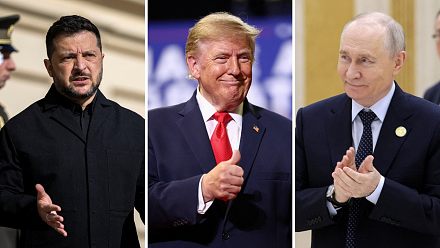
Donbas For Putin, NATO For Zelenskyy: Can Trump’s Peace Deal End Russia-Ukraine War?
Ukrainian President Volodymyr Zelenskyy has claimed that US negotiators have floated a proposal asking whether Ukraine would withdraw its remaining forces from the eastern Donbas region in exchange for NATO membership.
Ni Manjiri Joshi··44K nabasa
Donbas For Putin, NATO For Zelenskyy: Can Trump’s Peace Deal End Russia-Ukraine War?
Ukrainian President Volodymyr Zelenskyy has claimed that US negotiators have floated a proposal asking whether Ukraine would withdraw its remaining forces from the eastern Donbas region in exchange for NATO membership.
While the US has not officially confirmed the offer, with envoy Jared Kushner urging confidentiality and referring to the media reports as “maximalist propositions”, analysts and leaders across Kyiv, Moscow, and Europe suggest the trade-off faces steep political and military hurdles.
UKRAINE’S POSITION
Zelenskyy views the US question as a sign that “NATO is back on the agenda“, although he remains opposed to surrendering sovereign land, according to reports from Al Jazeera and The Guardian.
Zelenskyy is unwilling to unilaterally cede territory or recognize Russian-occupied areas as Russian. However, he noted he would put the decision to a national referendum if Ukraine received a comprehensive package that included binding security guarantees, reconstruction funds, and the right to maintain a strong army, according to reports.
Having previously experienced the failure of the Budapest Memorandum, Kyiv is wary of vague promises. Ukrainian officials are demanding legally binding guarantees approved by the US Congress rather than simple diplomatic “assurances”, say reports.
Zelenskyy and European leaders have warned that rewarding Russia with territory could allow Moscow to use the ceasefire as a “springboard” to regroup and launch future attacks, rather than establishing lasting peace.
RUSSIA’S POSITION
While the Kremlin has not issued a formal response to this specific US pitch, its long-standing demands directly contradict the core premise of the swap. Russian President Vladimir Putin has consistently stated that Ukrainian membership in NATO is a direct threat to Russian national security and cited it as a primary justification for the 2022 invasion.
Moscow continues to demand that Ukraine adopt a permanently neutral, demilitarized status and cede not only the entirety of Donbas, but also parts of the Zaporizhzhia and Kherson regions.
Moscow is pushing for a “new European security architecture” that would require NATO to pull back troops from countries bordering Russia, making it highly unlikely that Putin would accept Ukraine joining the alliance under any territorial arrangement, say reports in international media such as BBC, NYT.
DIPLOMATIC HURDLES
Even if Kyiv and Moscow were to consider the framework, observers point out significant external obstacles:
Admitting a new member into NATO requires the unanimous consent of all existing alliance members, many of whom, including previous US administrations, have been hesitant to extend an invitation due to the risk of direct conflict with Russia.
The talks are unfolding amid heightened friction between Washington and Kyiv over Ukrainian drone strikes on Russian oil infrastructure and reported US restrictions on Ukraine’s access to Starlink satellite internet.
Following meetings in Abu Dhabi and Dublin, US envoys indicated that major European powers, including Britain, France, Germany, Italy, and Poland, will be brought directly into future negotiations, adding another layer of complex interests to any potential security framework.
CAN THE PROPOSAL WORK?
For Ukraine: NATO membership could be a historic security gain, but surrendering the Donbas could undermine its eastern defences and create domestic opposition, say experts.
For Russia: Territorial gains would be attractive, but accepting Ukraine into NATO would contradict one of Putin’s central war objectives.
For the US: It offers a possible route to ending the war, but Washington would have to persuade both Moscow and its NATO allies.
For Europe: It could strengthen Ukraine’s long-term security, or create a dangerous precedent in which territorial conquest becomes a bargaining tool.