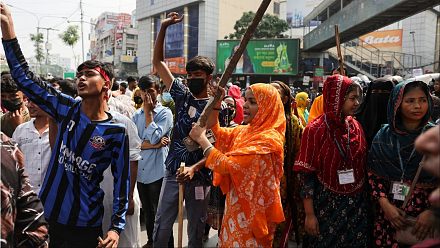
Bangladesh Garment Industry Under Pressure; Violent Wage Protests Disrupt Factories, Threaten Export Orders
Bangladesh’s economic backbone is under mounting pressure as violent protests over wages have disrupted garment manufacturing across the country, forcing hundreds of factories to suspend operations and raising concerns o
Ni Vani Mehrotra··70K nabasa
Bangladesh Garment Industry Under Pressure; Violent Wage Protests Disrupt Factories, Threaten Export Orders
Bangladesh’s economic backbone is under mounting pressure as violent protests over wages have disrupted garment manufacturing across the country, forcing hundreds of factories to suspend operations and raising concerns over export shipments and international buyer confidence.
The unrest comes at a critical stage in the production cycle for spring and summer orders, putting one of the country’s most important economic sectors under fresh strain.
Thousands of garment workers have taken to the streets, demanding a minimum monthly wage of 30,000 taka (around $243-$245), more than double their existing monthly pay of approximately 12,500-13,000 taka.
The protests, which began on Saturday, escalated on Monday as workers clashed with police, blocked highways and allegedly vandalised factories and vehicles across major manufacturing hubs.
According to Reuters, Bangladesh’s garment factories briefly resumed operations on Monday after a widespread shutdown a day earlier. However, fresh clashes between workers and police forced hundreds of plants to suspend production again.
Industry representatives told AFP that workers from at least 670 factories walked out on Monday, while Reuters reported that 679 factories had halted production.
The developments have raised concerns about potential shipment delays and the country’s ability to meet commitments to international buyers.
Why Bangladesh’s Economic Backbone Is Under Pressure
The garment industry is central to Bangladesh’s economic growth and its position in global manufacturing. The country is the world’s second-largest garment exporter after China, and the ready-made garment sector accounts for more than 80 per cent of its export earnings.
According to an AFP report, the industry generates up to $38 billion in export revenue and accounts for nearly 7 per cent of the global garment market. Bangladesh supplies ready-made garments to more than 150 countries, with the United States being its biggest individual market and the European Union its largest trading bloc.
The sector employs more than four million people directly, with women accounting for more than half of the workforce, according to estimates by the Bangladesh Garment Manufacturers and Exporters Association (BGMEA).
The International Labour Organisation estimates that these jobs indirectly support as many as 40 million people, roughly a quarter of Bangladesh’s population.
Reuters reported that the sector contributes around 10 per cent of the country’s economic output.
Its importance extends beyond employment and exports. Bangladesh’s central bank has described the garment sector as the country’s “export engine”.
An IMF report in January also identified the industry as a major driver of the country’s economic transformation over the past two decades, helping increase employment and per capita income while reducing poverty.
The current unrest, therefore, threatens an industry that has played a defining role in Bangladesh’s economic development.
Wage Protests Escalate As Workers Demand Higher Pay
Workers are demanding a minimum monthly wage of 30,000 taka, arguing that their existing earnings are no longer sufficient to meet rising household expenses.
The protests have gained momentum amid persistent inflation, with labour leaders pointing to rising prices of essential commodities and increasing expenses on food, housing, transport and healthcare.
AFP reported that inflation was around 8 per cent, adding to workers’ financial difficulties.
“Food prices, cooking gas and electricity bills have all gone up. The government must either bring down the prices of essential commodities or raise our wages,” Mamun, a 28-year-old factory worker, told AFP.
Factories Shut, Violence Spreads Across Manufacturing Hubs
The protests have spread across Dhaka and surrounding industrial districts, including Gazipur, Ashulia and Narayanganj.
According to AFP, hundreds of workers in Gazipur blocked the Dhaka-Tangail highway, with some damaging vehicles and setting a police vehicle on fire. Demonstrations also spread to the Mirpur district, where police used tear gas to disperse protesters.
Reuters reported that police used tear gas to disperse garment workers attempting to block roads in Dhaka after protesters allegedly hurled bricks and stones at officers.
Factories were also vandalised, while the office of a leather goods factory came under attack.
Mahmud Hasan Khan, president of the Bangladesh Garment Manufacturers and Exporters Association, told Reuters that around 20-25 factories had been vandalised during the unrest.
The scale of the clashes has also raised concerns over law and order.
AFP reported that at least 58 police officers had been injured since the protests began, while at least 57 people had been arrested.
Government Forms Wage Board, Warns Of Strict Action
In an attempt to defuse the situation, the government formed a six-member wage board on Sunday to review workers’ demands following negotiations involving workers’ representatives and factory owners.
AFP reported that Prime Minister Tarique Rahman had instructed officials, following an emergency cabinet meeting late on Sunday, to ensure workers’ rights and improve their living standards.
The Prime Minister also directed officials to ensure that production and exports continued “unhindered”, according to Home Minister Salahuddin Ahmed.
However, the government has also adopted a tough stance against the violence.
“Those engaging in unlawful activities and conspiracies under the guise of labour movements will be tackled with an iron hand,” Ahmed said after meeting industry leaders on Monday, according to AFP.