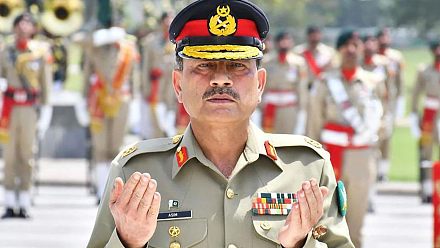
Asim Munir's Pakistan Woos Global Mining Giants, But Who Will Control Its Mineral Wealth? Exclusive
Pakistan is preparing to throw open its vast mineral wealth to international investors, with Islamabad hosting a two-day minerals investment conference from Thursday, even as questions persist over the growing role of th
Ni Manoj Gupta··52K nabasa
Asim Munir's Pakistan Woos Global Mining Giants, But Who Will Control Its Mineral Wealth? Exclusive
Pakistan is preparing to throw open its vast mineral wealth to international investors, with Islamabad hosting a two-day minerals investment conference from Thursday, even as questions persist over the growing role of the military establishment in the country’s economic affairs and the ownership of natural resources by provinces.
The Pakistan Minerals Investment Forum 2026 (PMIF26), being held in Islamabad on November 12 and 13, is expected to bring together more than 5,000 delegates from over 50 countries, including global mining executives, investors, policymakers and technical experts. The conference is aimed at attracting foreign capital, technology and partnerships to develop Pakistan’s largely untapped mineral reserves.
The event also puts Army Chief and Chief of Defence Forces Field Marshal Asim Munir in the spotlight. Munir is among the prominent speakers at the conference, alongside Prime Minister Shehbaz Sharif and Deputy Prime Minister Ishaq Dar, underlining the military establishment’s increasingly visible involvement in Pakistan’s economic and investment agenda.
At the heart of the debate is the question of who will control the economic opportunities emerging from Pakistan’s mineral wealth, particularly in resource-rich Balochistan, Khyber Pakhtunkhwa and Gilgit-Baltistan, and how much of the gains will accrue to local populations.
MILITARY’S EXPANDING ECONOMIC FOOTPRINT
The minerals investment drive is unfolding against the backdrop of the military’s growing role in Pakistan’s economic policymaking.
A key institutional vehicle in this effort is the Special Investment Facilitation Council (SIFC), established in 2023 to attract and fast-track domestic and foreign investment in sectors including defence, agriculture, minerals, information technology and energy.
The council has a multi-tier structure involving the prime minister, federal ministers and provincial chief ministers, but also includes the army chief by special invitation and a National Coordinator from the Pakistan Army. Military representatives are also part of its executive and sectoral structures.
The SIFC’s leadership platform currently features Field Marshal Asim Munir, who has publicly backed the military’s role in reviving Pakistan’s economy through a coordinated government approach.
The military’s involvement in the minerals sector is not new. At the 2025 Pakistan Minerals Investment Forum, Munir assured domestic and international investors that the Pakistan Army would provide a security framework for mining projects and protect their interests. He had also described economic security as an important pillar of national security.
The latest investment push, therefore, is also drawing attention to the extent of the military’s influence over strategic economic sectors and the role it could play in facilitating and securing mining investments.
BALOCHISTAN, KP AND GILGIT-BALTISTAN IN FOCUS
Pakistan’s mineral ambitions are particularly significant for its resource-rich western and northern regions.
Balochistan is home to the strategically important Reko Diq copper and gold project, one of the world’s largest undeveloped deposits of its kind. The project is jointly owned by Canada’s Barrick Mining Corporation, the provincial government and federal state-owned enterprises. It is seen as a major opportunity for Pakistan to attract international mining capital and strengthen its position in global mineral supply chains.
Khyber Pakhtunkhwa and Gilgit-Baltistan also possess considerable mineral potential, including precious stones and other commercially valuable resources. Pakistan is seeking to attract foreign investors to exploration, extraction, processing and infrastructure development across these regions.
The provincial governments have also been opening up mineral-related opportunities. Khyber Pakhtunkhwa’s Mines and Minerals Department, for instance, has published fresh royalty auction notices covering several districts. Balochistan has also advertised auctions for mineral-related royalty collection rights.
However, the investment drive raises questions about the distribution of revenues, local participation and the extent to which provincial governments will retain control over decisions concerning their natural resources.
Under Pakistan’s constitutional framework, minerals other than nuclear resources fall within provincial jurisdiction, with the 18th Constitutional Amendment strengthening provincial autonomy in this area. This makes the relationship between the federal government, the military-backed investment facilitation structure and provincial administrations particularly important.
WHO CONTROLS THE MINERAL WEALTH?
The question of provincial ownership and local consent has historically been sensitive, particularly in Balochistan, where resource extraction has frequently intersected with concerns over political representation, security and the distribution of economic benefits.
The Reko Diq project itself illustrates the complex ownership arrangements involving international corporations, provincial authorities and federal entities.
The military’s growing involvement in investment facilitation has added another dimension to this debate. While Islamabad presents the SIFC as a mechanism to streamline approvals, coordinate government agencies and provide investors with greater confidence, its military representation has also raised questions about the balance between civilian institutions and the armed forces in economic decision-making.
For provinces such as Balochistan and Khyber Pakhtunkhwa, the challenge will be to attract investment without compromising their constitutional rights over mineral resources or leaving local communities out of the economic gains.
5,000 DELEGATES, OVER 50 COUNTRIES
The Pakistan Minerals Investment Forum 2026 is expected to provide a platform for international mining companies, investors and government representatives to explore opportunities across the country’s mineral sector.
The two-day conference will feature strategic and technical discussions, alongside an international exhibition showcasing mining projects, equipment, technologies and investment opportunities. Critical minerals, exploration financing, geological surveys, infrastructure development and mineral processing are among the key subjects on the agenda.
PAKISTAN THE NEXT CRITICAL MINERALS DESTINATION
Among the international industry figures participating are Barrick Mining Chairman John L Thornton and Ivanhoe Mines Executive Chairman Robert Friedland, reflecting Pakistan’s efforts to bring established global mining players into its investment plans.
The conference is part of a larger effort by Islamabad to position minerals as a major source of foreign investment and economic growth. But beyond the headline investment commitments, the larger test will be whether the country’s mineral wealth can be developed through transparent arrangements that protect provincial interests, ensure local participation and clearly establish who controls the revenues.