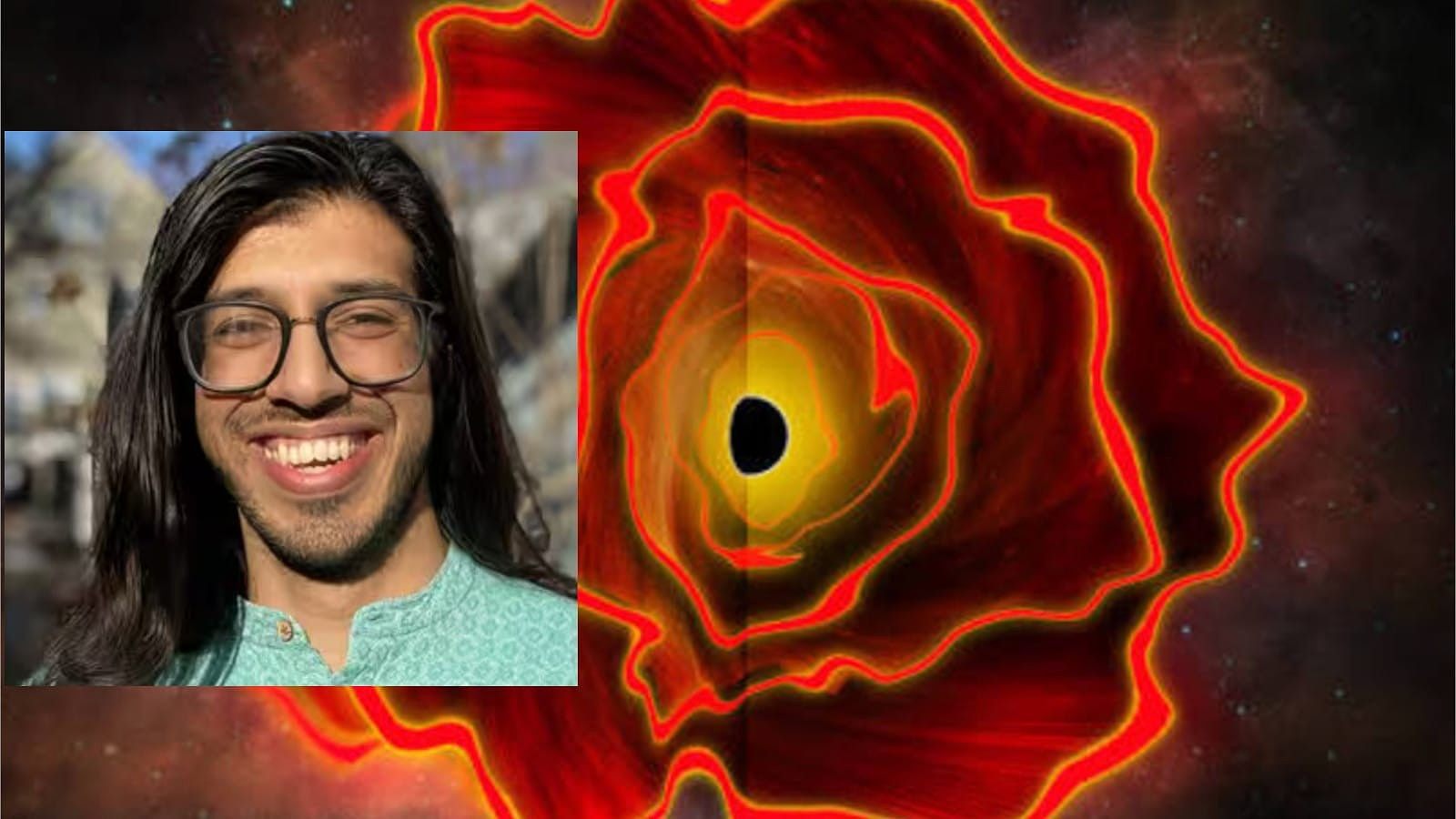
Who Is Rohan Naidu? Hyderabad-born MIT Astronomer Who Left India At 18 To Discover 'Black Hole Star'
At eighteen, Rohan Naidu did the thing Indian families spend years hoping their children will never do. He dropped out of engineering school.
Ni Ayush Mukherjee··41K nabasa
Who Is Rohan Naidu? Hyderabad-born MIT Astronomer Who Left India At 18 To Discover 'Black Hole Star'
At eighteen, Rohan Naidu did the thing Indian families spend years hoping their children will never do. He dropped out of engineering school.
He then bought the first plane ticket of his life and flew to Singapore to join the founding batch of 150 students at Yale-NUS College. MIT’s own biography of him describes this as a Bollywood-esque plot twist, which is a generous way of putting what it must have looked like at the time.
On 12 August, the journal Nature published his team’s finding that a new class of astrophysical object exists. They are calling it a black hole star, and there is a reasonable chance it explains how nearly every supermassive black hole in the universe began.
What They Found
The object is catalogued as MoM-BH*-1. It sits in the constellation Cetus, billions of light years away, and it formed roughly 660 million years after the Big Bang.
In images from the James Webb Space Telescope it appeared as a tiny red dot. Almost invisible in Webb’s bluer filters, blazing in the redder ones. One of the most extreme colours ever recorded in a distant object.
The explanation the team arrived at is unlike anything previously observed.
Component
What it is
The centre
A black hole roughly 100,000 times the mass of our Sun
The envelope
An enormous shroud of dense gas surrounding it
The size of that envelope
Comparable to our entire solar system
What powers it
The black hole, not nuclear fusion
How it appears
Like a star, because of the gas
Energy output
100 billion times more than any known star can produce
Every star you have ever seen shines because hydrogen is fusing into helium in its core. This object shines because a black hole is eating, and the gas around it is glowing from the effort.
Naidu’s description of the moment: one in a billion.
The Mystery It Might Solve
Since Webb began operating, astronomers have kept finding the same thing in deep space images: small, compact, intensely red sources. They have been calling them Little Red Dots, which is less a name than an admission of not knowing.
They are in virtually every image the telescope takes. They are everywhere in the early universe and essentially absent from the present-day one. What they are has been, in Naidu’s words, one of the most debated topics of the entire Webb era.
Three years of work by the wider astronomy community has established mainly what they are not. Conventional models of galaxies and of active galactic nuclei both fall short when applied to them.
The claim in this paper is that every Little Red Dot is consistent with being a black hole star sitting inside an ordinary early galaxy. What makes MoM-BH*-1 useful is that its black hole star completely outshines its host galaxy, so what Webb captured is almost pure black hole star light with nothing else mixed in.
Supporting that reading, the light carried almost no trace of metals. Hydrogen and helium, essentially nothing else, which is what you expect from the early universe before generations of stars had manufactured heavier elements.
Why This Matters Beyond Astronomy
If black hole stars are what the Little Red Dots turn out to be, they may represent the earliest phase in the life of nearly every supermassive black hole, including the one at the centre of our own galaxy.
Naidu has put the implication further than that. Black hole stars, he has said, may govern when stars are able to form and when they stop forming, setting the course for everything that follows from star formation: the birth of planets, the rise of life, and the emergence of species that may one day piece together this entire history.
That last clause is doing something unusual for a scientist quoted in a press release. He is pointing at us.
The Route From Hyderabad
Naidu grew up in Hyderabad. The decision he made at eighteen was not a small one, and it is worth being clear about what it actually cost him.
Indian engineering colleges do not lead to observational astronomy. They lead to software, to core engineering, to an MBA, or abroad for a master’s. The path Naidu ended up on does not exist inside that system, which means leaving it was not a detour from his career. It was the precondition for having one.
Stage
What happened
Age 18
Left engineering school in India, joined Yale-NUS College, Singapore
Undergraduate
Studied blazars in the Chilean Andes with Professor Charles Bailyn
Exchange
Yale, in the van Dokkum group
PhD
Harvard, supervised by Professor Charlie Conroy
Postdoctoral
NASA Hubble Fellow and Pappalardo Fellow, MIT Kavli Institute
Now
Assistant Professor, Institute for Astronomy, University of Hawai’i
His work has been cited more than 12,600 times. His own summary of the journey, in his social media biography, is four words and three flags: India to Singapore to the United States.
The thesis with a resonance he probably noticed
Naidu’s doctoral work at Harvard involved surveying the outermost reaches of the Milky Way to find ancient galaxies that our own galaxy had absorbed over billions of years. In the literature they are described as immigrant galaxies.
He spent his PhD studying things that travelled a long way, joined something larger, and became part of its structure.
The other things
MIT’s biography lists three interests outside astronomy. He is a quiz and trivia enthusiast. He is a published poet. And he is, in the department’s phrasing, always down to watch Test cricket.
Test cricket is the form that takes five days and can still end without a result. Little Red Dots have taken the astronomy community three years to get this far, and the question is not settled yet. There are worse temperaments for the work.
What Is Not Yet Known
This is a finding, not a conclusion, and the team is clear about that.
The physics is unexplained. Nobody yet knows what process allows a black hole wrapped in dense gas to radiate in a way that resembles a star. That is the open question the paper leaves behind.
The population is uncounted. The next step is working out how many of Webb’s Little Red Dots actually belong to this class. Consistent with is not the same as confirmed to be.
The picture is moving. Naidu’s own phrasing is that the team’s understanding of the object is evolving very rapidly, which is an honest thing to say three days after publication.
One Detail For The Record
The research was carried out while Naidu was at the MIT Kavli Institute, which is why most coverage describes him as an MIT astronomer. He has since moved to the University of Hawai’i.
He also led the team that found MoM-z14, currently the most distant galaxy known, seen as it was 280 million years after the Big Bang.
Which is to say the black hole star is not the first thing he has found at the edge of the observable universe. It is just the first one that came with a name people can remember.