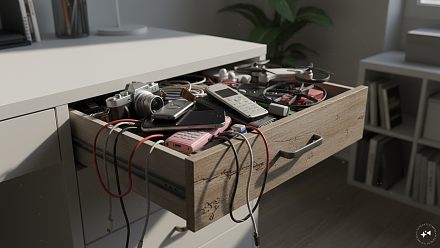
There are old phones, chargers, earphones, adapters, power banks and cables belonging to gadgets I probably don’t even own anymore. Some of these objects haven’t been touched in years.
Ni Anjan N Ghosh··44K nabasa
That Gadget Drawer: Where Technology Goes to Die
There are old phones, chargers, earphones, adapters, power banks and cables belonging to gadgets I probably don’t even own anymore. Some of these objects haven’t been touched in years.
Every now and then I decide I’m going to clean it out properly.
Then I pick up the first mysterious cable and think, “Better keep this. I might need it someday.”
Need it for what?
No idea.
But apparently throwing away a Mini-USB cable from 2009 could have catastrophic consequences.
The Drawer Is Actually an Insurance Policy
The problem is that experience encourages this behavior.
You keep a completely useless-looking adapter for six years, and then one Sunday afternoon you suddenly need exactly that adapter.
This is a dangerous moment because it validates everything.
You walk triumphantly towards the drawer thinking, See! This is why I never throw anything away.
From that day onwards, every unidentified cable receives another five-year extension.
I have chargers whose original devices have probably been recycled, dismantled and reincarnated as something else by now. Yet the charger remains with me because, well, it’s a perfectly good charger.
And don’t get me started on old phones.
An Old Phone Isn’t Always Just an Old Phone
Phones are harder to throw away because they carry memories.
Pick up an old handset and suddenly you remember when you used it, where you travelled with it, perhaps photographs you took or messages that were once important. Even the scratches on it can remind you of a particular period.
So we tell ourselves it’ll become the backup phone.
This sounds very sensible.
Of course, when an actual emergency arrives three years later, the battery is dead, the software is ancient and I’ve forgotten the PIN.
Excellent backup strategy.
Still, putting it back in the drawer somehow feels easier than getting rid of it.
Then There’s the Stuff That Is Actually Dead
Every gadget drawer eventually contains technology that isn’t waiting for a second life.
It’s dead.
The earphones stopped working. The power bank barely holds charge. The cable has been bent so many times that it now needs to be positioned at exactly 37 degrees while nobody breathes.
This is where the drawer stops being storage and starts becoming e-waste waiting for somebody to make a decision.
And this part is worth taking slightly seriously.
Electronic waste shouldn’t simply go into the household rubbish. India’s e-waste framework is built around sending end-of-life electronics through proper collection and recycling channels, and batteries are separately covered by battery-waste rules. The sensible route is a manufacturer’s take-back programme or an appropriate authorised/registered collection or recycling channel rather than the dustbin.
There. Environmental responsibility addressed without anybody having to attend a seminar.
Why Is Throwing Technology Away So Difficult?
Perhaps gadgets are unusual because they can be worthless to us while still looking valuable.
A ten-year-old cable still looks like a cable. An old phone still looks like a phone. A charger doesn’t visibly announce that nothing in the house needs it anymore.
So we keep them.
Some because they’re genuinely useful. Some because they hold memories. Some because we’re unsure how to dispose of them properly.
And some because of the terrifying possibility that we may need them the day after throwing them away.
I know what I should do. Separate the genuinely useful things, keep a few sensible backups, send the dead electronics for proper recycling and finally reclaim the drawer.
In fact, I think I’ll do it this weekend.
I’ll open the drawer, examine everything carefully, throw away… sorry, responsibly recycle… perhaps two things, rearrange the rest and close it again.
Then I’ll spend the evening feeling extremely productive.