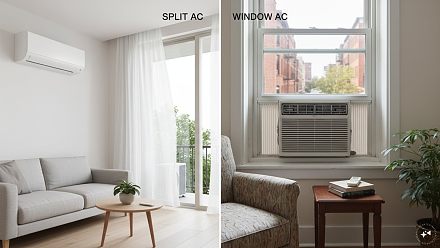
Split AC Vs Window AC: Which Is More Cost-effective For Small Rooms?
Buying an air conditioner for a small bedroom, study or home office can make the split-versus-window decision surprisingly difficult. A window AC usually has the advantage on upfront cost, while a split AC offers quieter
Ni Consumer Trends Desk··43K nabasa
Split AC Vs Window AC: Which Is More Cost-effective For Small Rooms?
Buying an air conditioner for a small bedroom, study or home office can make the split-versus-window decision surprisingly difficult. A window AC usually has the advantage on upfront cost, while a split AC offers quieter operation, more installation flexibility and a wider choice of models.
But the cheapest AC to buy is not necessarily the cheapest one to own. Capacity, star rating, electricity consumption, installation expenses and how many hours you run the AC every day can all affect the final cost. For a small room, choosing the right capacity is particularly important because buying a larger AC than you need can mean spending more without necessarily getting better comfort.
Which should you choose?
Choose a split AC if:
You use the AC for several hours every day.
Low noise is important, particularly in a bedroom.
You want more flexibility over where the AC is installed.
You prefer a wider choice of inverter and energy-saving models.
You are willing to spend more upfront for comfort and features.
Choose a window AC if:
Your priority is keeping the initial cost low.
Your room already has a suitable window or wall opening.
You want relatively straightforward installation.
You are comfortable with higher operating noise.
You are cooling a small room and do not need premium features.
For a small room with moderate AC use, a window model can be the more economical purchase. If the AC will run for long hours every day, however, an appropriately sized efficient split AC can justify its higher upfront cost over time.
Top picks
1. LG 1.5 Ton 3 Star Smart Inverter Split AC – Best split AC for overall value
Price: Was – Rs 75,190 | Now – Rs 36,990 | Discount: 51%
2. Daikin 1.5 Ton 3 Star Inverter Split AC – Best split AC for straightforward cooling
Price: Was – Rs 56,100 | Now – Rs 37,400 | Discount: 33%
3. Hitachi Smart Choice 1.5 Ton 3 Star Inverter Split AC – Best split AC for smart features
Price: Was – Rs 63,900 | Now – Rs 36,500 | Discount: 43%
4. Oakter 0.5 Ton Inverter Studio AC 5000 – Best window AC for a very small room
Price: Was – Rs 27,499 | Now – Rs 16,999 | Discount: 38%
5. Voltas 185V Vertis Elite A 1.5 Ton 5 Star Inverter Window AC – Best 5-star window AC
Price: Was – Rs 47,999 | Now – Rs 35,999 | Discount: 27%
6. Carrier 1.5 Ton 5 Star Inverter Window AC – Best window AC for powerful cooling
Price: Was – Rs 58,190 | Now – Rs 35,490 | Discount: 39%
Quick comparisonSituation
Feature
Split AC
Window AC
Upfront price
Usually higher
Usually lower
Installation cost
Higher
Usually lower
Noise inside room
Lower
Higher
Energy efficiency
Wide choice of efficient inverter models
Efficient inverter models also available
Installation flexibility
High
Requires suitable window/wall space
Maintenance access
Two separate units
Single compact unit
Appearance
Cleaner
Bulkier
Best for
Regular, long-hour use
Budget-conscious cooling
Small rooms
Choose capacity carefully
Budget-conscious cooling
How does a split AC work?
A split AC divides the cooling system into two units. The indoor unit contains the evaporator and blower that cool the room, while the compressor and condenser are housed in an outdoor unit.
Moving the compressor outside is one of the main reasons split ACs are quieter indoors. It also means the indoor unit can be mounted relatively high on a wall instead of occupying a window.
Modern inverter split ACs can vary compressor output according to the cooling requirement rather than repeatedly operating at full power and switching off. Models such as the LG, Daikin and Hitachi options here are 1.5-ton inverter ACs with 3-star ratings.
Where split ACs perform best
Bedrooms where low noise matters
Rooms used for long periods
Homes without a suitable AC window opening
Spaces where appearance matters
Buyers looking for more cooling modes and features
Where split ACs struggle
Higher initial budget
More complicated installation
Additional installation materials can increase cost
1.5-ton models may be unnecessarily large for very small rooms
That final point matters. For a compact room, buying a 1.5-ton AC simply because it is heavily discounted may not be the most economical choice.
How does a window AC work?
A window AC places the compressor, condenser, evaporator and fan in a single cabinet. The unit sits in a window or specially created wall opening, with the cooling side facing indoors and the heat-releasing side facing outdoors.
The simpler one-unit design can reduce installation complexity and upfront expenditure. It also makes window ACs attractive for rented homes or rooms that already have a suitable opening.
The category is no longer restricted to basic fixed-speed models. Both the Voltas and Carrier options here are 1.5-ton, 5-star inverter window ACs. The Oakter is an unusual 0.5-ton inverter model specifically marketed for rooms of around 75 sq ft.
Where window ACs perform best
Small rooms
Budget-conscious purchases
Rooms with an existing AC opening
Buyers wanting simpler installation
Situations where indoor noise is less important
Where window ACs struggle
Bedrooms where noise is a major concern
Rooms without a suitable window or wall opening
Homes where the window is needed for ventilation or light
Buyers who want a discreet installation
Which costs less to buy and install?
Window ACs generally have the advantage if the objective is to minimise the initial expense.
The difference is especially clear at the lower end of the market. The 0.5-ton Oakter model shown here costs Rs 16,999, compared with around Rs 36,500 to Rs 37,400 for the three 1.5-ton split ACs.
That is not a like-for-like capacity comparison, however. The Oakter is intended for a much smaller space. Among the 1.5-ton models, the gap is far narrower: the Carrier and Voltas inverter window ACs cost Rs 35,490 and Rs 35,900 respectively, while the LG, Hitachi and Daikin split models are between Rs 36,500 and Rs 37,400.
Installation can widen the difference. A split AC requires an indoor unit, outdoor unit, connecting pipes, drainage and electrical work. A window AC can be simpler if the room already has an appropriate opening.
Which costs less to run?
Do not decide this purely on whether an AC is split or window.
Electricity consumption depends on factors including the AC’s capacity, efficiency rating, inverter technology, room size, insulation, outdoor temperature, thermostat setting and number of hours used.
The examples illustrate why the label matters. The Voltas and Carrier window ACs are 5-star inverter models, while the three split ACs shown are 3-star inverter models. It would therefore be misleading to assume that a split AC automatically consumes less electricity simply because it is a split AC.
For running costs, compare the current BEE energy label and annual electricity-consumption figure of the individual models you are considering.
Does AC capacity matter more in a small room?
Yes. This can have a bigger impact on value than choosing between split and window designs.
The Oakter 0.5-ton model is marketed for rooms of around 75 sq ft. By contrast, the other models here have a 1.5-ton capacity.
A very small bedroom or study may not require a 1.5-ton AC. The appropriate capacity depends on more than floor area, though. Ceiling height, direct sunlight, top-floor location, number of occupants, windows and heat-producing appliances all influence the cooling load.
This is why capacity should be decided before comparing prices. An attractive deal on a larger AC is not necessarily a saving if your room does not need that capacity.
Which is quieter?
Split ACs generally have a clear advantage.
The compressor, one of the noisier parts of the air-conditioning system, sits outside the room. The indoor unit therefore mainly produces the sound of the blower and moving air.
In a window AC, the compressor is part of the same cabinet installed in the room opening. Vibration and compressor noise are consequently more noticeable.
For a study or bedroom, particularly if you are a light sleeper, the lower indoor noise of a split AC can justify paying more.
Which is easier to install and maintain?
If a suitable opening already exists, a window AC is generally simpler. The entire system is contained in one unit, making it comparatively straightforward to access.
A split AC requires more installation work because the indoor and outdoor units need to be connected. The final installation cost can also depend on the distance between the two units and whether extra copper piping, brackets or electrical work is required.
But window AC installation is not automatically cheap. If a carpenter or contractor has to modify a window or create a wall opening, some of its cost advantage can disappear.
Which is more cost-effective in the long run?
It depends heavily on how the room is used.
If you need an AC for a small guest room or study for a few hours at a time, paying substantially more for a sophisticated split system may offer limited financial benefit. A correctly sized window AC can be a practical solution.
If you use the room every night or work from home with the AC running for many hours, efficiency and comfort become more important. A quiet, correctly sized inverter split AC may offer better overall value even if its purchase and installation costs are higher.
The key is to compare comparable capacities and energy ratings rather than treating every split AC as more efficient than every window AC.
Common cooling scenarios
Situation
Better choice
Very small room
Correctly sized window AC can be economical
Lowest upfront expenditure
Window AC
Bedroom used every night
Split AC
Long daily usage
Efficient inverter model; compare energy labels
Existing AC window opening
Window AC
No suitable window
Split AC
Quiet operation
Split AC
Simple installation
Window AC
Appearance is important
Split AC
Rented accommodation
Often window AC, subject to installation rules
What to consider before buying
Room size: Determine the cooling capacity you actually need before choosing a model. Do not automatically buy a 1.5-ton AC for a very small room.
Energy label: Compare the current BEE star rating and annual electricity-consumption figure. Star rating is more useful than assuming one AC design is inherently cheaper to run.
Usage hours: The longer you run the AC, the more important energy efficiency becomes.
Installation cost: Ask what is included. Copper piping, outdoor-unit stands, electrical work or modification of a window can change the final cost considerably.
Noise: If the AC is for a bedroom or study, consider the indoor operating noise as well as price and electricity consumption.
FAQs
1. Is a window AC cheaper than a split AC?
Window ACs are often cheaper to buy and can cost less to install, particularly when a suitable window or wall opening already exists. The price difference can become much smaller when comparing inverter models with similar capacity and energy ratings.
2. Does a split AC use less electricity than a window AC?
Not automatically. Electricity consumption depends on capacity, efficiency rating, inverter technology and usage. Compare the BEE energy labels of the actual models rather than choosing solely by AC type.
3. Is a 1.5-ton AC too big for a small room?
It can be. Required capacity depends on room area, ceiling height, sunlight, insulation, occupancy and other factors. A very small room may require considerably less than 1.5 tons.
4. Which AC is better for a small bedroom?
A split AC is generally preferable if quiet operation is important. A window AC can be more economical if your budget is limited and the room has a suitable opening.
5. Are inverter window ACs available?
Yes. The Voltas and Carrier models considered here are both inverter window ACs, showing that inverter technology is not restricted to split systems.
6. Which AC is cheaper in the long run?
There is no universal winner. A correctly sized, energy-efficient AC that matches your usage pattern will generally be more economical than choosing simply on the basis of whether it is a window or split model.
Disclaimer: The product descriptions mentioned in the article are solely based on the primary and secondary research conducted by our experts. To keep you ahead of the curve with these latest products, News18 utilises affiliate links. This means if you decide to shop through our recommendations, we may earn a small referral commission at no extra cost to you. Please be advised that News18 is not responsible for any claims under the Consumer Protection Act, 2019, or other applicable laws regarding the final performance, quality, or safety of these products.