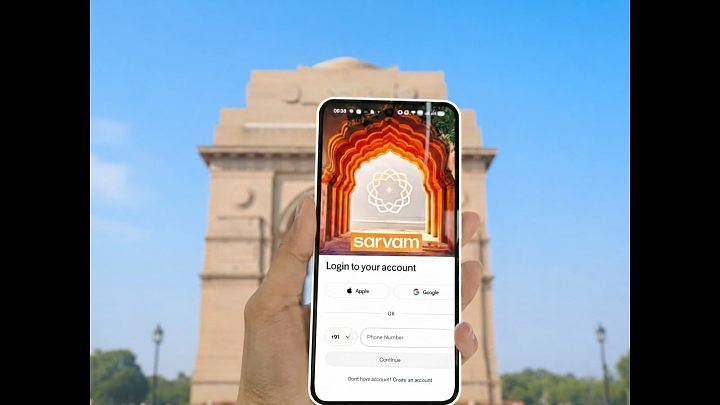
Sarvam AI App Lets You Control Your Mac With Your Voice in 22 Indian Languages
Speaking to a computer in Hindi, Tamil, Bengali or another Indian language is becoming considerably easier, and an Indian AI company is now trying to turn that idea into a full voice-computing experience.
Ni Ayush Mukherjee··44K nabasa
Sarvam AI App Lets You Control Your Mac With Your Voice in 22 Indian Languages
Speaking to a computer in Hindi, Tamil, Bengali or another Indian language is becoming considerably easier, and an Indian AI company is now trying to turn that idea into a full voice-computing experience.
Sarvam AI has launched Kivi for Mac, a voice-powered application designed to let users dictate, draft, edit and format text across different Mac applications.
The app is powered by Sarvam’s Saaras V4 speech model and supports English along with all 22 constitutionally recognised Indian languages.
That includes Hindi, Bengali, Marathi, Tamil, Telugu, Kannada, Malayalam, Gujarati, Punjabi, Odia, Assamese, Urdu, Sanskrit and Maithili, among others.
Kivi is designed to automatically identify the language being spoken.
This is particularly useful in India, where people frequently switch between English and an Indian language during the same conversation.
Sarvam says Saaras V4 is designed to handle code-mixed speech, dialects and noisy environments.
For example, someone could speak to the app using a combination of Hindi and English without having to manually switch languages.
The software can also remove filler words and format spoken text, making it more useful for writing emails, documents and messages rather than simply producing a raw transcript.
Sarvam says Kivi offers several output modes, including transcription, translation, verbatim transcription, transliteration and code-mixed output.
That means users can decide whether they want their speech converted directly into text, translated into another language or written using a different script.
The technology behind it is also significant.
Saaras V4 uses an audio encoder combined with a 3-billion-parameter hybrid state-space language model developed by Sarvam.
The company says the system achieves state-of-the-art performance across all 22 Indian languages it supports.
Kivi’s bigger pitch is therefore not simply “voice typing”.
The goal is to make voice a practical way of interacting with a computer, particularly for Indian users who may find conventional English-first voice interfaces limiting.
For someone who primarily communicates in Hindi, for example, the ability to speak naturally rather than carefully formulate commands in English could make a major difference.
The app can be useful for writing messages, drafting documents, taking notes, preparing content and performing other everyday tasks where typing is normally required.
It also reflects a broader trend in Indian AI development.
Instead of simply building another general-purpose chatbot, companies such as Sarvam are increasingly focusing on local-language applications where India’s linguistic diversity becomes an advantage.
Voice could be one of the most important areas.
India has hundreds of languages and dialects, while millions of people are more comfortable speaking than typing in English.
If AI can accurately understand those conversations and turn them into useful computer actions, voice could become a much more natural interface for the next generation of computing.
Kivi is therefore an interesting experiment in what an India-first AI application can look like.
Rather than making users adapt to an English-first computer, it attempts to make the computer adapt to the way Indians actually speak.