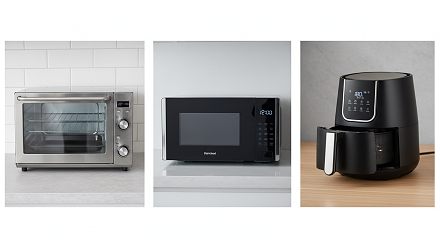
OTG Vs Air Fryer Vs Microwave – Best Choice For Compact Indian Kitchens
For a compact Indian kitchen, every appliance needs to earn its counter space. An OTG, air fryer and microwave can all make cooking more convenient, but they do very different jobs.
Ni Consumer Trends Desk··20K nabasa
OTG Vs Air Fryer Vs Microwave – Best Choice For Compact Indian Kitchens
For a compact Indian kitchen, every appliance needs to earn its counter space. An OTG, air fryer and microwave can all make cooking more convenient, but they do very different jobs.
An OTG uses heating elements to bake, toast, grill and roast. It is especially useful for cakes, pizzas, bread and larger batches, but it needs more counter space and usually takes longer to preheat.
Air fryers use rapidly circulating hot air to crisp food with little or no oil. Their smaller cooking chambers heat quickly, making them particularly useful for fries, samosas, paneer, chicken, vegetables and reheating foods where crispness matters.
Microwave ovens are built around speed. A solo microwave is excellent for reheating, defrosting and quick cooking, while a convection microwave adds baking and roasting capabilities. The choice therefore depends less on which appliance is “best” and more on what you cook most often.
For this comparison, we looked at three OTGs, three air fryers and three microwave ovens and compared the three categories on cooking method, speed, capacity, baking, grilling, reheating, crisping, counter space, cleaning and everyday convenience.
Which should you buy?
Buy an OTG if:
You regularly bake cakes, bread, cookies or pizzas.
You want better control over baking and grilling.
You prepare larger portions than a typical air fryer can accommodate.
You want to roast or grill larger pieces of food.
You don’t mind giving the appliance more counter space.
You prefer conventional oven-style cooking.
You want an appliance primarily for baking, grilling and roasting.
Buy an air fryer if:
You frequently make crispy snacks with little oil.
You cook for one to four people.
You want quick preheating and shorter cooking times.
You regularly prepare fries, tikka, paneer, vegetables or frozen snacks.
You have limited counter space.
You want a simple appliance with presets.
You don’t need to reheat liquids or large quantities of everyday meals.
Buy a microwave if:
Reheating rice, dal, sabzi and other meals is your priority.
You frequently defrost frozen food.
You want quick everyday cooking.
You have limited time for meal preparation.
You want an appliance that is easy for multiple family members to use.
You are considering a convection model for baking and roasting too.
You want the most practical single appliance for everyday reheating.
Top picks
1. Bajaj Majesty 1603 TSS 16L
Price: Was – Rs 4,725 | Now – Rs 4,725 | Discount – NA
2. Morphy Richards 52RCD Digi 52L OTG
Price: Was – Rs 29,999 | Now – Rs 13,679 | Discount – 54%
3. Philips NA120/00 4.2L Air Fryer
Price: Was – Rs 5,995 | Now – Rs 4,706 | Discount – 22%
4. Pigeon Healthifry Digital 4.2L
Price: Was – Rs 5,995 | Now – 2,980 | Discount – 50%
5. AGARO Regency 12L Air Fryer
Price: Was – Rs 19,995 | Now – Rs 9,999 | Discount – 50%
6. LG MS2043BP 20L Solo Microwave
Price: Was – Rs 8,199 | Now – Rs 7,889 | Discount – 4%
Price: Was – Rs 15,590 | Now – Rs 14,500 | Discount – 7%
8. IFB 24PM2S 24L Solo Microwave
Price: Was – Rs 10,290 | Now – Rs 8,790 | Discount – 15%
Quick comparison
Feature
OTG
Air Fryer
Microwave
Cooking method
Top and bottom heating elements
Rapid hot-air circulation
Electromagnetic waves
Best function
Baking, grilling and roasting
Crisping and low-oil cooking
Reheating, defrosting and quick cooking
Cooking speed
Slow to moderate
Fast
Very fast
Preheat time
Usually 10–15 minutes
Usually 2–5 minutes
Not required in solo mode
Oil requirement
Depends on recipe
Little to none
Little to none
Baking
Excellent
Good for small batches
Good with convection models
Grilling
Excellent
Good for small portions
Good with grill/convection models
Reheating
Slow
Limited; can dry food
Excellent
Crisping
Very good
Excellent
Limited in solo models; better with grill/convection
Typical capacity
Medium to large
Small to medium
Medium to large
Ease of use
Requires more manual control
Easy, often with presets
Generally easy, especially with presets
Counter-space requirement
High
Low
Medium to High
Cleaning
Moderate
Relatively easy; removable basket
Moderate
Energy efficiency
Moderate
Generally efficient for small portions
Efficient for quick reheating
Best for
Baking, grilling and roasting
Crispy low-oil foods
Reheating and quick cooking
How does an OTG work?
An OTG, or Oven Toaster Griller, uses electric heating elements positioned around the cooking cavity. Depending on the selected mode, the top element, bottom element or both can provide heat to bake, toast, grill or roast food.
Unlike a microwave, an OTG needs to heat the cooking chamber before the food starts cooking. That makes it slower for quick jobs, but the conventional heating method is well suited to baking, where stable heat and controlled temperature are important.
The Bajaj Majesty 1603 TSS, for example, has a 16L capacity, 1200W power, temperature control up to 250°C and a 60-minute timer. Its compact size makes it more suitable for smaller kitchens than a large-capacity OTG.
Where OTGs perform best
OTGs shine when baking is a regular part of your cooking. Cakes, cookies, pizzas, bread, grilled vegetables and roasted food benefit from the oven-style heating that an OTG provides.
A larger OTG also gives you more usable cooking space. The Morphy Richards 52RCD Digi, for example, offers a 52L cavity, convection and motorised rotisserie, making it capable of handling considerably larger quantities than a compact air fryer. Its official product information also lists eight preset menus, a 120-minute timer, dehydrator and fermentation functions.
Where OTGs struggle
The biggest issue in a compact kitchen is physical size. Even a small OTG occupies meaningful counter space, while larger models can be difficult to accommodate in a kitchen with limited worktop area.
Preheating is another limitation. If you simply want to warm yesterday’s dal or rice, waiting for an OTG to heat up makes little sense when a microwave can do the job much faster.
How does an air fryer work?
An air fryer combines a heating element with a high-speed fan that circulates hot air around food. The compact cooking chamber allows the appliance to heat rapidly and helps create a browned, crisp exterior with little oil.
This makes air fryers particularly effective for foods where texture matters. Frozen snacks, potato wedges, samosas, paneer, chicken pieces and vegetables can develop a crisp surface without deep frying.
The Philips NA120/00, for example, uses RapidAir technology, offers a 4.2L capacity and has 12 cooking methods. Philips also states that its technology can deliver crispy results with up to 90% less fat compared with conventional frying.
Where air fryers perform best
Air fryers are particularly useful in compact kitchens because they combine a small footprint with quick cooking. They are also convenient when you want to prepare a small portion without heating a full-sized oven.
For one or two people, a 3–4L class appliance can be sufficient for many everyday foods. A 4.2L model such as the Philips NA120/00 offers more room while remaining considerably smaller than a full-sized OTG.
Where air fryers struggle
The basket is the main limitation. You cannot simply treat a small air fryer like a conventional oven and expect it to accommodate a large cake, whole chicken or multiple trays of food.
Reheating moist foods can also be less suitable. An air fryer is designed to circulate hot air, so rice, dal and some curries may dry out rather than simply warm through.
An oven-style air fryer with a much larger cavity can address some of these limitations, but once the appliance becomes very large, the space advantage over an OTG becomes smaller.
How does a microwave work?
A microwave oven uses electromagnetic waves to heat food rapidly. Instead of relying on a hot cooking chamber like an OTG, it transfers energy into the food, making it particularly effective for reheating and defrosting.
This is why a microwave is so useful in an Indian kitchen. Rice, dal, sabzi, curry, milk and leftovers can be reheated quickly without waiting for an oven to preheat.
The LG MS2043BP is a 20L solo model designed for reheating, defrosting and cooking. It includes 45 Auto Cook Menu options and a child lock. LG’s official specifications identify it as a 20L solo microwave with 700W microwave output.
Where microwaves perform best
For everyday meal reheating, the microwave is the most practical of the three. It can warm a bowl of rice or dal in a fraction of the time required by an OTG, while an air fryer may change the food’s texture.
Microwaves are also convenient for defrosting frozen ingredients and carrying out quick cooking tasks.
The Samsung MC28A5013AK/TL is different from the two solo models in this list because it is a 28L convection microwave. It supports convection cooking, has a convection temperature range of 40–200°C, includes a grill heater and convection heater, and offers auto-cook functions. It also has fermentation and deodorisation functions.
Where microwaves struggle
A basic solo microwave cannot reproduce the crisp exterior produced by an air fryer. It also cannot provide the same conventional baking and roasting performance as an OTG.
Convection microwaves address some of these limitations by adding an oven-style heating system. This makes them more versatile than solo models, although they may not match a dedicated OTG or air fryer for every specialist task.
OTG vs air fryer vs microwave: Which is actually better?
If the comparison is purely about baking, grilling and roasting, the OTG has the advantage.
If the priority is crispy food with little oil and quick preparation, the air fryer wins. Its compact chamber and rapid hot-air circulation make it especially useful for small portions and everyday snacks.
For reheating, defrosting and quick everyday cooking, the microwave is the clear winner. It is particularly valuable in Indian households where cooked rice, dal, sabzi and leftovers are reheated regularly.
The important point is that these appliances are not perfect substitutes. An air fryer cannot fully replace an OTG for large-batch baking, while a solo microwave cannot replace an air fryer when crisping is the priority.
For a compact kitchen, the best decision is therefore based on the job you perform most often rather than the number of features printed on the appliance box.
Which is better for Indian cooking?
For a household that mostly reheats home-cooked food, the microwave is likely to be the most useful first purchase. It handles rice, dal, vegetables and frozen food quickly and requires little supervision.
For households that frequently make snacks, kebabs, paneer tikka, roasted vegetables or frozen foods, the air fryer may provide more noticeable everyday value. It also needs less counter space than most OTGs.
For people who bake cakes, bread, cookies and pizzas regularly, the OTG remains the specialist choice. A convection microwave can combine several functions, but a dedicated OTG still makes more sense for someone whose main interest is oven-style baking.
A compact kitchen does not necessarily need all three. In many homes, a microwave plus air fryer covers more everyday needs than an OTG plus microwave, while a serious home baker may prefer an OTG instead of an air fryer.
Common usage scenarios
Common usage
OTG
Air fryer
Microwave
Small apartment
Takes more space
Compact
Medium-sized
Reheating dal
Slow
Can dry food
Very fast
Reheating rice
Slow
May dry rice
Excellent
Frozen snacks
Good
Excellent
Limiting crisping
French fries
Very good
Excellent
Poor for crisping
Samosas
Good
Excellent
Soft rather than crisp
Paneer tikka
Excellent
Excellent for small portions
Limited in solo models
Baking cake
Excellent
Good for small cakes
Good with convection
Baking bread
Excellent
Limited by size
Better with convection
Pizza
Excellent
Good for small pizzas
Good with convection/grill
Roasting chicken
Excellent in larger models
Good for smaller portions
Better with convection
Defrosting
Slow
Not ideal
Excellent
Daily Indian meal reheating
Poor choice
Limited
Best choice
Large batches
Excellent
Limited
Good depending on cavity
Quick cooking
Moderate
Fast
Very fast
Counter space
High
Low
Medium to high
So, which should you choose?
If reheating and quick everyday cooking are the biggest priorities, choose a microwave. It earns its place in a compact Indian kitchen by handling tasks that the other two appliances do less efficiently.
If crispy, low-oil snacks dominate your cooking, an air fryer is the better choice. It is compact, quick and particularly effective for smaller portions.
If baking and grilling are the main reasons you want an appliance, choose an OTG. Its larger cavity and conventional heating make it the better specialist for cakes, bread, pizzas, roasting and grilling.
For someone who wants just one appliance in a small kitchen, a convection microwave can be the most versatile compromise because it combines microwave heating with oven-style cooking. However, if you care deeply about either crisping or baking quality, a dedicated air fryer or OTG will usually be the more focused purchase.
FAQs
1. Which is better for a compact Indian kitchen: OTG, air fryer or microwave?
There is no universal winner. A microwave is best for reheating and defrosting, an air fryer is best for quick crispy foods, and an OTG is best for baking, grilling and roasting.
2. Can an air fryer replace an OTG?
For small portions of roasted or baked food, it can. However, an air fryer has a smaller cooking area and is less suitable for large cakes, bread loaves and larger baking batches.
3. Can a microwave replace an OTG?
A solo microwave cannot replace an OTG for conventional baking and grilling. A convection microwave can perform both microwave and oven-style cooking, making it a more versatile alternative.
4. Which is fastest for reheating Indian food?
A microwave is generally the fastest and most practical choice for reheating foods such as rice, dal, sabzi and curry.
5. Which is best for crispy samosas and fries?
An air fryer is the better choice. Its rapid hot-air circulation is specifically suited to browning and crisping food with little oil.
6. Which is best for baking cakes?
An OTG is generally the stronger choice for regular baking. A convection microwave can also bake, but an OTG offers a more conventional oven-style environment and is particularly useful for people who bake frequently.
7. Which appliance takes the least counter space?
A compact air fryer generally requires the least counter space. A small OTG can also be manageable, while microwaves and large-capacity OTGs need more room.
Disclaimer: The product descriptions mentioned in the article are solely based on the primary and secondary research conducted by our experts. To keep you ahead of the curve with these latest products, News18 utilises affiliate links. This means if you decide to shop through our recommendations, we may earn a small referral commission at no extra cost to you. Please be advised that News18 is not responsible for any claims under the Consumer Protection Act, 2019, or other applicable laws regarding the final performance, quality, or safety of these products.