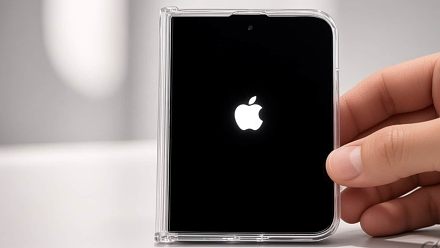
iPhone Fold Took Almost 10 Years To Make. Tim Cook's 'Obsession' To Be Face First Test Today- Can Apple Make The 'Display Crease' Go?
iPhone Fold: Around 2020, Apple CEO Tim Cook came back from a trip through Asia with a new obsession. He’d seen growing numbers of people using folding phones from Samsung and Huawei, and came home convinced Apple needed
Ni Ayush Mukherjee··31K nabasa
iPhone Fold Took Almost 10 Years To Make. Tim Cook's 'Obsession' To Be Face First Test Today- Can Apple Make The 'Display Crease' Go?
iPhone Fold: Around 2020, Apple CEO Tim Cook came back from a trip through Asia with a new obsession. He’d seen growing numbers of people using folding phones from Samsung and Huawei, and came home convinced Apple needed to build one too, according to people familiar with the matter cited by Bloomberg. What he didn’t know at the time was that Apple’s own engineers had already been quietly studying foldable displays and hinges for years, going back to before Samsung’s original Galaxy Fold launched in 2019.
That decade-long effort reaches its conclusion this week, when Apple is expected to unveil its first foldable iPhone: the biggest design shift in the device’s nearly 20-year history.
Why The Crease Took So Long To Solve
Bloomberg reports that Apple’s hardware teams zeroed in on four core problems early in development: hiding the crease that has marked nearly every foldable screen to date, making the hinge reliable over years of folding, engineering a flexible cover glass that wouldn’t scratch or shatter, and fitting camera components behind the display itself to avoid wasting screen space on notches or cutouts.
Of those four, the crease was the one Apple’s design team reportedly treated as non-negotiable. A visible fold line might be tolerable on a $1,000 Android device competing on features, but Apple was preparing to charge more than double that for a device it wanted people to see as premium first and foldable second. A crease running down the center of a $2,000 phone doesn’t just look unfinished — it undercuts the entire pitch. Every other flaw in a first-generation foldable can be framed as a trade-off. A visible seam reads as an unsolved problem.
Apple’s answer was a titanium-and-aluminum hinge developed alongside a custom cover glass built with Corning. According to Bloomberg’s sourcing, the combination produces a crease noticeably less visible than on any foldable currently on the market — and Apple intends to make that comparison a central part of how it sells the device.
From iPad Concept To iPhone
The project didn’t start out as a phone. Early internal concepts imagined something closer to an iPad mini that unfolded into a larger tablet. It was Cook’s push after his trip to Asia that redirected the effort toward a foldable iPhone instead, according to Bloomberg’s sourcing — a notable intervention for a CEO better known for supply-chain and financial discipline than shaping product direction. “Tim was the earliest and biggest champion of this,” one person told Bloomberg. “He saw them everywhere in Asia and said Apple needed to play in this space.”
The project was reportedly conceived under Dan Riccio, before Cook and current CEO John Ternus became its biggest internal advocates. Ternus, Bloomberg reports, later used his position to push the device through to completion.
The launch also marks Ternus’s first keynote as CEO, following his official start on September 1. Bloomberg’s reporting suggests the timing of the leadership handover was deliberate — designed to let Ternus, not Cook, be the one to introduce the device on stage, with Cook, now executive chairman, watching from the audience instead.
iPhone Fold Price
Apple originally targeted $1,999 for the device, mirroring the just-under-a-threshold pricing it used for the $999 iPhone X in 2017. According to Bloomberg, recent internal discussions have pushed that number as high as $2,199, with the ongoing memory chip shortage driving costs past Apple’s original targets. Larger storage configurations could approach $3,000. That compares with a $799 starting price for the standard iPhone, and $1,099 for the iPhone 17 Pro.
Apple appears to be betting that its existing Pro-buyer base, already used to spending close to $2,000 on top-tier iPhones, will absorb the price. The company’s new Apple Upgrade subscription plan, along with trade-in deals and carrier installment plans, are expected to soften the sticker shock. Competing foldables aren’t cheap either — Samsung and Google’s latest fold designs start around $1,899.
Design Trade-Offs
The device is expected to feature a roughly 7.8-inch interior display, wider than most Android foldables, paired with a 5.5-inch outer screen sized for one-handed use. Bloomberg reports Apple’s design team pictured the folded device as roughly passport-sized, unfolding to proportions close to its Magic Trackpad.
None of this comes without compromise. The phone has to be opened to use its main screen, and Bloomberg’s sourcing indicates it will likely be less durable than a standard iPhone, with a weaker camera system and shorter battery life than Apple’s current flagships.
Wall Street estimates point to sales of 7 million to 10 million units this year, in a global foldable market IDC expects to grow 13% to 22.9 million units in 2026 — still a small slice of the more than 1 billion smartphones shipped annually. IDC’s Nabila Popal told Bloomberg she expects the device to succeed regardless of price, comparing its potential status appeal in China to that of a Hermès Birkin bag.
The foldable is also expected to open the door to a broader run of ambitious Apple hardware in the coming years, including a touchscreen MacBook, a tabletop robot, smart glasses, camera-equipped AirPods, and a home security system built without video recording.