iPhone Duo: I Used Apple's First Foldable iPhone For An Hour; iOS 27 Made Me 'Forget' It Was A 'Foldable'
iPhone Duo impressions: I have used a lot of foldable phones over the years. I have watched Samsung, Google, OnePlus, Vivo and others figure out what works, what doesn’t, and what users actually want from a phone that fo
Ni Debashis Sarkar··43K nabasa
iPhone Duo: I Used Apple's First Foldable iPhone For An Hour; iOS 27 Made Me 'Forget' It Was A 'Foldable'
iPhone Duo impressions: I have used a lot of foldable phones over the years. I have watched Samsung, Google, OnePlus, Vivo and others figure out what works, what doesn’t, and what users actually want from a phone that folds.
So when I finally spent about an hour with the iPhone Duo, Apple’s first foldable iPhone, I expected the obvious reaction: Apple is seven years late. Instead, I came away thinking about something else.
Apple may actually have arrived at the right time.
Samsung launched its first Galaxy Fold in 2019. Seven years later, Apple has entered the foldable market with the iPhone Duo. On paper, that sounds like Apple is playing catch-up. But after using the Duo, particularly the software, I understood what Apple appears to have been doing all this time.
It wasn’t simply trying to make an iPhone that folds. It was trying to make iOS understand folding.
And that difference becomes obvious within minutes.
iPhone Duo customs: Declared properly at the Red Channel, buying the iPhone Duo abroad still saves anywhere between roughly Rs 49,000 and Rs 68,000, depending on which state it was bought in.
The First Thing I Noticed Wasn’t The Hardware
The iPhone Duo is obviously an impressive piece of hardware. But after a few minutes, I stopped looking at the hinge. I stopped thinking about the crease. I stopped thinking about how thin the phone is. I started using it like an iPhone.
That, to me, was the biggest compliment I could give the Duo. The phone doesn’t constantly remind you that you’re using a first-generation foldable. The software tries very hard to make the folding mechanism disappear. And that is where Apple’s seven-year “delay” starts looking rather different.
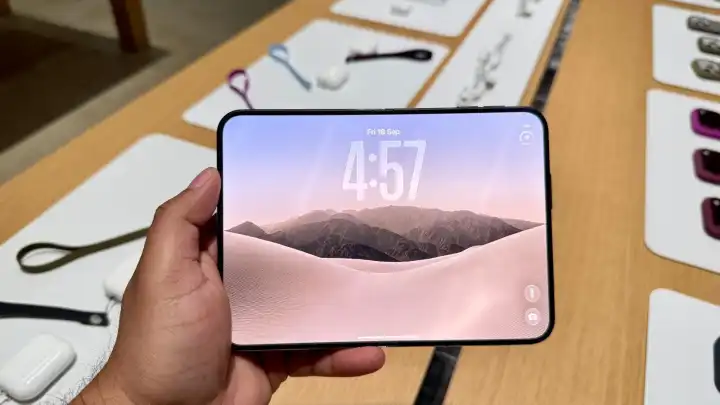
The best example came from something as simple as playing a game. I started playing on the outer display. Nothing unusual there. It felt like using a smaller iPhone. Then I rotated the phone. The interface responded. I opened the phone. The game continued on the larger inner display. I rotated it again. The game continued. I folded it. It continued. I unfolded it. Again, it continued!
There was no moment where I felt I had to stop and think, Ok, now I need to tell the phone what screen I want to use.
The phone simply understood what I was doing. That is what Apple means when it talks about designing hardware and software together.
The iPhone Duo can react as you fold, unfold and rotate it, moving content to the appropriate display and maintaining continuity between the two screens.
It sounds like a small thing when written down. It isn’t.
After using it, I found myself doing something I don’t normally do with foldables: changing the physical shape of the phone without worrying about what the software was going to do next.
App Continuity Is The Real Feature
This is probably the software feature I would highlight above everything else. Apple isn’t treating the outer and inner displays as two completely separate experiences. They feel like two parts of the same experience.
Start something outside and continue inside. Open the phone and get more space. Rotate it and the interface adapts. Fold it back and the experience follows you.
And when you experience that rather than simply reading about it, the difference is noticeable. This is where some Android foldables still feel like they are asking the user to understand the phone. The Duo feels like the phone is trying to understand the user.
iOS 27 Finally Has Room To Breathe
The other major change is what Apple has done with iOS itself. The standard iPhone interface obviously wasn’t designed for a large foldable display. Apple has therefore moved several elements around. Controls, navigation and the Dock are positioned differently to make better use of the available space. When the phone is open, you can have two Home Screen pages with Today View on the left. The status bar and Dynamic Island have also been redesigned for the unusual display arrangement.
It sounds complicated. It doesn’t feel complicated. That is probably the most Apple thing about it.
The software changes are noticeable, but they don’t feel like a completely different operating system.
Finally, Multitasking On An iPhone Makes Sense
With Split View multitasking, you can have two apps open side by side on the inner display. You can also open two windows of the same app, such as Safari, switch between apps quickly and save app pairs for later.
This is one area where the bigger screen changes how I used the phone. A foldable is supposed to give you more screen.
But simply making an app bigger isn’t enough. The software has to make use of that additional space. The Duo does.
You can have one app occupying one side while another sits beside it. You can browse something while keeping another app visible. You can even have a conversation with Siri AI while continuing to look at content on the other side of the display.
After an hour, I could see why this form factor makes more sense for productivity than simply giving you a gigantic phone screen.
Apple Has Also Thought About The In-Between Moments
On a regular iPhone, StandBy is primarily something you associate with charging. On the Duo, Apple has expanded it significantly. You can put the phone down and use StandBy on either the outer or inner display, even when it isn’t charging. It can become a clock, photo frame, widget hub or information display. These aren’t headline-grabbing features. But they are exactly the kind of details that make a new form factor feel considered.
Third-Party Apps Are Going To Be Important
The software experience will ultimately depend on developers. Apple has given developers tools to adapt applications to the Duo’s larger display and folding design, and several major apps are already designed to take advantage of the additional screen space.
Netflix, for example, can use the outer display for browsing and then take advantage of the larger inner screen when the phone is opened. Zoom can use the larger display to show participants alongside shared content. Slack can use the additional screen real estate to bring more of a workspace into view.
This is where Apple’s ecosystem could become important. A foldable is only as useful as the software that supports it. Apple has a massive developer ecosystem and is giving developers a specific set of tools to build for the Duo.
Siri AI Makes More Sense On The Big Screen
The Duo also gets Apple’s new Siri AI experience through iOS 27. The interesting part isn’t simply that Siri is available. It’s how much more useful a conversational assistant becomes when you have a large screen available at the same time.
Siri AI can use personal context, understand what’s on screen and take actions related to the content you’re viewing. You can also keep Siri AI open while looking at something else on the opposite side of the display.
That is a much more natural fit for an assistant than having it take over your entire phone screen.
And because Apple Intelligence is built around on-device processing and Private Cloud Compute for supported workloads, Apple is continuing to position privacy as part of the experience rather than an afterthought.
The Software Makes The Hardware Feel Less Complicated
That, ultimately, is what stayed with me after an hour with the iPhone Duo.
Foldables can sometimes feel like you’re constantly managing the hardware: Do I open it? Should I close it? Will this app resize? Will the interface rotate? Will the app restart? Will I lose what I was doing?
The Duo reduces much of that mental friction. You simply use the phone. Fold it. Unfold it. Rotate it. Start on the outside. Continue inside. The software follows.
Is Apple Really Seven Years Late?
Technically, yes. Samsung and other Android manufacturers have spent years developing foldable hardware and software. Apple is entering a category that competitors have already been refining for several generations.
But after using the Duo, I’m not convinced that “late” is the right way to describe Apple’s entry. Apple didn’t need to be the company that made the first foldable. It needed to make a foldable that felt like an iPhone. And that is exactly what surprised me most.
The Duo doesn’t feel like Apple has taken an existing iPhone, put a hinge in the middle and installed a bigger screen.
It feels like Apple started with a simple question: What should iOS do if the phone can physically change shape?
The answer is what makes the Duo interesting. The hinge is important. The displays are important. The thinness is important. But after an hour, the software is what I remembered. And that may be the biggest reason Apple’s first foldable doesn’t feel like a first-generation product.