IMC 2026: The World Is Almost Connected. The Next Challenge Is Getting The Next Billion Onto AI
The world has spent decades trying to connect people to the internet. Now, as artificial intelligence becomes the next major layer of the digital economy, the challenge is changing: getting people online is no longer eno
Ni Debashis Sarkar··45K nabasa
IMC 2026: The World Is Almost Connected. The Next Challenge Is Getting The Next Billion Onto AI
The world has spent decades trying to connect people to the internet. Now, as artificial intelligence becomes the next major layer of the digital economy, the challenge is changing: getting people online is no longer enough. They also need affordable access to AI, the skills to use it and the infrastructure to support it.
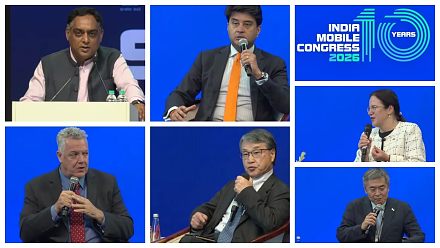
That was one of the central themes to emerge from a panel discussion titled “Scale Without Boundaries: Investing In The Next Billion Digital Connections” at India Mobile Congress 2026. The discussion, moderated by Nalin Mehta, Managing Editor of Moneycontrol and Chief AI Officer – Editorial Operations at Network18, brought together policymakers and telecom industry leaders from India, Estonia, Japan and international organisations.
The panel featured Jyotiraditya M. Scindia, India’s Minister for Communications and Development of North Eastern Region; Liisa-Ly Pakosta, Estonia’s Minister of Justice and Digital Affairs; Hideo Fuseda, Vice Minister for International Affairs at Japan’s Ministry of Internal Affairs and Communications; Seizo Onoe, Director of the Telecommunication Standardization Bureau at the ITU; and John Giusti, Chief Regulatory Officer at GSMA and President of the GSMA Foundation.
The World May Be Connected, But Billions Still Aren’t Using The Internet
One of the starkest numbers came from Giusti. He said around 97% of the global population is now covered by mobile broadband. Yet about 3.1 billion people are covered by a mobile network but are still not using mobile internet.
That distinction is important. Network coverage does not automatically translate into digital participation.
Giusti said digital skills and, particularly, affordability remain major barriers. The arrival of AI could make that problem harder if the technology increases the cost of smartphones and other connected devices.
He pointed to the current pressure on memory supply caused by the AI boom and warned that rising costs could make it increasingly difficult for the poorest 20% of the population to access newer technologies.
That potentially creates a new version of the digital divide. Instead of simply asking who has an internet connection, governments and the technology industry may increasingly have to ask who can afford to access the AI services running on top of that connection.
India Has Solved One Part Of The Problem
India’s experience was central to the discussion. Scindia said 99% of the country’s population is now covered by mobile broadband, putting India among the world’s largest connected markets.
But the government’s focus is shifting towards making the underlying infrastructure more efficient and extending connectivity into areas where commercial investment alone may not provide sufficient returns.
Scindia highlighted the amended BharatNet programme, which he said involves around $14 billion in investment to build the middle-mile digital infrastructure connecting districts, blocks and Gram Panchayats. The government sees this infrastructure as a kind of digital highway that private telecom companies can use to reach customers.
India is also pushing infrastructure sharing. According to Scindia, sharing towers and fibre, along with greater use of government-built infrastructure, has resulted in a roughly 25% reduction in capital expenditure and a 33% reduction in operating expenditure.
The government is also working to extend mobile coverage into villages that still lack a signal. Scindia said around 26,000 towers are being deployed across approximately 35,000 villages as part of the push towards nationwide coverage.
The message from India was therefore clear: connectivity has to be treated as shared infrastructure rather than something every private operator needs to build independently.
But AI Could Create A New Digital Divide
That is where Pakosta’s comments from Estonia added another dimension to the discussion.
Estonia is one of the world’s most digitally advanced countries. Pakosta said nearly 100% of Estonian households have access to 5G and 82% have fibre connections. Almost all government services have also been digitised.
But Estonia’s approach is not simply to put every service online and assume everyone will use it.
Pakosta said citizens can choose not to use digital devices and can still access government services through a network of public libraries. Those libraries are increasingly also being used to teach people AI skills.
The underlying principle, she argued, is that digitalisation should not leave people behind. People should have access to digital and AI services even if they do not personally own a smartphone, computer or other connected device.
For Pakosta, the issue is becoming one of equality and sovereignty. If access to increasingly powerful AI systems is limited by income, language, skills or infrastructure, AI could make the existing digital divide larger rather than smaller.
She also argued that smaller languages and cultures need to be represented in AI systems, highlighting a problem that goes beyond connectivity: even when people have access to AI, the technology needs to work for them.
India, Japan And Estonia Are Tackling Different Parts Of The Same Problem
The Japanese perspective focused heavily on the infrastructure required to support the next generation of digital services.
Fuseda said Japan is supporting investments and technology demonstrations involving data centres, fibre networks, submarine cables and 5G infrastructure. Japanese companies are also working with Indian partners across areas including mobile networks, 5G equipment, fibre technologies and data centres.
Japan’s focus is increasingly on resilience as well. Digital infrastructure has to remain operational during natural disasters and cyberattacks, while the rapidly increasing energy requirements of AI also need to be addressed.
Onoe of the ITU made a similar point from a global perspective. He argued that traditional connectivity infrastructure remains fundamental even in the AI era. Broadband networks, data centres and cloud infrastructure are not separate from AI; they are the foundation on which AI services will be built.
He also stressed that no single country can build the entire AI infrastructure ecosystem on its own. Cooperation between countries and industries, along with common technical standards, will therefore become increasingly important.
The Next Billion Need More Than A Network
The discussion at India Mobile Congress ultimately pointed to a significant change in how digital inclusion needs to be measured.
For years, the primary objective was to bring a mobile network or broadband connection to people who did not have one. India and many other countries have made enormous progress on that front.
The next challenge is considerably more complicated.
People need devices they can afford. They need digital and AI skills. They need services in languages they understand. They need reliable electricity, fibre, cloud infrastructure and data centres behind those services. They need protection from cyber threats and other risks. And they need enough trust in digital systems to actually use them.
Most importantly, the economics of AI cannot be allowed to push the least-connected people further away from the technology.
That is why the next billion digital connections may not simply be about connecting another billion people to the internet. They may be about connecting them to the opportunities created on top of it.
India’s infrastructure expansion, Estonia’s emphasis on inclusion, Japan’s investment in resilient networks and the ITU’s push for international standards are different approaches to the same challenge.
The world may be approaching universal network coverage. But universal access to the AI economy is a much bigger task.