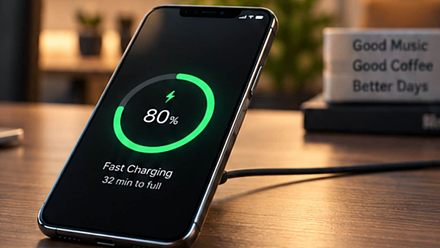
Fast Charging, 80% Limits & Overnight Charging: Are We Overthinking Phone Batteries?
I remember a time when charging a mobile phone meant plugging it in at night and forgetting about it until morning. Nobody discussed charging curves, battery cycles, temperature, 80% limits or whether those innocent elec
Ni Anjan N Ghosh··32K nabasa
Fast Charging, 80% Limits & Overnight Charging: Are We Overthinking Phone Batteries?
I remember a time when charging a mobile phone meant plugging it in at night and forgetting about it until morning. Nobody discussed charging curves, battery cycles, temperature, 80% limits or whether those innocent electrons were slowly murdering the battery.
Today, charging a smartphone apparently requires a degree in electrical engineering. Never charge beyond 80%. Don’t let it fall below 20%. Never charge overnight. Fast charging destroys your battery. Don’t use your phone while it’s charging. Only use the charger that came with the phone. That last one has become particularly interesting considering many manufacturers don’t give you a charger anymore!
Then we have phones proudly advertising 80W, 100W or even faster charging. Manufacturers spend enormous amounts of engineering and marketing effort telling us how quickly their phones can charge, while many owners immediately go into Settings looking for a way to make them charge more slowly.
It’s a bit like buying a Ferrari and then spending the first evening searching the owner’s manual for instructions on how to permanently restrict it to 60 km/h.
Something doesn’t quite add up.
So, after separating battery chemistry from internet mythology, here’s the question I really wanted answered: How much should we actually worry about the way we charge our phones?
First, your battery is going to die
Let’s get the unpleasant part out of the way. Your smartphone uses a rechargeable lithium-ion battery, and from the moment you start using it, that battery begins ageing. You cannot stop this. Even if you treat your phone like a newborn baby, whisper encouraging words to the battery and never allow the charge percentage to leave the sacred 20-80% zone, it will still age.
Battery ageing is affected by several things, including temperature, charging patterns, how deeply the battery is regularly discharged and how much time it spends at very high states of charge. So the objective isn’t to prevent battery degradation. That’s impossible. The objective is simply to avoid unnecessarily accelerating it.
And if there’s one thing I’d worry about more than most of the charging myths we obsess over, it’s heat.
Heat – that’s the one I’d worry about
Lithium-ion batteries don’t particularly like heat. Charging generates some heat. Fast charging can generate more. Gaming generates heat. Shooting long videos generates heat. Leaving your phone on the dashboard of a car parked in Delhi in May generates the sort of heat that makes everything else in this article academic.
This is why I wouldn’t worry too much if my phone becomes mildly warm while fast charging. That’s normal. If it becomes uncomfortably hot, that’s different. It also explains why playing a demanding game while simultaneously fast charging isn’t something I’d make a daily habit. The issue isn’t that electricity is somehow entering and leaving the battery at the same time and confusing it. You’re simply combining two heat-generating activities.
And please don’t charge your phone underneath a pillow. Your phone isn’t cold and the pillow isn’t a blanket.
If you’re doing that while playing Call of Duty, I suspect the 80% battery limit is the least of your problems.
So, does fast charging destroy your battery?
No. But there’s a slightly longer answer.
Modern smartphones don’t simply connect 100W to the battery and hope for the best. Charging is controlled by the phone’s battery-management system, charger and software. Power is adjusted depending on battery temperature, state of charge and other conditions. You’ll also notice that the spectacular charging speeds manufacturers advertise don’t continue all the way to 100%. Charging is generally much faster when the battery is relatively empty and slows considerably as it fills.
Think of filling an empty glass from a tap. Initially you can open the tap fully. As the water approaches the top, you slow down unless you particularly enjoy cleaning the kitchen floor. Battery charging isn’t literally the same process, obviously, but the analogy works.
There is a qualification. Higher charging currents and the additional heat associated with aggressive charging can contribute to battery wear, so gentler charging conditions can benefit long-term battery health.
But context matters.
If I’m charging overnight and have eight hours available, do I need 100W charging? Of course not. If I’m leaving for the airport in 20 minutes and my phone is at 12%, am I going to refuse fast charging because I might preserve another fraction of battery capacity two years from now? Also no.
At that moment I have a flight to catch. My battery’s retirement planning can wait.
That’s exactly what fast charging is there for.
Ah, the famous 80% rule
This one isn’t a myth. Lithium-ion batteries generally prefer not spending excessive amounts of time completely full, which is why many modern phones now provide charging limits or adaptive charging features.
So should everybody immediately limit their phone to 80%?
I don’t think so, because you’ve just voluntarily given yourself a phone with a battery that’s effectively 20% smaller.
If you normally finish the day with 30-40% remaining, an 80% limit makes perfect sense. You’re giving up capacity you weren’t using anyway. If your phone regularly reaches 10% by 7 PM, deliberately starting every morning with only 80% because you’re worried about battery health seems slightly absurd.
You’re compromising today’s battery life to preserve tomorrow’s battery life.
It’s the smartphone equivalent of refusing to sit on your new sofa because you don’t want the cushions to wear out.
And 80% isn’t a magical number where batteries suddenly become immortal. If your phone allows 85%, 90% or 95%, one of those may be a better compromise. On a normal working day I might not need 100%. Travelling all day? Long flight? Poor mobile coverage where the phone will constantly hunt for a signal? I’ll take every percentage point available, thank you very much.
Battery protection should be a tool, not a religion.
Is charging overnight bad?
This is probably one of the oldest smartphone battery myths still circulating.
Modern smartphones don’t continue force-feeding electricity into a full battery until sunrise. Once full, the charging system manages the battery rather than simply hammering it with maximum power for the rest of the night. Features such as Apple’s Optimised Battery Charging, Google’s Adaptive Charging and similar battery-protection systems are designed to reduce unnecessary time spent sitting completely full.
So yes, I charge overnight when it’s convenient.
My preference is simply to turn on whatever adaptive or optimised charging feature the phone provides and let the phone manage itself. Modern phones monitor temperature, charging behaviour and battery condition continuously.
It’s probably monitoring the battery more carefully than I am.
Actually, considering the amount of time some of us spend staring at Battery Health percentages, perhaps that’s debatable.
Should I wait until 0% before charging?
Please don’t.
Lithium-ion batteries don’t need to be routinely drained to zero before being recharged. Frequent deep discharges are generally harder on them than shallower charging cycles.
So if your battery is at 47% and you’re leaving home in an hour, charge it. You don’t have to wait until 20%. Likewise, plugging it in at 63% isn’t somehow ‘wasting a cycle’. A battery cycle is based on cumulative battery usage equivalent to its full capacity, not simply how many times you connect the charger.
Your phone isn’t keeping a notebook saying, ‘Aha! He plugged me in again. That’s another cycle.’
If it were, mine would probably have requested counselling by now.
Can I use the phone while it’s charging?
Yes.
Answering WhatsApp, reading email, browsing or watching YouTube while charging isn’t going to destroy the battery. Again, heat is the qualification.
Running a graphically demanding game at maximum brightness while simultaneously fast charging in a hot room is different because you’re potentially creating considerably more heat. The activity isn’t forbidden. I simply wouldn’t turn it into a daily battery-health experiment.
Think of the phone getting slightly warm as normal exercise.
If it starts feeling like a freshly made dosa tawa, perhaps give it a rest.
Do I need the original charger?
Not necessarily. What you need is a good-quality, standards-compliant charger and cable compatible with your phone’s charging requirements.
This is one area where saving ₹700 after spending ₹80,000 on a smartphone has always puzzled me. You don’t necessarily need the manufacturer’s charger, particularly with devices supporting widely adopted USB-C charging standards, but I’d stick to established brands, appropriate power ratings and properly certified cables.
The charger is connected to an expensive electronic device containing a lithium-ion battery sitting a few centimetres from your body.
Perhaps this isn’t the ideal place to discover the cheapest product available on the internet.
There are better opportunities in life to save ₹700.
What about wireless charging?
Wireless charging is wonderfully convenient. Place the phone down. Pick it up. No cable. I use and like it.
It can, however, be less energy-efficient and generate more heat than a good wired connection, depending on the charger, alignment, case and charging standard. Does that mean you should stop using wireless charging? Again, no. If the phone remains reasonably cool and wireless charging fits your routine, use it.
I’m beginning to notice a pattern here.
Almost every battery question eventually comes back to the same answer: don’t unnecessarily cook the battery.
Perhaps that should have been the entire article.
Would have saved both of us ten minutes.
So how should we actually charge our phones?
After all the arguments, specifications, YouTube videos and battery-health discussions, my approach has become surprisingly uncomplicated. I use optimised charging features. If I don’t need the full capacity that day, I’m perfectly comfortable using a charge limit. If I’m travelling or expect heavy usage, I charge to 100%. I use fast charging when I need fast charging, and I don’t lose sleep if the phone stays plugged in overnight.
What I pay considerably more attention to is temperature. If the phone is getting unusually hot while charging, I want to know why. Maybe I’m running something demanding, maybe it’s sitting somewhere without ventilation, maybe wireless charging alignment is poor or perhaps the ambient temperature is simply too high.
Those things concern me far more than accidentally charging the battery from 78% to 100%.
And perhaps that’s where we’ve gone slightly wrong with battery-health advice. Recommendations that were meant to help us use our phones sensibly have gradually turned into rules that make some people afraid to use 20% of the battery they already paid for.
My Take
We’ve somehow reached a point where smartphone batteries have become another thing we’re expected to micromanage. Charge to 80%. Don’t fall below 20%. Don’t charge overnight. Don’t fast charge. Don’t wireless charge. Don’t use the phone while charging.
Follow every piece of internet battery advice simultaneously and eventually the safest option may be to switch the phone off, place it in a climate-controlled cupboard at 50% charge and never use it again.
Your battery will probably remain in excellent condition.
Your smartphone will be slightly less useful.
For me, the sensible approach is much simpler: avoid excessive heat, use good chargers and cables, turn on your phone’s battery optimisation features, use a lower charge limit when it comfortably fits your routine, charge to 100% when you actually need 100%, and use fast charging when having your phone ready quickly matters more than obsessing over theoretical battery longevity.
The battery is a consumable component. Eventually it will degrade and, if you keep the phone long enough, it may need replacing. I’d rather replace a battery after a few years than spend those years suffering from battery anxiety.
After all, I bought the phone to make my life easier.
I didn’t buy it to become its battery caretaker.
Disclaimer: Battery behaviour varies by device, battery chemistry, charging system, software and usage conditions. Follow your device manufacturer’s charging and safety recommendations, particularly if your phone, battery or charger becomes abnormally hot, damaged or swollen.