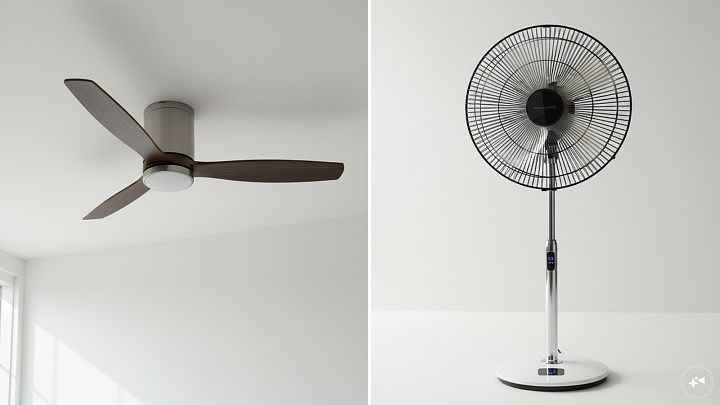
Ceiling Fan Vs Pedestal Fan: Which Cools Better During Peak Summer?
When temperatures climb during peak summer, simply buying the most powerful-looking fan may not give you the cooling you expect. Ceiling fans and pedestal fans both cool people by moving air, but they distribute that air
Ni Consumer Trends Desk··12K nabasa
Ceiling Fan Vs Pedestal Fan: Which Cools Better During Peak Summer?
When temperatures climb during peak summer, simply buying the most powerful-looking fan may not give you the cooling you expect. Ceiling fans and pedestal fans both cool people by moving air, but they distribute that air very differently.
A ceiling fan circulates air over a much larger area and is generally better when several people are using the room. A pedestal fan concentrates airflow in a particular direction, which can make it feel more powerful when you are sitting or sleeping close to it.
So, which actually cools better? For whole-room comfort, a ceiling fan usually has the advantage. For strong, targeted airflow, a pedestal fan can feel cooler.
Which should you buy?
Buy a ceiling fan if:
You want air circulation across most of the room.
Several people regularly use the space.
You want a permanent cooling solution for a bedroom or living room.
You prefer to keep floor space free.
You want an energy-efficient BLDC model for long hours of use.
Buy a pedestal fan if:
You want a strong breeze directed towards you.
You need a fan that can be moved between rooms.
You cannot install a ceiling fan.
You want additional airflow alongside an air conditioner or ceiling fan.
You need cooling for a specific area such as a desk, bed or seating space.
Top picks
1. Havells Ambrose 1200mm
Price: Was – 4,040 | Now – Rs 2,349 | Discount: 42%
2. Crompton Surebreeze Sea Sapphira 1200mm
Price: Was – Rs 2,599 | Now – Rs 1,799 | Discount: 31%
3. atomberg Renesa Enzel 1200mm BLDC
Price: Was – Rs 5,110 | Now – Rs 3,849 | Discount: 25%
4. Orient Electric Stand 81 400mm
Price: Was – Rs 3,999 | Now – Rs 2,579 | Discount: 36%
5. atomberg Renesa 400mm BLDC
Price: Was – Rs 6,700 | Now – Rs 3,699 | Discount: 45%
6. Havells Gatik Pro 400mm
Price: Was – Rs 4,800 | Now – Rs 2,990 | Discount: 38%
Quick comparison
Feature
Ceiling fan
Pedestal fan
Air coverage
Wide, room-level
Focused
Perceived breeze
More evenly distributed
Stronger at close range
Portability
No
Yes
Floor space required
No
Yes
Installation
Usually required
Minimal
Direction control
Limited
Easy
Oscillation
No
Usually yes
Best for several people
Better
Less suitable
Best for one person
Good
Excellent
Peak-summer use
Whole-room circulation
Direct cooling
How does a ceiling fan cool you?
A ceiling fan does not actually reduce the temperature of the room. Instead, the moving air helps sweat evaporate from your skin more quickly, making you feel cooler.
Its biggest advantage is coverage. Because a ceiling fan sits above the room and uses relatively large blades, it can move air across a broad area. A 1200mm fan is a common choice for bedrooms and other medium-sized rooms.
This makes ceiling fans particularly useful when several people are in the same room. Rather than directing a narrow stream of air at one person, the fan creates more general air circulation.
Where ceiling fans perform best
Ceiling fans make sense for bedrooms, living rooms, dining areas and other spaces where you want continuous airflow across much of the room.
They are also convenient for long-duration use because they do not occupy floor space. Modern BLDC ceiling fans can further reduce power consumption compared with conventional fan motors.
Where ceiling fans struggle
The main limitation is that you cannot easily direct the breeze towards one particular person.
If you are sitting in one corner of a large room, for example, a pedestal fan positioned nearby may feel considerably stronger.
Installation is another consideration. A ceiling fan requires a suitable ceiling point and proper mounting, whereas a pedestal fan can essentially be positioned wherever there is a power socket.
How does a pedestal fan cool you?
A pedestal fan uses a smaller fan head mounted on an adjustable stand. Instead of circulating air broadly from above, it pushes air horizontally towards a particular part of the room.
That concentrated airflow explains why a pedestal fan can sometimes feel cooler than a ceiling fan during extremely hot weather.
Place one a few feet from your bed, sofa or work desk and you receive much more direct airflow.
Most pedestal fans also oscillate from side to side, allowing them to distribute air across a wider section of the room.
Where pedestal fans perform best
Pedestal fans are particularly useful for personal cooling. You can position one beside a bed, desk or sofa and direct the airflow towards yourself.
Portability is another major advantage. The same fan can be used in a bedroom during the night and moved to a living area during the day.
Where pedestal fans struggle
Coverage is the biggest drawback. Even with oscillation, the airflow is more directional than that of a ceiling fan.
A pedestal fan also takes up floor space and requires positioning relatively close to the area you want to cool. At higher speeds, some models can also be more noticeable in terms of airflow noise.
Which gives stronger airflow?
This depends on what you mean by stronger.
If you stand directly in front of a pedestal fan, the concentrated breeze can feel significantly stronger because the air is being directed towards a relatively small area.
A ceiling fan spreads its airflow across a larger portion of the room. The breeze may therefore feel less concentrated, but more people can benefit from it simultaneously.
Think of it this way: a pedestal fan is better at cooling a person, while a ceiling fan is better at circulating air around a room.
Which is better during peak summer?
For most bedrooms and living rooms, a ceiling fan remains the more practical primary fan during peak summer. It provides continuous circulation without occupying floor space and can serve several people at once.
But a pedestal fan can be extremely useful when temperatures become uncomfortable and you want extra airflow directly on you. It can also complement an air conditioner by helping circulate cooled air around the room.
In particularly hot conditions, therefore, the best solution may not necessarily be choosing one over the other. A ceiling fan can provide general circulation while a pedestal fan supplies additional targeted airflow where it is needed most.
Common usage scenarios
Situation
Ceiling fan
Pedestal fan
Better choice
Bedroom with two people
Excellent
Good
Ceiling fan
Large living room
Excellent
Good
Ceiling fan
One person working at a desk
Good
Excellent
Pedestal fan
Need strong breeze near bed
Good
Excellent
Pedestal fan
Several people in a room
Excellent
Good
Ceiling fan
Need to move fan between rooms
No
Excellent
Pedestal fan
Limited floor space
Excellent
Poorer
Ceiling fan
Additional cooling with AC
Excellent
Excellent
Either
So, which should you choose?
Choose a ceiling fan if you are buying the main fan for a bedroom, living room or other regularly occupied space. Its wider air circulation makes it the better all-round choice, particularly when more than one person needs cooling.
Choose a pedestal fan when portability and concentrated airflow matter more. It is particularly useful for people who want a strong breeze while sleeping, working or sitting in one location.
For peak summer, neither actually lowers room temperature in the way an air conditioner does. The difference is in airflow. Ceiling fans win for coverage; pedestal fans win for targeted cooling.
FAQs
1. Does a pedestal fan cool better than a ceiling fan?
It can feel cooler when positioned close to you because it directs a concentrated stream of air towards your body. A ceiling fan, however, provides better overall circulation across a room.
2. Which fan is better for sleeping?
A ceiling fan is generally convenient for maintaining airflow throughout the bedroom. A pedestal fan may be preferable if you like a stronger breeze directed towards the bed.
3. Which fan is better for a large room?
A suitably sized ceiling fan is generally the better primary option because it distributes air over a wider area.
4. Can I use a pedestal fan with a ceiling fan?
Yes. During very hot weather, the ceiling fan can provide general circulation while the pedestal fan provides additional airflow towards a particular seating or sleeping area.
5. Does a fan actually reduce room temperature?
No. Fans primarily make people feel cooler by increasing air movement and helping sweat evaporate. They do not refrigerate the air or substantially lower the room temperature.
6. Is a BLDC fan better for long hours of use?
BLDC fans are generally designed to consume less electricity than conventional induction-motor fans, making them worth considering when the fan runs for many hours each day.
Disclaimer: The product descriptions mentioned in the article are solely based on the primary and secondary research conducted by our experts. To keep you ahead of the curve with these latest products, News18 utilises affiliate links. This means if you decide to shop through our recommendations, we may earn a small referral commission at no extra cost to you. Please be advised that News18 is not responsible for any claims under the Consumer Protection Act, 2019, or other applicable laws regarding the final performance, quality, or safety of these products.