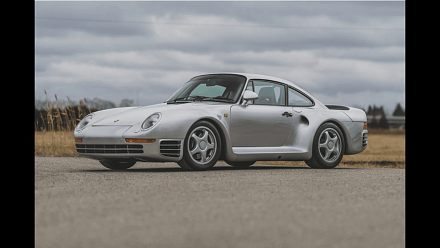
Bill Gates Bought a Porsche 959 in 1988. It Then Spent 13 Years Stuck in US Customs
Bill Gates once owned a Porsche that he could not legally drive on American roads. The Microsoft co-founder bought a rare Porsche 959 in 1988, but the supercar ended up spending more than 13 years in a US customs facilit
Ni Ayush Mukherjee··26K nabasa
Bill Gates Bought a Porsche 959 in 1988. It Then Spent 13 Years Stuck in US Customs
Bill Gates once owned a Porsche that he could not legally drive on American roads. The Microsoft co-founder bought a rare Porsche 959 in 1988, but the supercar ended up spending more than 13 years in a US customs facility because it had not been certified to meet American safety and emissions regulations.
The problem was not the Porsche’s performance or whether it was considered safe by normal standards. The issue was that the 959 had never been produced in a version certified for the US market. That meant Gates could own the car, but could not simply register it and drive it legally on public roads.
According to Forbes, Gates’ Porsche remained in customs for 4,745 days — more than 13 years. The lengthy wait reportedly resulted in around $133,000 in storage and related fees.
Why Was Bill Gates’ Porsche 959 Held by US Customs?
The Porsche 959 was built in extremely limited numbers and was never officially certified for the US market. As a result, it did not satisfy the Federal Motor Vehicle Safety Standards and emissions requirements necessary for normal importation and registration.
For Gates and other American collectors, this created an unusual situation. They could purchase one of the world’s most technologically advanced sports cars, but there was no straightforward legal way to put it on American roads.
Gates’ 959 consequently remained in customs while he and other enthusiasts looked for a solution that would allow these historically significant vehicles to be legally imported.
The Porsche 959 Was Years Ahead of Its Time
The 959 was not an ordinary sports car. Porsche developed it using technology from its Group B rally programme and used the road-going version as a showcase for what advanced automotive engineering could achieve in the 1980s.
At its heart was a 2.85-litre flat-six engine equipped with sequential twin turbochargers. It produced roughly 450 PS and helped the car reach a top speed of around 317 km/h. Porsche says the 959 could accelerate from 0 to 100 km/h in just 3.7 seconds.
Its technology extended well beyond the engine. The car featured an advanced all-wheel-drive system, electronically controlled suspension, ABS and lightweight construction — features that were highly unusual for a production performance car at the time.
Only 292 Road-Going Porsche 959s Were Built
Its engineering was matched by extraordinary rarity.
Porsche produced just 292 road-going customer examples of the 959 between 1987 and 1988. The original price was around $225,000, making it an exceptionally expensive car for its era.
Today, its combination of rarity, racing heritage and technological importance has made the 959 one of Porsche’s most desirable collector cars. Porsche notes that examples have sold for more than $1.5 million at auction.
Gates was also not the only high-profile owner. Porsche lists comedian Jerry Seinfeld and tennis legend Martina Navratilova among other notable owners of the model.
How Bill Gates and Other Owners Pushed for a Legal Solution
The problem affected more than Gates. American collectors who wanted to bring rare foreign vehicles into the country faced the same regulatory barrier when those cars had never been certified for the US market.
Bruce Canepa, an automotive entrepreneur and Porsche specialist, became particularly involved in efforts to find a solution. Canepa had acquired a Porsche 959 himself and worked on making the car comply with US requirements.
Those efforts helped contribute to the eventual creation of the Show or Display exemption, giving owners of certain historically or technologically significant vehicles a legal route to import them despite not meeting every requirement applicable to ordinary vehicles.
What the Show or Display Exemption Changed
The exemption came into effect in the late 1990s and allowed qualifying vehicles to be imported into the US under specific restrictions rather than being treated like conventional cars.
One of the most important conditions was a strict mileage limit. Vehicles imported under the exemption generally could not be driven more than 2,500 miles per year.
The vehicles also had to demonstrate sufficient historical or technological significance to qualify. Importantly, approval under the exemption did not automatically remove every federal requirement, including applicable emissions regulations.
For rare vehicles such as the Porsche 959, however, the rule created a legal path that had previously been difficult or impossible to access.
The Porsche 959 Was Born From Rally Racing
The story of the 959 begins with Porsche’s involvement in Group B rallying.
The company used its rally programme as a laboratory for developing technologies that would eventually find their way into the road-going 959. Porsche says the earlier competition version won the 1984 Paris-Dakar Rally, while the company went on to achieve a one-two finish in the 1986 event.
The rally programme was particularly important in the development of the sophisticated four-wheel-drive technology that became one of the defining characteristics of the 959.