'I Was Making More Money...': HR Executive Who Oversaw Mass Layoffs Gets Promoted, Then Loses His Own Job
An HR executive who was once responsible for delivering the difficult news of layoffs found himself receiving the same news just weeks later. Bobby Powers had recently secured a promotion and a significant career boost a
Ni Buzz Staff··54K nabasa
'I Was Making More Money...': HR Executive Who Oversaw Mass Layoffs Gets Promoted, Then Loses His Own Job
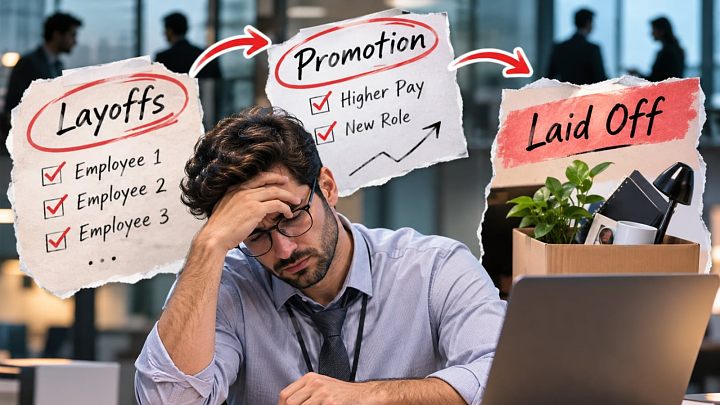
An HR executive who was once responsible for delivering the difficult news of layoffs found himself receiving the same news just weeks later. Bobby Powers had recently secured a promotion and a significant career boost after helping his company carry out mass layoffs. But his improved professional standing offered little protection when the organisation announced another round of job cuts.
Powers, a Seattle-based leadership coach who previously worked in the human resources department of a media startup, recalled the emotionally challenging experience in an interview with Business Insider. He had been involved in helping the company’s management carry out a significant round of workforce reductions, which involved informing several employees that their services were no longer required.
What made the process particularly difficult was that many of the people affected were not underperformers but employees who had built close professional relationships with their colleagues and consistently delivered strong results.
“It was a really jarring experience because it involved people you knew pretty closely,” he said.
According to Powers, the company’s leadership initially wanted to make sufficiently large cuts to avoid having to conduct another round of layoffs in the future. However, worsening revenue projections forced executives to repeatedly reconsider their decisions and expand the list of employees who would be let go.
‘You’re Putting Humans In A Spreadsheet’
Powers said one of the most difficult aspects of the exercise was dealing with the human consequences of decisions that were largely driven by business requirements. While companies often approach workforce reductions through financial projections and operational planning, those decisions ultimately affect people’s livelihoods.
“At the end of the day, you’re putting humans in a spreadsheet,” he said.
He recalled spending considerable time with his manager discussing how they could make the process as compassionate and respectful as possible. After weighing different approaches, the company decided to communicate the layoffs through video calls rather than emails or automated notifications, believing that direct conversations would make the difficult news slightly more personal.
However, that did little to ease the emotional burden of having to deliver such news to colleagues. “The layoff calls were some of the hardest conversations I’ve ever had to have,” Powers said.
Got Promoted After Layoffs, Only To Lose His Own Job Six Weeks Later
Interestingly, Powers’ professional circumstances appeared to improve after the initial round of workforce reductions. Following the layoffs, he received a promotion and saw his earnings increase, reaching a point where he was making more money than ever before.
“I was making more money than I’d ever made,” he said.
However, the positive development did not last long. Approximately six weeks after his promotion, Powers received an unexpected call from his manager, who informed him that another round of layoffs was being planned. “We’re doing another layoff, and I think we’re on the chopping block this time,” she told him.
The warning soon became reality. On the morning the company carried out the next round of job cuts, Powers discovered that he could no longer access his official company email account. It was then that he realised his employment had come to an end. “The cord had been pulled,” he recalled.
Layoff Experience Changed His Perspective
The experience also challenged Powers’ earlier assumptions about corporate layoffs. Before being involved in the process himself, he believed that workforce reductions primarily affected employees who were not performing well or failing to meet expectations.
However, witnessing the process from the management side and subsequently experiencing it as an employee made him realise that job cuts are not necessarily a reflection of an individual’s professional capabilities.
He explained that even employees who are performing well, earning promotions and contributing to a company’s growth can find themselves affected by organisational decisions. “Going through the process of laying people off, you realise that’s not at all what it is,” he said.
Powers’ experience highlights how layoffs can often extend beyond individual performance, with financial pressures and changing business priorities influencing decisions about who stays and who goes.
It also underscores the emotional complexity faced by HR professionals, who may be responsible for communicating difficult decisions without necessarily having control over the larger circumstances driving them.
Disclaimer: This article is based on user-generated content. The claims made in the original post have not been independently verified by News18.