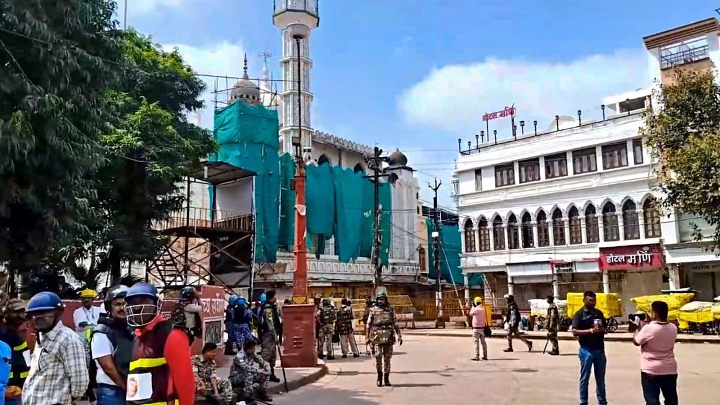
Why Is Ujjain's Shahi Masjid Facing Demolition? A 600-Year-Old Claim, History Explained
The Shahi Masjid in Ujjain has become the centre of a growing controversy as the Madhya Pradesh government prepares the city for the 2028 Simhastha Kumbh. Protests broke out around the mosque on Monday after authorities
Ni Apoorva Misra··45K nabasa
Why Is Ujjain's Shahi Masjid Facing Demolition? A 600-Year-Old Claim, History Explained
The Shahi Masjid in Ujjain has become the centre of a growing controversy as the Madhya Pradesh government prepares the city for the 2028 Simhastha Kumbh. Protests broke out around the mosque on Monday after authorities began work to remove a portion of the structure as part of a road-widening project.
The dispute has also put a spotlight on the mosque’s history. While members of the Muslim community have described it as a 636-year-old structure dating back to 1390, historical records supporting that exact date have not been clearly established in the public domain.
So, how old is the Shahi Masjid, where exactly is it located, why does the government want a portion removed, and what have the courts said?
Is The Shahi Masjid Really 600 Years Old?
The claim that the mosque is 636 years old comes primarily from the mosque’s imam, Mohammad Ibrahim.
Speaking to The Indian Express, Ibrahim claimed that the Shahi Masjid dates back to 1390, which would make it 636 years old in 2026. He added that previous road-widening exercises had left religious structures untouched.
However, this date is not an established historical fact based on the material currently available publicly.
A report by IBC24 quoted archaeology expert Dr Shubham Kevaliya as questioning the claim that the mosque is 636-650 years old, saying there was no archaeological record or historical evidence available to substantiate the date. The report also said the mosque’s year of construction is not clearly documented.
An online heritage database, Indo-Islamic Heritage, similarly lists the year of construction as unknown, while describing the mosque as a local historic mosque at Chatri Chowk near Gopal Mandir.
Where Is The Shahi Masjid?
The Shahi Masjid is located at Chatri Chowk in Ujjain, near Gopal Mandir, in the old market area of the city. The location is significant because the mosque lies on the road connecting Kanthal Chouraha to Gopal Mandir, a route that also connects towards the Mahakaleshwar Temple and the Kshipra river.
The Madhya Pradesh High Court, while hearing the mosque management’s challenge, noted that the structure is located almost opposite the Mahakaleshwar Temple and close to the Kshipra river. The road is also used during religious processions, including the Shahi Sawari and Peshwai, and is expected to see heavy movement during the 2028 Simhastha.
Why Does The Government Want To Demolish Part Of It?
The issue is not a proposal to demolish the entire mosque.
The Ujjain Municipal Corporation wants to widen the road to 15 metres, and a portion of the Shahi Masjid falls within the proposed road alignment.
According to the court record, the proposed removal affects part of the mosque’s prayer hall, or Jamat Khana; a 120-foot-high minaret, and the Mazhar Chouk Shahi. The mosque is registered as a Waqf property, and its management challenged the municipal notices in court.
The road-widening project is part of the broader preparations for Simhastha 2028, when Ujjain is expected to receive very large numbers of pilgrims. The Ujjain Municipal Corporation has said the widening is necessary for traffic management and public safety.
Why Is Simhastha 2028 Central To The Dispute?
Ujjain hosts the Simhastha Kumbh every 12 years. The 2028 edition is expected to bring crores of devotees to the city. The administration has therefore undertaken a large infrastructure push, including road widening and other projects.
According to The Economic Times, authorities have identified 272 structures affected by the road-widening project. The project covers a stretch of roughly 730 metres and involves widening the existing road to 15 metres, with around Rs 9.80 crore sanctioned for the work.
The Indian Express reported that the road stretch under consideration is roughly 900 metres and runs between Kanthal Chouraha and Gopal Mandir.
The differences in the reported length appear to relate to the particular stretch being described, but the central issue is the same: authorities want a wider road through this congested part of Ujjain ahead of Simhastha.
Was The Mosque Singled Out?
This is one of the central arguments in the dispute.
The mosque management argued that the authorities should explore another alignment or remove structures on the opposite side of the road instead of touching the mosque.
The Madhya Pradesh High Court, however, rejected the argument that the mosque was being selectively targeted. In its September 9 order, the court noted that portions of 10 temples and one mosque had already been removed along the same road and that action had been taken against structures involving around 80 religious places in Ujjain.
The court therefore held that the municipal corporation’s action could not be described as arbitrary merely because the property was a religious structure.
What Did The Madhya Pradesh High Court Say?
On September 9, a single judge of the Madhya Pradesh High Court’s Indore Bench dismissed two petitions challenging the proposed demolition.
The court said the authorities had followed the required statutory procedure and had considered the objections raised by the mosque management. It also said the upcoming Simhastha, traffic management and public safety were relevant considerations.
The court observed that “it is a hard reality that with the efflux of time, the population of the city has increased”. It further said the action could not be considered arbitrary, unjust or unconstitutional, or violative of Articles 14, 25, 26 and 300A of the Constitution, after the authorities followed due process.
The court also took note of the expectation of crores of devotees during Simhastha and the need to provide better facilities and manage traffic.
What Did The Mosque Management Argue?
The petitioners said the mosque was an ancient religious structure and that removing parts of the prayer hall, minaret and other structures would infringe their constitutional rights. They also argued that other properties near the mosque could be removed to achieve the required road width.
The mosque’s registration as a Waqf property was also highlighted during the proceedings. After the single-judge ruling, the mosque management approached a Division Bench of the high court.
What Happened During The Protests?
The controversy intensified over the weekend when members of the Muslim community gathered at the mosque and some decided to remain inside the premises to oppose the proposed demolition. Police and security forces were deployed around the area.
On Monday, tensions escalated after people gathered at the site as municipal workers began removing the portion falling within the proposed road alignment. Stone-pelting was reported, following which police used tear gas to disperse the crowd. Rapid Action Force personnel were also deployed.
The confrontation came as the matter was scheduled to come before a Division Bench of the Madhya Pradesh High Court.
The immediate legal question for now is whether the Division Bench will grant relief against the proposed removal after the single-judge bench dismissed the earlier petitions.
Meanwhile, the administration is continuing preparations for the Simhastha infrastructure works, while the mosque management and community members are opposing the removal.