When Kaziranga Waits For The Flood: The Boon And Bane Of The Brahmaputra
It’s almost three-quarters of the way through the year and time for early winter to set in across this part of the country, yet Kaziranga National Park in Upper Assam still waits for its share of floods.
Ni Niloy Bhattacherjee··88K nabasa
When Kaziranga Waits For The Flood: The Boon And Bane Of The Brahmaputra
It’s almost three-quarters of the way through the year and time for early winter to set in across this part of the country, yet Kaziranga National Park in Upper Assam still waits for its share of floods.
As floodwaters wreak havoc across Upper Assam’s Sivasagar, Charaideo and Jorhat districts, the World Heritage Kaziranga National Park anxiously waits for the very water that many outside its boundaries desperately dread.
It is one of nature’s most striking contradictions.
For communities across Assam, the arrival of floodwaters often signals disruption, displacement and loss. Roads disappear beneath the water, homes are inundated, agricultural fields are damaged and everyday life is brought to a standstill. Yet, only a few kilometres away from many of these flood-affected landscapes, there is a place where the absence of the same water can cause ecological anxiety. In the floodplains of Assam, Kaziranga National Park waits for the annual flood not as a catastrophe, but as an essential part of its ecological cycle.
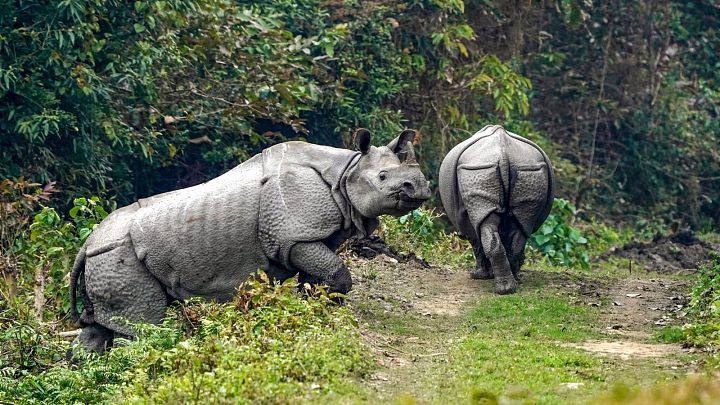
The apparent contradiction lies at the heart of Kaziranga’s relationship with the Brahmaputra. The river and its tributaries have, over centuries, shaped the park’s floodplain landscape, creating a dynamic mosaic of alluvial grasslands, wetlands, marshes, river channels and woodland. Kaziranga, spread across roughly 430 square kilometres, is globally recognised for its greater one-horned rhinoceros and is also an important habitat for elephants, swamp deer, wild water buffalo, tigers and a remarkable diversity of birds and other wildlife. Much of this biological richness is sustained by the ecological processes associated with seasonal flooding.
The annual flood is therefore far more than an episode of rising water. It is a major component of Kaziranga’s flood-pulse ecology. As the Brahmaputra and its tributaries overflow during the monsoon, water spreads across the floodplain, reconnecting wetlands and channels, transporting sediments and redistributing nutrients. When the water eventually recedes, it leaves behind nutrient-rich alluvial deposits that contribute to the productivity of grasslands and wetlands. This recurring cycle of inundation and recession helps maintain the ecological character of the park.
Kaziranga’s grasslands are particularly dependent on this disturbance regime. Grasslands are not permanent or static communities; their composition is continuously influenced by flooding, grazing, fire, soil moisture and sediment deposition. In the absence of periodic disturbance, natural ecological succession can gradually encourage shrubs and woody vegetation to expand into open grassland. Such a shift could reduce the availability of the short- and tall-grassland habitats that support large herbivores, including rhinoceroses, swamp deer and wild water buffalo.
Flooding can act as a natural ecological regulator in this process. The force and duration of floodwaters can disturb vegetation, reshape channels and redistribute sediments, creating a constantly changing landscape in which different plant communities compete and regenerate. The result is a shifting balance between grassland, wetland and woodland rather than the permanent dominance of one vegetation type.
The flood also influences Kaziranga’s wetlands, locally known as beels. These wetlands are vital feeding and breeding habitats for fish, amphibians, birds and numerous other organisms. Seasonal connectivity between rivers and wetlands allows water, nutrients and aquatic organisms to move through the floodplain. This hydrological connectivity is an important ecological function of a naturally operating river system.
Floodwaters can also influence the distribution of invasive plants. Water hyacinth, an aggressive aquatic weed, can form dense floating mats across wetlands and slow-moving water bodies. Such mats can interfere with light penetration, oxygen exchange and the ecological functioning of aquatic habitats. Strong seasonal water movement can break apart and transport these floating mats, preventing some water bodies from remaining permanently dominated by dense stands. Flooding should not, however, be considered a complete control mechanism for water hyacinth. Depending on water flow and subsequent conditions, floodwaters can also transport plant fragments and facilitate recolonisation elsewhere.
A similar complexity exists with invasive terrestrial plants. Species such as Mimosa diplotricha can invade grasslands and form dense vegetation, competing with native herbaceous plants. Floodwaters can transport seeds and other propagules through the floodplain, a process known as hydrochory. This means flooding can have two contrasting effects: it can disturb established vegetation while simultaneously dispersing seeds to new locations. Whether this benefits native grassland regeneration or contributes to the spread of an invasive species depends on the plant’s biology, seed viability, flood duration, sediment deposition and post-flood conditions.
This complexity is important because a flood is not inherently good or bad for an ecosystem. Its ecological effect depends on its magnitude, duration, timing and spatial extent.
A moderate seasonal flood that follows the natural hydrological cycle can replenish wetlands, redistribute nutrients and maintain grassland dynamics. An extreme flood, on the other hand, can inundate large portions of the park for prolonged periods and create significant risks for wildlife. For Kaziranga’s animals, flooding is often a test of survival. When water levels rise, rhinoceroses, elephants, deer and other animals move towards elevated areas.
The Karbi Anglong hills, located south of the park, become particularly important as natural refuges during periods of severe inundation. To reach these higher landscapes, however, wildlife may have to cross roads and human-dominated areas. This increases the risks of vehicle collisions, poaching and human-wildlife conflict.
The paradox is particularly striking in the case of the greater one-horned rhinoceros. Kaziranga is one of the world’s most important strongholds of the species, with recent official assessments recording more than 2,600 rhinos in the Kaziranga landscape. The park also supports a large elephant population, swamp deer and other herbivores, while its tiger population reflects the extraordinary productivity of its prey-rich floodplain ecosystem. These populations cannot be understood separately from the habitats that sustain them, and those habitats are themselves shaped by the annual hydrological cycle.
For this reason, conservationists increasingly emphasise that the objective should not be to prevent flooding in Kaziranga. Instead, conservation must seek to preserve the natural flood regime while reducing the risks associated with extreme events. Maintaining wetlands, natural drainage channels and river connectivity, protecting wildlife corridors and ensuring safe movement routes towards higher ground are all critical components of floodplain conservation.
The distinction between a natural flood and a disaster is particularly important.
A flood that inundates a village can be devastating because it threatens human lives, homes and livelihoods. Within a floodplain ecosystem, however, seasonal inundation can be an essential ecological process.
The same water that destroys a road outside the park may replenish a wetland inside it. The same sediment that creates problems for human infrastructure can provide nutrients for grassland vegetation. The same river that threatens communities can sustain one of India’s most important wildlife landscapes.
This does not mean Kaziranga needs increasingly severe floods. Nor does it mean every flood is beneficial. Climate variability, changes in river morphology, land-use change, embankments and other human interventions can alter the natural timing and intensity of flooding. A floodplain ecosystem evolved around a particular rhythm of wetting and drying, and significant disruption to that rhythm—whether through excessive inundation or prolonged absence of flooding—can have ecological consequences.
The absence of flooding can therefore be deceptively reassuring. Without sufficient seasonal inundation, wetlands may not receive the same degree of hydrological renewal, while changes in soil moisture and disturbance can gradually influence vegetation dynamics. Over time, woody plants and shrubs may expand into grasslands, while altered hydrological conditions may affect aquatic habitats and invasive-species dynamics.
Kaziranga’s story is consequently not a story about choosing between flood and no flood. It is about understanding the ecological pulse of a living floodplain. The park needs water, but it needs water arriving through a functioning natural system. It needs wetlands that can expand and contract, grasslands that can regenerate, sediments that can move and wildlife that can move safely when the water rises.
The Brahmaputra has never been merely a geographical boundary beside Kaziranga. It is one of the forces that has created the landscape itself. Its floods have helped shape the wetlands, grasslands and riverine habitats on which the park’s extraordinary wildlife depends. When the waters rise and eventually retreat, they leave behind more than mud and sediment. They leave behind the ecological conditions for another cycle of growth.
That is the paradox of Kaziranga: the flood is both boon and bane. Too much water, for too long, can threaten wildlife and people. Too little, or a prolonged disruption of the natural flood pulse, can weaken the ecological processes that sustain the park. For Kaziranga, therefore, the real need is not protection from the flood, but protection of the natural relationship between the river, the floodplain and the wildlife that has evolved within it.
As Assam’s communities continue to confront the destructive side of the monsoon, Kaziranga’s unusual wait offers a reminder that the meaning of a flood depends on the ecosystem receiving it. For some, it is a calamity. For Kaziranga, it is also renewal.
The park does not wait for destruction. It waits for the river to perform its ecological work.