What Will Devotees See At Lalbaugcha Raja On Day 3? Here's What Days 1 And 2 Suggest
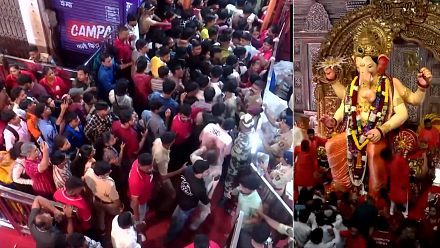
Devotees heading to Lalbaugcha Raja for Day 3 darshan can expect a familiar mix: long, snaking queues that move steadily but briefly reward patience with only seconds before the idol, tight security, and the kind of crow
Ni Sumedha Kirti··141K nabasa
What Will Devotees See At Lalbaugcha Raja On Day 3? Here's What Days 1 And 2 Suggest
Devotees heading to Lalbaugcha Raja for Day 3 darshan can expect a familiar mix: long, snaking queues that move steadily but briefly reward patience with only seconds before the idol, tight security, and the kind of crowd friction that has already surfaced on social media from the festival’s opening days.
Morning visuals from Day 3 show devotees streaming into Parel from the early hours, echoing the patterns seen since Ganeshotsav 2026 began.
A Mid-day reporter who joined the Mukh Darshan queue past midnight on Day 1 found the walk from Bharat Mata Circle alone stretched nearly a kilometre, with vehicle movement restricted well before that at Kalachowki Circle.
If Day 3 crowds match the scale seen on Day 2 — when devotees reportedly queued for eight to ten hours for Charan Darshan, some without eating or drinking, according to visuals shared on X — first-time visitors should prepare for a long haul.
How Long Might The Wait Be?
Timing has varied sharply depending on which darshan route devotees take. The Mukh Darshan queue on Day 1 moved at what the Mid-day reporter called a “fairly brisk pace,” with the entire process — from joining the line to standing before the idol — taking around 40 minutes after midnight.
Charan Darshan, which involves the far more sought-after opportunity to touch the idol’s feet, has reportedly taken considerably longer, with an X user, @AMIT_GUJJU, claiming devotees waited eight to ten hours for it on Day 2.
Devotees choosing between the two routes on Day 3 should weigh that gap before joining a queue.
Will The Darshan Itself Be Brief?
Even after the wait, the moment in front of Bappa has, so far, been fleeting. Volunteers reportedly kept urging devotees forward during Mukh Darshan on Day 1, leaving little time to pause, and a clip circulated by @AMIT_GUJJU purportedly showed devotees being moved along within seconds of touching the idol’s feet during Charan Darshan.
This is what Charan Darshan looks like at Lalbaugcha Raja.
These devotees have stood in line for 8–10 hours to reach this point. Some of them have come here without even eating or drinking anything.
The atmosphere at the pandal is actually quite good, though. Bhandara is also… pic.twitter.com/560ucg17Pt
— Amit Kumar Sindhi (@AMIT_GUJJU) September 15, 2026
Visitors on Day 3 may want to temper expectations of a lingering darshan experience.
Is There Relief Along The Way?
Some comfort measures have been in place. The mandal arranged free packaged drinking water before the zig-zag queue on Day 1, and devotees exiting the Mukh Darshan route received prasad — two laddus per packet — free of cost, per the Mid-day account.
Posts on X have also referenced a round-the-clock bhandara running at the pandal. Whether these arrangements hold up as crowds build through Day 3 remains to be seen.
What About Security And Crowd Management?
Security appears to have been a consistent feature. CCTV cameras installed by Mumbai Police have reportedly kept watch over the venue and surrounding lanes, and barricades along with police personnel have been deployed to regulate both foot and vehicle traffic near the pandal.
However, the Mid-day reporter noted limited direction boards and inconsistent guidance from mandal volunteers on Day 1, which left several devotees unsure which queue — Mukh Darshan or Charan Darshan — they were meant to join. That gap in signage could resurface as an issue on Day 3 unless addressed.
Have There Been Any Flashpoints?
Yes. A video from Day 2, shared by @djhrishi, purportedly showed women arguing at the venue, with the user predicting more such “kalesh” over the coming ten days given the scale of the crowds.
In a country where we hate standing in queues and still want to go to crowded places … expect such kalesh
Be ready to see more such videos from Lalbaugh cha Raja for the next 10 days pic.twitter.com/1iA32vtlsl
— Hrishikesh Shinde (@djhrishi) September 15, 2026
Separately, a clip shared by @rushiii_12 showing actor Sidharth Malhotra reportedly standing comfortably near the idol drew criticism online, with the user alleging that VIPs and celebrities are allowed extended, even repeat, darshan while ordinary devotees are moved along within seconds — a claim that has stirred debate about equal access at the pandal.
At Lalbaugcha Raja, there is such discrimination. A normal person has to quickly bow his head, take Bappa’s blessings, and move ahead, while VIPs and celebrities can comfortably stay at Bappa’s feet for as long as they want and even take darshan twice.
This is nothing but a… pic.twitter.com/mjJWBGd3pX
— ????????????????????????????⁴⁵ (@rushiii_12) September 15, 2026
Who Else Has Visited So Far?
Maharashtra Governor Jishnu Dev Varma visited the pandal on Day 2 and offered prayers, according to visuals from the event, underscoring the pandal’s status as a stop for dignitaries during the festival.
VIDEO | Mumbai: Maharashtra Governor Jishnu Dev Varma offers prayers at Lalbaugcha Raja.
(Full video available on PTI Videos – https://t.co/d8jp61yd2p) pic.twitter.com/SMtPhCAZls
— Press Trust of India (@PTI_News) September 15, 2026
What Happens To The Donations Devotees Make?
Devotees dropping offerings into the dan peti should know where that money goes. The donation box was opened on Tuesday, a day after Ganeshotsav began, revealing cash, dollars, gold chains, and even wooden bats inside, ANI reported.
Counting is being carried out by a joint team of Bank of Maharashtra staff, BMC personnel, and mandal members and advisors, mandal treasurer Mangesh Dalvi told ANI. Cash collected is deposited with Bank of Maharashtra each evening, while gold and other valuables are counted and assessed separately.
Dalvi said the funds raised over the ten-day festival go toward the mandal’s dialysis centre, a patient welfare scheme, a computer centre, a library, and its book bank.
For those planning a Day 3 visit, the takeaway from the first two days is consistent: come prepared for a long wait, keep expectations modest about the darshan itself, and don’t expect much hand-holding once you’re in the crowd.