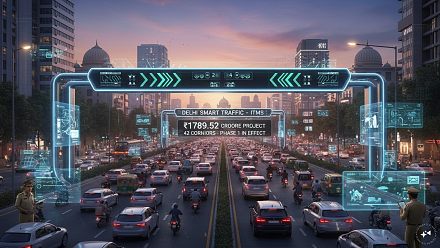
What Is ITMS? How Centre’s ₹1,789-Crore Project Could Ease Delhi’s Traffic Woes
With nearly 71 lakh vehicles competing for road space in Delhi, while road infrastructure has not expanded at the same pace, the capital’s traffic management system is set for a major technology upgrade.
Ni Saurabh Verma··105K nabasa
What Is ITMS? How Centre’s ₹1,789-Crore Project Could Ease Delhi’s Traffic Woes
With nearly 71 lakh vehicles competing for road space in Delhi, while road infrastructure has not expanded at the same pace, the capital’s traffic management system is set for a major technology upgrade.
The Union Cabinet has approved a ₹1,789.52-crore Intelligent Traffic Management System (ITMS), which will be implemented by the Delhi Police across 42 identified corridors in the capital in three phases.
The project aims to move Delhi away from a traffic-management model that relies heavily on fixed signal timings and manual intervention, towards a system that can respond to traffic conditions in real time.
Why Is Delhi Getting ITMS?
Delhi currently has around 71 lakh active registered vehicles, with the growth in vehicle numbers significantly outpacing the expansion of road infrastructure.
Traffic management in the capital has traditionally depended largely on fixed signal timings and manual policing. The ITMS is designed to make more efficient use of the existing road network by allowing traffic signals, enforcement and incident response to adapt to real-time conditions.
The initiative is part of a broader effort by the Central Government and the Government of the National Capital Territory of Delhi to improve traffic management, transport infrastructure and urban mobility.
What Will The ITMS Do?
The ITMS will integrate real-time traffic data, adaptive traffic signals, automated enforcement and command-and-control systems to manage Delhi’s road network more dynamically.
Key features of the system include:
* Adaptive traffic signals: Signal timings will be adjusted dynamically according to prevailing traffic conditions. Signals along identified corridors will also be coordinated to reduce unnecessary stoppages and delays.
* Priority for emergency vehicles: The system will facilitate green corridors and priority passage for ambulances and other emergency vehicles through congested stretches.
* Faster response to incidents: Real-time detection of congestion, slow-moving traffic and road incidents will enable Delhi Police to respond more quickly and introduce diversions when required.
* Real-time information for commuters: Variable Message Signs and digital platforms will provide information on congestion, diversions, parking availability and prevailing traffic conditions. Relevant data is also expected to be shared with navigation service providers.
* Automated traffic enforcement: The system will strengthen the detection of violations such as red-light and stop-line jumping, speeding, wrong-way driving, riding without helmets, driving without seat belts, illegal parking and the use of mobile phones while driving.
* AI-based vehicle tracking: Artificial intelligence-based analytics will help identify stolen, hot-listed and blacklisted vehicles, repeat offenders and vehicles linked to hit-and-run cases.
What Infrastructure Will Be Built?
The project will integrate traffic regulation, enforcement and information dissemination through Traffic Command and Control Centres.
These centres will be supported by a secure Data Centre and Disaster Recovery infrastructure. The system will use open standards and APIs, allowing it to be scaled up and integrated with other systems in the future.
The project will cover 1,092 Adaptive Traffic Control System locations and 1,029 enforcement locations.
Implementation will be performance-driven. Each phase will proceed only after the preceding phase meets prescribed testing, commissioning, acceptance and performance parameters.
Who Will Implement The Project?
The Delhi Police will implement the ITMS through a Master System Integrator selected through competitive bidding.
The Centre for Development of Advanced Computing (C-DAC) will act as the Project Management Consultant. It will provide technical scrutiny, monitoring, validation and acceptance support during both the implementation and subsequent operation-and-maintenance phases.
What Does It Mean For Delhi Commuters?
The government expects the ITMS to complement ongoing efforts to upgrade Delhi’s road and transport infrastructure by adding real-time data and technology to the city’s existing traffic network.
The system is expected to help improve traffic flow, strengthen road-safety enforcement, speed up responses to incidents and provide commuters with more timely information about congestion and diversions.
The broader objective is to make Delhi’s traffic management more responsive to actual road conditions, rather than relying primarily on fixed signal cycles and manual intervention.