VK Saxena's Big Plan To Revive Tso Kar Lake With 320 Million Litres Of Glacier Water Daily
Ladakh Lieutenant Governor VK Saxena has taken up a project to revive the shrinking Tso Kar Lake by channelising glacier meltwater from the Rupsho Kharnak stream in Changthang, following the successful diversion of 90 mi
Ni News Desk··167K nabasa
VK Saxena's Big Plan To Revive Tso Kar Lake With 320 Million Litres Of Glacier Water Daily
Ladakh Lieutenant Governor VK Saxena has taken up a project to revive the shrinking Tso Kar Lake by channelising glacier meltwater from the Rupsho Kharnak stream in Changthang, following the successful diversion of 90 million litres of Stok Glacier water to canals in Igoo-Phey and Chuchot villages.
The project envisages diverting an average 132 cusecs, or 320 million litres, of untapped glacier water per day from the Rupsho Kharnak stream to Tso Kar Lake. The water currently flows into the Sindhu River.
Tso Kar, located at an altitude of nearly 15,000 feet, has shrunk by almost 70 per cent over the last decade. The lake, which originally covered nearly 11,000 acres, has now reduced to around 3,200 acres. The shrinking lake has also affected its ecological role as a habitat for migratory birds, including the famed Black-Necked Crane. The number of birds arriving at the site has also declined.
According to the project plan, fully utilising the available glacier water is expected to revive Tso Kar Lake to its original condition within one year.
How Will The Water Reach Tso Kar?
The Rupsho Kharnak stream is situated nearly 11 kilometres from Tso Kar Lake, at an altitude of around 18,000 feet. Its peak summer discharge is estimated at around 132 cusecs, equivalent to 320 million litres per day.
The plan uses three natural depressions along the downward flow of the glacier stream towards the lake.
The first depression covers 270 acres, the second 24 acres, and the third 10 acres. Check dams equipped with three RCC pipes will be constructed at the outlet of each depression to raise water levels and regulate the flow downstream.
From the third depression, the water will flow into Tso Kar, which is located just 400 metres away. The diversion will use gravity flow and simple, low-cost earthworks. No new concrete channel is being constructed for this stretch.
20 Cusecs Already Being Diverted
Work on the project began amid preparations for the winter season.
Since September 9, around 20 cusecs of water from the Rupsho Kharnak glacier stream has been successfully diverted towards the first depression, which has already begun filling rapidly. The water is being channelised through an earthen channel as well as a concrete canal that had remained defunct at the site since 1995.
In four days, around 20 per cent of the area of the first depression had already been filled.
Three New Wetlands Along The Way
The project is also expected to create three new freshwater wetlands before the water reaches Tso Kar. The three natural depressions, covering 270 acres, 24 acres and 10 acres, are expected to hold nearly 1,230 million litres of water.
According to the project plan, the depressions will allow sediments to settle before the water enters Tso Kar, enabling relatively pure water to reach the lake.
The new water bodies are also expected to provide additional habitats for migratory birds. Since they will be visible from the adjoining Leh-Manali Highway, they could also become new tourist spots.
Why Was The Project Taken Up?
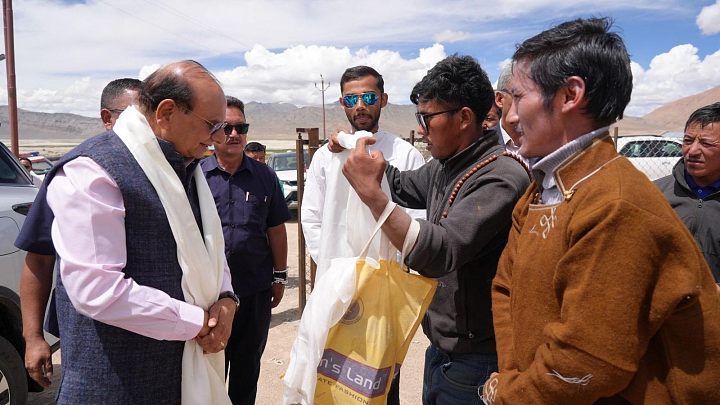
The initiative was conceived by Saxena during his visit to Tso Kar on August 10 this year, when local villagers and the Nambardar, or village head, told him about the lake’s shrinking size and the decline in its bird population.
The villagers also told him that Tso Kar had once been a large glacial water body that supported centuries of local salt trading and maintained the area’s ecological balance.
The receding lake has also resulted in the loss of grazing land. Large dry patches can now be seen around areas where deep water once stood. Following the visit, Saxena directed the Public Health Engineering (PHE) Department to conduct a detailed survey.
After 15 days of groundwork and surveying, the department submitted its report on August 30, recommending an 11-km RCC channel. However, considering ecological concerns, Saxena suggested that a new RCC water channel should not be constructed. Instead, the plan was modified to bring the water to the first depression through a simple earthen channel.
With winter approaching and temperatures expected to cause water to freeze, work began on a war footing from September 2 to divert water from Rupsho Kharnak to the first large depression.
Impact On Pashmina Herders
The revival of Tso Kar is also expected to affect the livelihoods of local communities.
Most villagers around Tso Kar are Pashmina goat herders. As the lake has shrunk, grazing grounds for Pashmina goats have also disappeared. This has forced herders to travel 50 to 75 kilometres away from their homes in search of grazing land.
The revival of the lake is expected to create grasslands and livelihood opportunities and potentially allow herders to return closer to their homes.
This is the first and the only attempt of this nature and magnitude in India, to revive a dying lake at this high-altitude and in such harsh conditions.
‘Vital Blueprint’
Saxena said the success of the Stok Glacier project had demonstrated the feasibility of large-scale water management in Ladakh’s cold desert using simple engineering. “By redirecting the Rupsho Kharnak stream, we aim at bringing life back into Tso Kar Lake.”
He described the project as a blueprint for high-altitude ecological restoration and said the diversion of untapped glacier water would support agricultural prosperity, rural economies and long-term climate resilience.
He added that the effort would help preserve landscapes such as Tso Kar and the ecosystems they support for future generations.