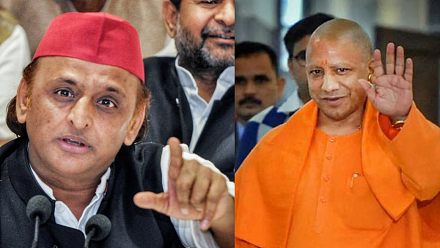
UP Rajya Sabha Polls On October 16: Real Test Of BJP, SP Poll Arithmetic Ahead Of 2027 Battle
Can the Bharatiya Janata Party-led alliance convert its numerical advantage into eight Rajya Sabha seats, or can the Samajwadi Party (SP) disrupt the arithmetic by holding its camp together and attracting support from sm
Ni Oliver Fredrick··181K nabasa
UP Rajya Sabha Polls On October 16: Real Test Of BJP, SP Poll Arithmetic Ahead Of 2027 Battle
Can the Bharatiya Janata Party-led alliance convert its numerical advantage into eight Rajya Sabha seats, or can the Samajwadi Party (SP) disrupt the arithmetic by holding its camp together and attracting support from smaller parties?
Will the BJP make room for the Bahujan Samaj Party (BSP), which otherwise faces the prospect of losing its last parliamentary representation?
These questions will come into sharper focus on October 16, when Uttar Pradesh votes for 10 Rajya Sabha seats — the first major test of legislative arithmetic and alliance management ahead of the 2027 Assembly election. The Election Commission has fixed polling from 9 am to 4 pm, with counting at 5 pm the same day.
The stakes are unusually high because eight of the 10 outgoing seats are currently held by the BJP, while one each belongs to the SP and BSP. The outgoing BJP members include Hardeep Singh Puri, Brij Lal, Geeta Shakya, Seema Dwivedi, Neeraj Shekhar, Arun Singh, BL Verma, and Dinesh Sharma, who has already resigned after being appointed Lieutenant Governor of the Andaman and Nicobar Islands. SP general secretary Ram Gopal Yadav and BSP’s Ramji Gautam are the other outgoing members.
NUMBER GAME
The numbers explain why the election has become a test of political management rather than a straightforward contest. The effective strength of the 403-member UP Assembly is currently 397 because six seats are vacant. Under the Rajya Sabha election formula, each candidate requires 37 first-preference votes.
The BJP-led NDA has 289 votes, including 256 BJP MLAs, 13 Apna Dal (S), five Nishad Party, nine RLD, and six SBSP MLAs. At that strength, the alliance has enough votes for seven seats and would need seven additional votes for an eighth. The equation could become easier if the support of two Jansatta Dal (Loktantrik) MLAs and three unattached legislators materialises, taking the effective support base to 294. In that scenario, only two additional votes would be required for the eighth seat.
The SP-led bloc has 103 MLAs — 101 from the SP and two from Congress. That is enough for two Rajya Sabha seats, leaving 29 votes after the first two candidates. The bloc would need eight additional votes to cross the 37-vote threshold for a third candidate.
CROSS-VOTING FACTOR
That is where cross-voting and smaller parties become important. The 2024 Rajya Sabha election provides a clear precedent. The BJP won eight of the 10 seats after cross-voting by several SP MLAs helped it secure an additional seat. With the 2027 Assembly election now approaching, both parties will be keen to prevent defections while simultaneously trying to exploit vulnerabilities in the rival camp.
KEY CHALLENGES FOR BJP, SP, BSP
Political analyst Prof. Shashikant Pandey, of the Department of Political Science at Babasaheb Bhimrao Ambedkar University, Lucknow, has underlined the importance of organisational strength and candidate selection as UP moves towards 2027. “A lot will depend on how both distribute tickets,” Pandey said in a recent assessment of the emerging political contest. He also noted that the BJP continues to rely on a strong organisational machine while the SP has been expanding its support base.
For the SP, the immediate challenge is therefore two-fold: retain its existing 103-vote bloc and look for additional support. The party is exploring the support of RLD legislators, Abbas Ansari, and some SBSP MLAs, while also looking at possible discontent among sections of the ruling alliance. These remain political calculations rather than confirmed shifts.
The BSP faces a fundamentally different problem. Its lone UP Assembly MLA, Uma Shankar Singh, died in August, leaving the party without representation in the state legislature. Its lone Rajya Sabha member, Ramji Gautam, completes his term in November. Since elected MLAs constitute the electoral college, the BSP cannot independently secure a Rajya Sabha seat from Uttar Pradesh under the present numbers.
This has opened a separate political conversation over whether the BJP could facilitate another BSP entry into the Upper House, as happened when Ramji Gautam was elected unopposed in 2020 with BJP support. Such a move, however, would have consequences for the BJP-led alliance’s own seat arithmetic and would become part of the broader negotiations around the election.
The Rajya Sabha contest will also be followed closely because it will be followed by elections to 11 seats in the Uttar Pradesh Legislative Council on October 23. Together, the two exercises will give parties an opportunity to assess legislative cohesion, alliance management, and the willingness of smaller groups to remain within existing political formations.
For the BJP, the October exercise is about maintaining control over the numbers it already possesses. For the SP, it is an opportunity to demonstrate that its 2024 gains can translate into tighter legislative coordination ahead of 2027. For the BSP, the stakes are even more fundamental: whether it retains any parliamentary representation at all.
The October 16 vote, therefore, will not directly measure voter sentiment. It will instead offer a closely watched snapshot of the strength of political camps inside the Assembly — and of how effectively parties can manage their allies, legislators, and negotiations before Uttar Pradesh enters the much larger electoral battle of 2027.