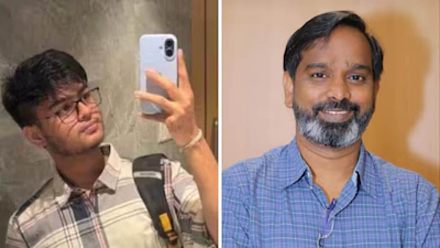
‘Sahil Loved Sports’: IIT-B Student’s Friend Recounts Last Meeting, Says Prof Doolla Opposed Caste Discrimination
As the investigation into the death of Indian Institute of Technology (IIT), Bombay student Sahil Wakode continues, those who knew him remember the 20-year-old not for the controversy surrounding his final days, but for
Ni Ananya Gupta··109K nabasa
‘Sahil Loved Sports’: IIT-B Student’s Friend Recounts Last Meeting, Says Prof Doolla Opposed Caste Discrimination
As the investigation into the death of Indian Institute of Technology (IIT), Bombay student Sahil Wakode continues, those who knew him remember the 20-year-old not for the controversy surrounding his final days, but for the person he was before it.
One of Sahil’s close friends, who was also his senior during his first year at IIT Bombay, described him as an outgoing and lively student who was deeply involved in campus life.
‘SAHIL LOVED SPORTS’
Sahil was heavily involved in sports, particularly badminton, and would often be found at cafés and eateries around the campus. He would also regularly reach out to his friend, sometimes asking him to come to campus for a treat or simply to meet, “it’s a culture of giving treat to juniors from seniors in IITB,” he says.
According to his friend, he and Sahil remained in touch even after the first year. They would meet roughly once a month or at important points in Sahil’s academic journey, after certain events, semesters or other significant junctures.
One such meeting happened just a few days before Sahil’s death.
Sahil came to meet him over snacks and spent around five minutes with him. It was a brief, routine interaction. There was no indication, according to him, of what was to follow.
The close friend also said Sahil never spoke to him about any caste-based discrimination or harassment. He added, he himself was not aware of Sahil’s caste and claimed that students and faculty at the institute generally did not know each other’s caste identities.
Sahil’s family has alleged that caste-based harassment and institutional pressure played a role in his death. A case has been registered and the allegations are being investigated.
‘PROF DOOLLA GOT JEE INFO REMOVED TO PREVENT CASTE DISCRIMINATION’
According to him, Professor Suryanarayana Doolla was generally strict with students, but Sahil had not told him of any caste-related issue involving the professor.
The student also pointed to an earlier incident concerning access to students’ JEE ranks.
Professor Doolla had reportedly opposed faculty access to students’ JEE rank information through the institute portal. The access was subsequently removed, ensuring that professors would not have access to information that could reveal students’ caste backgrounds.
Another issue that had come up among students was what should happen when a student was caught cheating during an examination.
Students had demanded that, in such situations, a student’s mentor or another close contact should be informed.
The demand was accepted by the Director, according to the information shared by Sahil’s friend.
The concern was that while examination rules and disciplinary proceedings could continue, students should have someone from their support system informed about the situation.
THE INVESTIGATION
The Mumbai Crime Branch is now investigating Sahil’s death and is examining the circumstances surrounding his final days.
The investigation includes questioning students who were present with Sahil during his examination, those who interacted with him at the hostel and others who knew him.
Police are also examining available CCTV footage and other material to reconstruct what happened inside and outside the examination hall.
The administration had initially publicly alleged that Sahil had used a mobile phone and ChatGPT during an examination. IIT Bombay later apologised for making the allegation public before the investigation had been completed.
The police investigation is continuing.
SAHIL’S FAMILY’S CLAIMS
At the same time, Sahil’s family has continued to allege caste-based harassment and institutional pressure. These allegations have not been established by the investigation.
For the people who knew him, however, Sahil’s story does not begin with an examination and does not end with the allegations surrounding it.
They remember a student who played badminton, spent time around campus cafés, met friends and mentors and reached out for conversations and small moments of connection.
For his friend, perhaps one of the most difficult memories now is that short meeting three days before Sahil’s death.
At the time, there was no way of knowing that it would become one of their last.