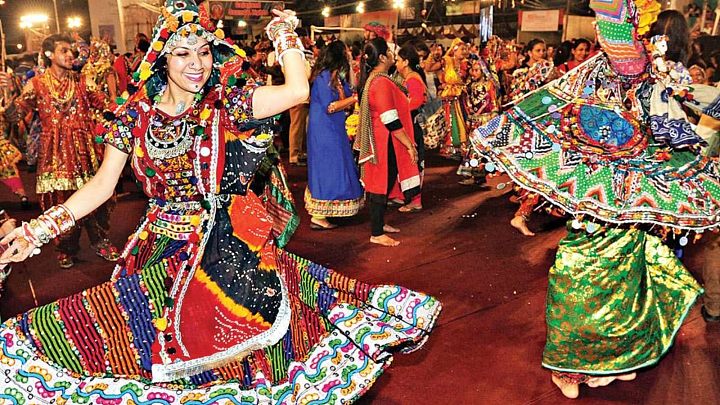
Rent-A-Partner, Aadhaar Checks & Claims Of 'Girls Eloping With Non-Hindus': The Big Garba Fight
Navratri 2026: As Gujarat prepares for Navratri, a series of social media posts offering ‘Garba partners on rent’ has drawn online attention, prompting Ahmedabad’s Cyber Crime Cell to investigate the trend and warn peopl
Ni Parishmita Saikia··164K nabasa
Rent-A-Partner, Aadhaar Checks & Claims Of 'Girls Eloping With Non-Hindus': The Big Garba Fight
Navratri 2026: As Gujarat prepares for Navratri, a series of social media posts offering ‘Garba partners on rent’ has drawn online attention, prompting Ahmedabad’s Cyber Crime Cell to investigate the trend and warn people about potential fraud. The posts advertise companions for Garba sessions at different prices, with additional offerings such as matching outfits, dance tutorials, selfies and extended companionship.
The unusual concept has raised questions about whether the advertised services represent a genuine business opportunity, a social media marketing strategy or a potential scam. It has also triggered objections from Hindu organisations, bringing the relationship between commercialised festival experiences, religious traditions and personal safety into focus.
What Is The ‘Rent A Garba Partner’ Trend?
The ‘Rent A Garba Partner’ concept involves social media posts offering individuals the opportunity to hire a companion for Garba celebrations during Navratri. The advertisements typically feature photographs of young men and women alongside tiered packages, with prices varying according to the duration and services offered.
The Indian Express reported that some posts advertised male partners for between Rs 500 and Rs 2,000, while female partners were offered at prices of up to Rs 3,000 for shorter sessions. Certain advertisements also promoted all-night packages costing as much as Rs 6,500.
The advertised services vary between accounts. Some posts mention two-hour Garba sessions, matching outfits, selfies and dance-step guidance. Other packages claim to offer longer companionship, opportunities to create Instagram reels, and additional activities.
However, the existence of these advertisements does not independently establish that every advertised service is genuine or operational. Ahmedabad police are examining the authenticity of the offers and whether they could be connected to fraudulent activity.
Is It A Genuine Commercial Service Or A Social Media Trend?
The viral posts have generated different interpretations. According to reporting by India Today, some of the initial posts were shared by genuine social media users, with the apparent aim of increasing reach and engagement. Police later observed similar content appearing across multiple accounts, including posts suspected of being AI-generated.
This distinction is important: some posts may have originated as promotional or satirical social media content, but that does not mean every subsequent advertisement is authentic or safe. The police investigation is intended to establish whether any accounts are being used to mislead users, obtain payments fraudulently or expose them to other cybercrime risks.
The trend’s popularity also reflects the way social media users increasingly package festival-related experiences into shareable content. However, the exact scale of genuine bookings, the number of people offering the service and whether a formal business model exists across cities remain unclear based on the available reporting.
The viral advertisements have drawn criticism from Hindu organisations in Gujarat. According to reports, Gujarat Bajrang Dal regional co-convenor Jwalit Mehta called for an investigation into the people behind the posts and questioned their intentions. Mehta argued that Navratri is traditionally associated with the worship of Maa Shakti and that the festival is commonly celebrated through gatherings involving families, friends and relatives. He also questioned the need for a rented Garba partner.
Ahmedabad Cyber Cell Warns Against Suspicious Links And Payments
Ahmedabad police have issued a public warning as the advertisements continue to circulate online. Deputy Commissioner of Police (Cybercrime Branch) Lavina Sinha said officials were investigating the posts to determine whether they involved fraud or malicious intentions.
In a video statement, DCP Sinha warned that payment links and attachments containing photographs could potentially contain fraudulent links capable of compromising messaging applications or bank accounts. She urged people who encounter such frauds to approach their nearest police station.
The warning highlights a risk that extends beyond the advertised service itself. A user responding to a social media post could be directed to an unfamiliar payment page, asked to share personal information or encouraged to open an attachment. Such interactions can expose users to phishing, account compromise and financial fraud.
Ahmedabad Cyber Crime Cell officials have also been monitoring accounts associated with Ahmedabad, Surat and Mumbai, according to The New Indian Express. Investigators are examining whether the advertisements could be used to lure users into phishing schemes, WhatsApp hacking or other financial crimes.
People should avoid transferring money to unknown profiles without verifying the identity of the person or the legitimacy of the service. Suspicious links and attachments should not be opened, and anyone who believes they have been defrauded should report the incident to the police or cybercrime authorities.
Are Similar Concepts Emerging Across India?
The idea of paying for companionship is not entirely unfamiliar in India. Services and social media trends involving rented companions, platonic dates and event partners have appeared in different contexts. However, these examples should not automatically be treated as equivalent to the current Garba-related advertisements.
The ‘rent a boyfriend’ and ‘rent a girlfriend’ concepts have previously attracted attention online, with some platforms and individuals promoting companionship for social occasions. The nature of these services varies, and their authenticity, legality and operating arrangements cannot be assumed solely from social media descriptions.
Garba Entry Row: Usha Thakur Raises Questions Over Non-Hindu Participation
The debate around Garba this Navratri extends beyond the viral ‘Rent A Garba Partner’ advertisements, with former Madhya Pradesh minister Usha Thakur weighing in on the entry of non-Hindus into Garba pandals.
Thakur has said people who do not believe in idol worship should not be allowed to enter Garba venues. She has also alleged that some people enter Garba events wearing tilaks and tying kalavas in an attempt to conceal their identity and mislead women. Her comments come amid a wider debate over identity checks and restrictions at Garba and Dandiya events. Earlier, Thakur had also called for identity cards to be checked at Garba venues.
Thakur has also claimed that around 4.5 lakh girls allegedly leave with people from other communities during Garba events every year and argued that such relationships could affect population patterns by nearly 9 lakh a year. Thakur has thanked the Vishwa Hindu Parishad (VHP) and Bajrang Dal for campaigns opposing what they describe as the commercialisation of Garba. She has argued that the increasing commercialisation of the festival has diluted its spiritual significance.
The comments come as Hindu organisations in several parts of India push for tighter entry rules at Garba events. In Maharashtra, the VHP has called for Muslims to be barred from Garba and Dandiya events and has advocated Aadhaar checks and tilak requirements for attendees.
The issue has also drawn differing responses. Union minister Ramdas Athawale has opposed calls to bar Muslims from Garba events, saying people of different faiths have the right to participate in each other’s festivals.
VHP Entry Restrictions And Aadhaar Checks At Garba Venues
Some Hindu organisations, including the Vishwa Hindu Parishad (VHP), have been associated with demands for stricter monitoring of attendees at certain events.
Reports of Aadhaar card checks and identity verification at Garba venues need to be examined on an event-by-event basis. Such measures should not be presented as a uniform requirement across all Garba celebrations in Gujarat unless supported by an official announcement from the organisers or authorities.
Aadhaar is an identity document, but the legality and appropriateness of collecting or retaining identity information depend on the circumstances, the entity requesting it and applicable data protection requirements. Attendees should seek clarity about why their details are being requested, how the information will be used and whether it is being retained.
The presence of identity checks at a particular venue also does not establish that every Garba event in the state follows the same policy. Organisers, local authorities and attendees may have different responsibilities depending on the event’s arrangements and applicable rules.
What Should People Keep In Mind Before Responding To Such Posts?
The Cyber Crime Cell’s warning comes at a time when social media activity surrounding Navratri is increasing. Attractive packages, low prices and promises of companionship can encourage users to respond quickly without verifying the person behind an account.
People should be cautious about sending advance payments to unknown individuals, clicking unfamiliar links or sharing personal and banking details. They should also verify the authenticity of an advertised service independently rather than relying solely on photographs, follower counts or promotional claims.
If someone suspects that they have fallen victim to a cyber fraud, they should report the incident promptly through the appropriate police or cybercrime channels.
What Lies Ahead Of Navratri?
The ‘Rent A Garba Partner’ trend has brought together several conversations: the growing influence of social media marketing, the risks associated with online payments, the commercialisation of festival experiences and debates over cultural and religious norms.
While some advertisements may have originated as engagement-driven content, the police investigation is focused on determining whether any malicious activity is involved. Until the authenticity of individual offers is established, users should treat them with caution.
As Navratri approaches, the wider question is not simply whether someone can hire a companion for Garba, but whether such offers can be accessed safely, transparently and without exposing users to financial or personal risks.