Rahul Gandhi Has The Gen Z Pitch. Does Congress Have The Organisation To Convert It?
For a brief moment, it appeared that Rahul Gandhi had found an opening with a generation that Congress has struggled to connect with. The protests over the NEET paper leak had put students and their concerns at the centr
Ni Parimal Peeyush··73K nabasa
Rahul Gandhi Has The Gen Z Pitch. Does Congress Have The Organisation To Convert It?
For a brief moment, it appeared that Rahul Gandhi had found an opening with a generation that Congress has struggled to connect with. The protests over the NEET paper leak had put students and their concerns at the centre of the political conversation. The agitation, championed by the Instagram-birthed Cockroach Janata Party (CJP), eventually contributed to pressure on the Narendra Modi government and culminated in Education Minister Dharmendra Pradhan’s resignation.
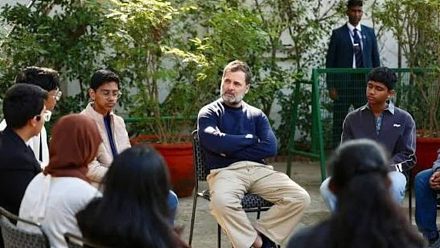
Rahul Gandhi moved aggressively into the space, positioning himself as a political voice for students and young Indians through his “Chhatron Ki Goonj” campaign. Then came the Delhi University Students’ Union election.
The Congress-affiliated NSUI failed to win any of the four central posts. The BJP-backed ABVP won three, while the vice-president’s post went to independent candidate Deepanshu Shokeen, who had previously been associated with the NSUI. ABVP’s Yash Dabas defeated NSUI’s Vijay Shankar Meena in the presidential contest by 2,053 votes.
While one campus election cannot be treated as a verdict on Gen Z across India — Delhi University has its own political culture, organisational networks and local dynamics — but the result nevertheless poses an awkward but familiar question for Congress. What happens when the political mood is on your side, but the organisation is not?
The Congress Problem Is Bigger Than Rahul Gandhi
Elections after elections post its decimation in 2014 have shown that the Congress’ predicament is not necessarily that it cannot find issues that resonate with voters. The larger problem is what happens after it finds them.
Congress’s own leadership has acknowledged the organisational deficit. After the defeats in Haryana and Maharashtra in 2024, party president Mallikarjun Kharge asked how long Congress could depend on national issues and national leaders to fight state elections and stressed the need to convert the political “mood” into victories.
In the 2024 Lok Sabha elections, Congress improved substantially, winning 99 seats compared with 52 in 2019. But the subsequent Assembly elections in Haryana and Maharashtra exposed how difficult it was for the party to reproduce that performance at the state level. Delhi and Bihar in 2025 added to the problem.
In Haryana, organisational weaknesses were particularly stark. The state unit had gone for years without a functioning structure across much of the block and district levels, with factional disputes holding up appointments. The problem was not merely electoral strategy. The machinery required to fight an election was itself incomplete.
Bihar offered another version of the same problem. A post-election assessment by Congress leaders and candidates pointed to weak district and booth structures, internal coordination problems and an election operation that was seen as being too centralised. And that is where the contrast with the BJP becomes important.
BJP’s Advantage Beyond Modi
The BJP’s electoral strength does not rest solely on Narendra Modi’s appeal or the party’s national narrative. Its organisational architecture allows that narrative to travel much further down the political chain.
The party’s booth-level structure is built around layers of mandals, districts, booth committees and workers assigned to highly specific groups of voters. The BJP’s panna pramukh model, in which workers are responsible for a page of the electoral roll, is perhaps the clearest example of this granular approach.
The Financial Times reported in 2024 that the BJP’s organisational structure extended down to extremely localised voter groups, with the RSS cadre network providing an additional source of manpower.
The BJP’s own 2024 organisational exercise also illustrates the scale of this network. By early 2026, party data reported that elections had been completed for more than 788,000 booth presidents and that nearly 8.95 million booth committee members had been constituted, alongside thousands of mandal and district-level appointments.
The point is not that every BJP election is won because of booth management. Nor does organisation eliminate the importance of leadership, alliances, caste arithmetic, local candidates or anti-incumbency. It does, however, give the party a mechanism to translate a political message into repeated contact with voters. Congress has often had the first part of that equation without the second.
What DUSU Results Reveal
That is what makes the Delhi University result more interesting than the numbers alone suggest. The NSUI’s defeat was accompanied by internal disagreements over candidate selection. Shokeen, who had sought an NSUI ticket, eventually contested independently and won the vice-president’s post. Reports on the election have also pointed to disputes over candidate choices in other contests.
That is an organisational problem in miniature. Rahul Gandhi can hold large student outreach events, Congress can raise the NEET issue, its leaders can identify education, jobs and youth frustration as politically potent subjects. But elections are eventually fought through candidates, campus networks, local workers, voter contacts and mobilisation on polling day.
That is where political momentum has to become organisation. And that conversion is precisely where Congress has repeatedly struggled.
A Recurring Pattern
There is a recurring sequence in recent Congress politics. The party finds an issue that gives it political space. A national leader amplifies it. Public sentiment appears receptive. But when the contest moves from the national conversation to a state, constituency, district, booth or campus, the advantage becomes harder to sustain.
In Haryana, factionalism and an incomplete organisational structure weakened the party’s ability to fight beyond its top leadership. In Maharashtra, the Congress’ relatively weak performance despite the broader Opposition’s position raised questions about seat management and election strategy. In Bihar, candidates complained about weak ground structures and over-centralised campaign management and candidate selection.
Even Congress’s current organisational reforms acknowledge the problem. The party has been trying to revive district committees and introduce a new layer of mandal committees to connect the central leadership with the ground organisation. Reports in 2026 said Congress had revived hundreds of district committees and was attempting to build a structure covering groups of booths.
In Punjab, the party has gone a step further by explicitly borrowing from the BJP’s playbook, planning to appoint “booth sevaks” with responsibility for individual pages of the electoral roll, similar to the BJP’s panna pramukh model.
That admission is telling in itself. The question isn’t whether Congress can identify where its weakness lies but whether it can repair it quickly enough.
The Rahul Gandhi Test
This brings the story back to Rahul Gandhi. His political challenge is no longer simply to find issues that young voters care about. The NEET episode demonstrated the possibilities of doing that. His student outreach shows that he is actively trying to build a political conversation with Gen Z. But while a leader can create a moment, it requires an organisation to sustain it.
That distinction matters because the BJP’s response to moments of vulnerability is often organisational rather than merely rhetorical. When an issue threatens its support among a particular group, its machinery gives it multiple channels through which to respond, recalibrate and reach voters.
Congress, on the other hand, has often been more dependent on its national leadership to generate momentum, leaving it vulnerable to the same cycle of a political opening appearing, Rahul Gandhi occupying it, the Opposition sensing momentum, and then the organisational machinery failing to convert that momentum into votes.
The DUSU result does not prove that Rahul Gandhi’s Gen Z pitch has failed. But it does provide a timely reminder of the harder question confronting Congress. Can the party build an organisation capable of turning Rahul Gandhi’s political reach into electoral reach? Because if it cannot, the problem will not be Gen Z, NEET, Delhi University or even Rahul Gandhi.
It will be the gap between having a political message and having the machinery to make voters act on it.