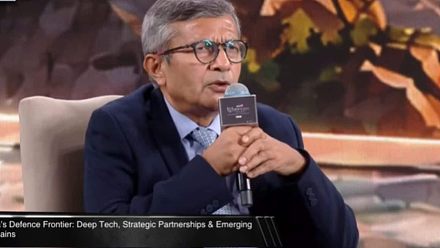
‘PM Modi Is Highly Tech-Savvy, Spots Innovations Faster’: Defence Secy Rajesh Singh At News18 DEFCON 2026
Defence Secretary Rajesh Kumar Singh on Thursday said Prime Minister Narendra Modi is “highly tech-savvy” and often identifies technological innovations and ideas faster than many others.
Ni Saurabh Verma··81K nabasa
‘PM Modi Is Highly Tech-Savvy, Spots Innovations Faster’: Defence Secy Rajesh Singh At News18 DEFCON 2026
Defence Secretary Rajesh Kumar Singh on Thursday said Prime Minister Narendra Modi is “highly tech-savvy” and often identifies technological innovations and ideas faster than many others.
Speaking at News18’s DEFCON 2026, Singh said scientists should ideally be the first to identify and understand technological changes, while stressing the need to institutionalise the process of identifying and responding to emerging technologies.
“Scientists should ideally be the first to spot and understand technological change. We have a unit within DRDO, which I am temporarily holding charge of, that continuously conducts horizon scanning to identify emerging technologies and developments. Similar systems also exist within the armed forces,” he said.
“From a leadership perspective, Prime Minister Narendra Modi is highly tech-savvy and often identifies technological innovations and ideas much faster than many of us. But this cannot be dependent on any individual. It has to be institutionalised so that the country can identify and respond to technological changes faster,” he added.
News18 Defcon 2026: Deep Tech,Strategic Partnerships Discussions With Defence Secretary Rajesh Kumar#news18defcon #defcon2026 #defencenews @KishoreAjwani pic.twitter.com/Pzc8fhee0n
— News18 India (@News18India) September 24, 2026
Singh said the changing geopolitical environment has created a continuous need to learn from developments on the battlefield, including India’s recent experience with Operation Sindoor.
“We are living in an era where geopolitical conflicts are at their highest level since World War II. There is therefore a continuous cycle of learning from the battlefield, including from our own recent experience with Operation Sindoor,” he said.
“These lessons are feeding back into our procurement cycles, industry and efforts to build a large, diversified and hybrid defence production pipeline, drawing equally on the public sector, private enterprises and startups,” he added.
On defence procurement, the Defence Secretary said the government’s buying power can help sustain India’s defence industry by providing suppliers greater visibility on future orders.
“Since it is a single-buyer market, our buying power can sustain this industry, so we are giving visibility of orders to these suppliers,” he said.
Singh said the government has significantly increased the pace of defence orders over the past two years.
“We have been giving orders at double the pace over the last two years. We have done Rs 2 lakh crore of orders, against a trend rate of Rs 50,000-80,000 crore,” he said.
The Defence Secretary also said the government wants to accelerate the procurement cycle, particularly for emerging technologies such as drones.
“We want much more recourse to a faster procurement cycle for technologies like drones, with deliveries within two years and contracts signed between six to eight months,” he said.
Singh said the financial delegation available to the Ministry of Defence may also need to be increased, noting that contracts above Rs 3,000 crore currently require Cabinet approval.
“Everything above Rs 3,000 crore goes to Cabinet. We would need to increase financial delegation in the case of MoD,” he said.
On technological change, Singh reiterated the importance of early identification of emerging technologies and said the DRDO has a dedicated unit for horizon scanning.
“Scientists should understand the change first. We have a unit in DRDO that does horizon scanning. PM Modi is very tech-savvy and he spots technologies and innovation much faster,” he said.
He also reiterated that lessons from the battlefield are continuously feeding into India’s procurement process.
“There is a continuous cycle of learning from the battlefield, and that is feeding back into our procurement cycle,” Singh said.