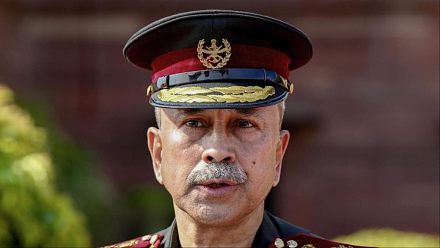
'Nobody Is Safe Anywhere': CDS Subramani Says Time Gap Between Detection, Engagement 'Collapsing'
The traditional distinction between the forward and rear areas of a battlefield is increasingly disappearing in modern warfare, with the effects of a conflict potentially extending deep into a nation’s territory, Chief o
Ni Vani Mehrotra··199K nabasa
'Nobody Is Safe Anywhere': CDS Subramani Says Time Gap Between Detection, Engagement 'Collapsing'
The traditional distinction between the forward and rear areas of a battlefield is increasingly disappearing in modern warfare, with the effects of a conflict potentially extending deep into a nation’s territory, Chief of Defence Staff NS Raja Subramani said in an interaction with CNN-News18.
Describing the broader evolution of warfare, the CDS said a conflict can no longer be viewed simply as a confrontation between soldiers at the front lines.
“The distinction between the forward area and rear area no longer exists. Now the battlefield is shifted from the front to the rear, to the depth. Nobody is safe anywhere,” CDS Raja Subramani said.
“There is no safe place in case of a conflict. The time gap between the detection and engagement is collapsing,” he added.
The CDS was speaking about the changing character of war in a generic conflict scenario and the implications of these changes for how militaries prepare for future battlefields.
He said the entire nation can become involved in a war, rather than conflict remaining restricted to troops operating at the front.
“The whole nation is involved in war, not only the soldiers. We can see the example of the Russia-Ukraine conflict,” he said.
His assessment reflected the changing geography and speed of warfare, where the distinction between areas close to the front and those traditionally considered the rear is becoming less relevant.
The shrinking interval between detecting a threat and engaging it, he said, is another feature of this changing battlefield.
‘Cannot Prepare For One Conflict At A Time’
CDS Raja Subramani also described how future conflicts could unfold across several domains simultaneously.
He said the security environment requires militaries to account for different forms of warfare rather than preparing for only one type of conflict at a time.
“We face a continental security challenge, a maritime security challenge and an increasingly contested space, cyber and information warfare environment,” he said.
The CDS said future warfare would increasingly involve multiple domains operating together.
“We cannot prefer to prepare for one conflict at a time. The future battlefield will be increasingly simultaneous, connected and contested across multiple domains,” he said.
The point, he suggested, is not simply about the location of fighting but about the interconnected nature of future conflicts, in which developments across different domains can occur at the same time.
‘Character Of War Is Changing Faster Than We Are Able To Adapt’
CDS Raja Subramani said the pace at which warfare is changing is itself creating a challenge for military systems and processes.
“The character of war is changing faster than we are able to adapt. Our processes and systems have to change much faster,” he said.
He described the period as one of profound change across geopolitical, geoeconomic and technological spheres.
“We are living through a period of profound change whether it is geopolitically, geoeconomically or technologically,” the CDS said.
“In every aspect things are changing faster than we are able to comprehend or adapt,” he added, referring to changes in the balance of power between nations.
CDS Outlines ‘BUILT’ Framework For Future War
CDS Raja Subramani also outlined five factors under the acronym BUILT that he said are important to understanding future warfare.
B — Battlefield is changing
U — Economics of war is also changing
I — Integration of technology and data is becoming decisive
L — Learning is becoming decisive for future war
D — Delivery at scale will determine strategic endurance
The CDS also highlighted the role of technology in altering the character of warfare. He said the wider availability of weapons and technology has enabled even non-state actors to use asymmetric means more effectively.
“Technology is both an equaliser in the sense that it has democratised the availability of weapons and technology even to non-state actors, making asymmetric means that much more useful,” he said.